Fact Check 4: The Marquise of Saint-Fargeau
This is The Siècle, Fact-Check 4: The Marquise of Saint-Fargeau.
Welcome back, everyone.
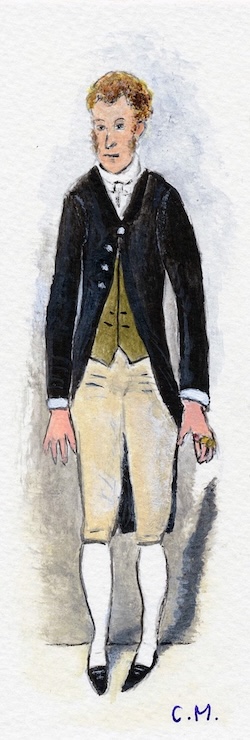 I started off Episode 49 with the story of Jules de Polignac’s arrest in the town of Granville, while trying to flee France unconvincingly disguised as a manservant. And I noted in that story that Polignac was pretending to be the manservant of a noblewoman, the “Marquise de Saint-Fargeau.”
Right: Christelle Murie, “Jules de Polignac in disguise as the manservant ‘Pierre,’” from Yves Murie, La fuite à Granville (self-published, 2025). Used with permission.
Dear listener or reader, when I started writing that episode last November, all I wanted to do was to add a little bit of color to my description by telling you whether this Marquise was a young woman, or an old woman, or middle-aged. A simple question. Easy. Definitely not a rabbit hole that would take dozens of hours of research, all in a state of steadily escalating frustration and disbelief. I read modern historians, perused genealogy sites, downloaded 19th Century memoirs and government documents, and even wrote an email to a living Saint-Fargeau descendant. Despite all this work, finding the answer proved almost impossible. Because the aristocrats of Saint-Fargeau are actually a really big deal in French history — but not for anything they did in 1830.
I finally did solve this mystery. And I want to unravel this for you today, partly because the true story is fascinating, and partly so that the truth is published and no future historian ever has to repeat my research nightmare ever again.
First, very quickly, I wanted to thank The Siècle’s podcast network, Evergreen Podcasts, and all the show’s supporters. Since my last episode, new patrons include Alberto Samori, Jacqueline Lussier, Nigel Burke, hobbesdj, Jackson Doss, Matt Thompson, and BamesJohnd. They and all other patrons get an ad-free feed of the show. Find out how to join them at thesiecle.com/support.
I also wanted to take the time to recognize some of the show’s most generous supporters — by creating two honorary titles to bestow. First is the President of the Council of Ministers. In the period of The Siècle, that was the formal title of the office I’ve generally referred to as “prime minister.” And on Patreon, The Siècle’s President of the Council of Ministers is the patron with the highest monthly contribution to the show. Right now I’m pleased to congratulate Robey Pointer on his appointment, a recognition of his generous $20 per month pledge! May his tenure end better than Jules de Polignac’s.
Second, I’m creating a Panthéon for the show. In real life, the Panthéon is a former church in Paris where great French men and women are interred. To join The Siècle’s Panthéon, you don’t have to do anything so drastic as dying. Instead, it will honor lifetime contributions to the show. The Panthéon will launch with four honored members: Damian, Rachel Harris, James T., and Venice Beach, each of whom have given more than $400 to the show over years of backing. I’ll induct more members each episode, moving down the list of cumulative donations.
Thank you again to all of you! Your financial support makes the show possible, and every new pledge moves me closer to being able to afford to spend more time producing episodes. You can find a list of both awards at thesiecle.com/support. You can also visit thesiecle.com/factcheck4 to see a full annotated transcript of this episode. Now, let’s get back to our mysterious marquise.
Marquise and Marquis
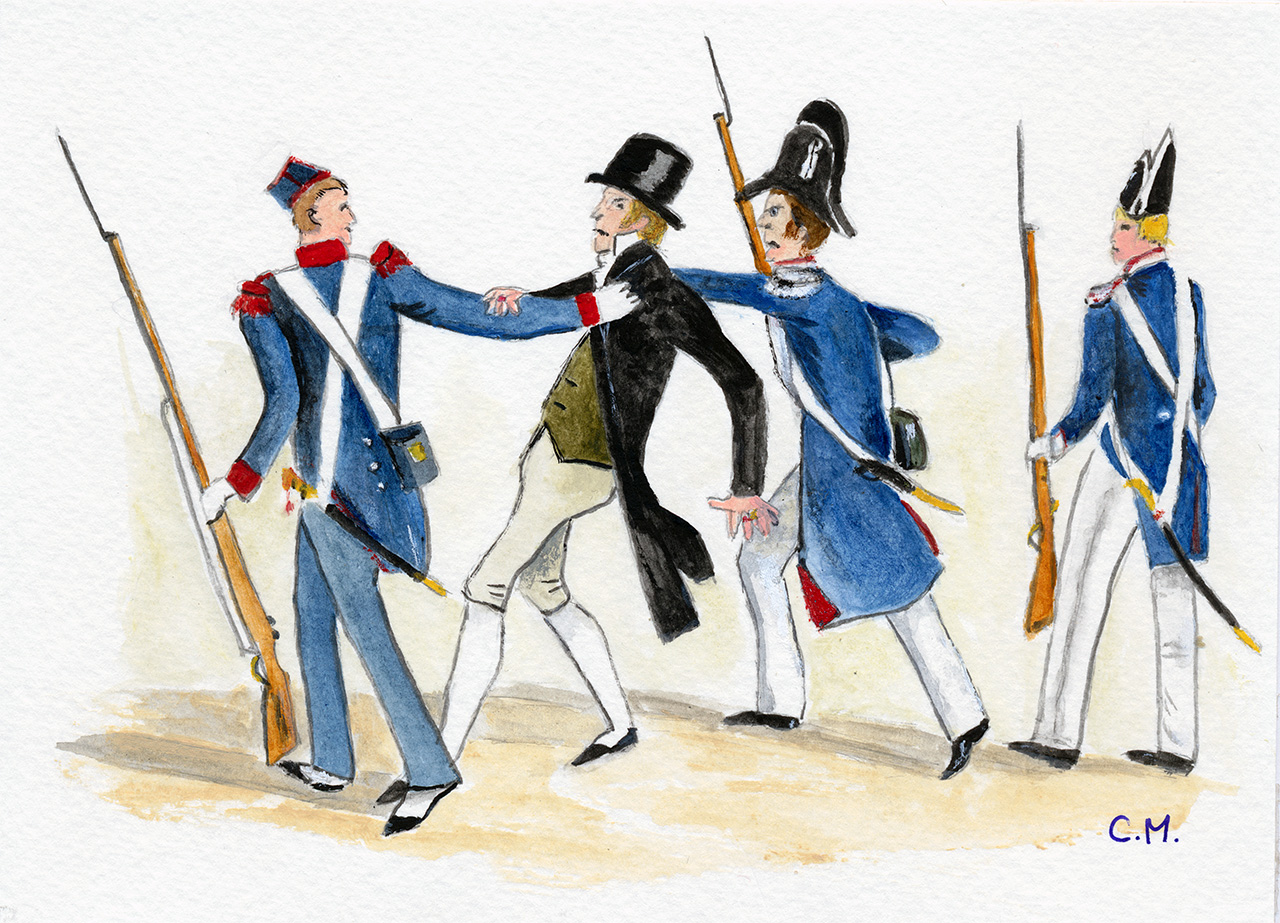
Accounts of the arrest of Jules de Polignac differ in a lot of important details. But every one I found agrees on a few key facts: that Polignac was disguised as a manservant to a noblewoman, and that the particular noblewoman was the “Marquise de Saint-Fargeau.”
Right: Christelle Murie, “‘Pierre’ [Jules de Polignac] is taken to the detention center in the dead of night,” from Yves Murie, La fuite à Granville. Used with permission.
A “marquise,” just to be clear, is the female equivalent of the noble title of “marquis.”
For example, one of the very earliest accounts, the August 20, 1830 edition of the National newspaper, begins its account by saying, “Madame the Marquise de Saint-Fargeau had checked into the main hotel in Granville.” It continues to note how Polignac, disguised as a servant, “said that he was in the service of Madame de Saint-Fargeau.”1 Other contemporary sources repeat the same claim, as do modern accounts like Polignac’s biographer Pierre Robin-Harmel.2
But who was this Marquise?
If you do a simple Google search for “Marquise de Saint-Fargeau,” you get a bunch of hits. The first seven, and eight of the first 10, all relate not to a marquise but to a much more famous marquis: Louis-Michel le Peletier, Marquis de Saint-Fargeau. Louis-Michel was born in 1760 and died in 1793, and his 1793 death is a big reason why he’s famous today. See, Louis-Michel was a liberal noble who enthusiastically supported the French Revolution. He supported it so enthusiastically that as a member of the National Convention in January 1793, Louis-Michel voted to execute France’s former king, Louis XVI. A few days later, Louis-Michel was eating in a restaurant in the Palais-Royal when he was fatally stabbed by a former member of the royal guard, in revenge for his regicide.
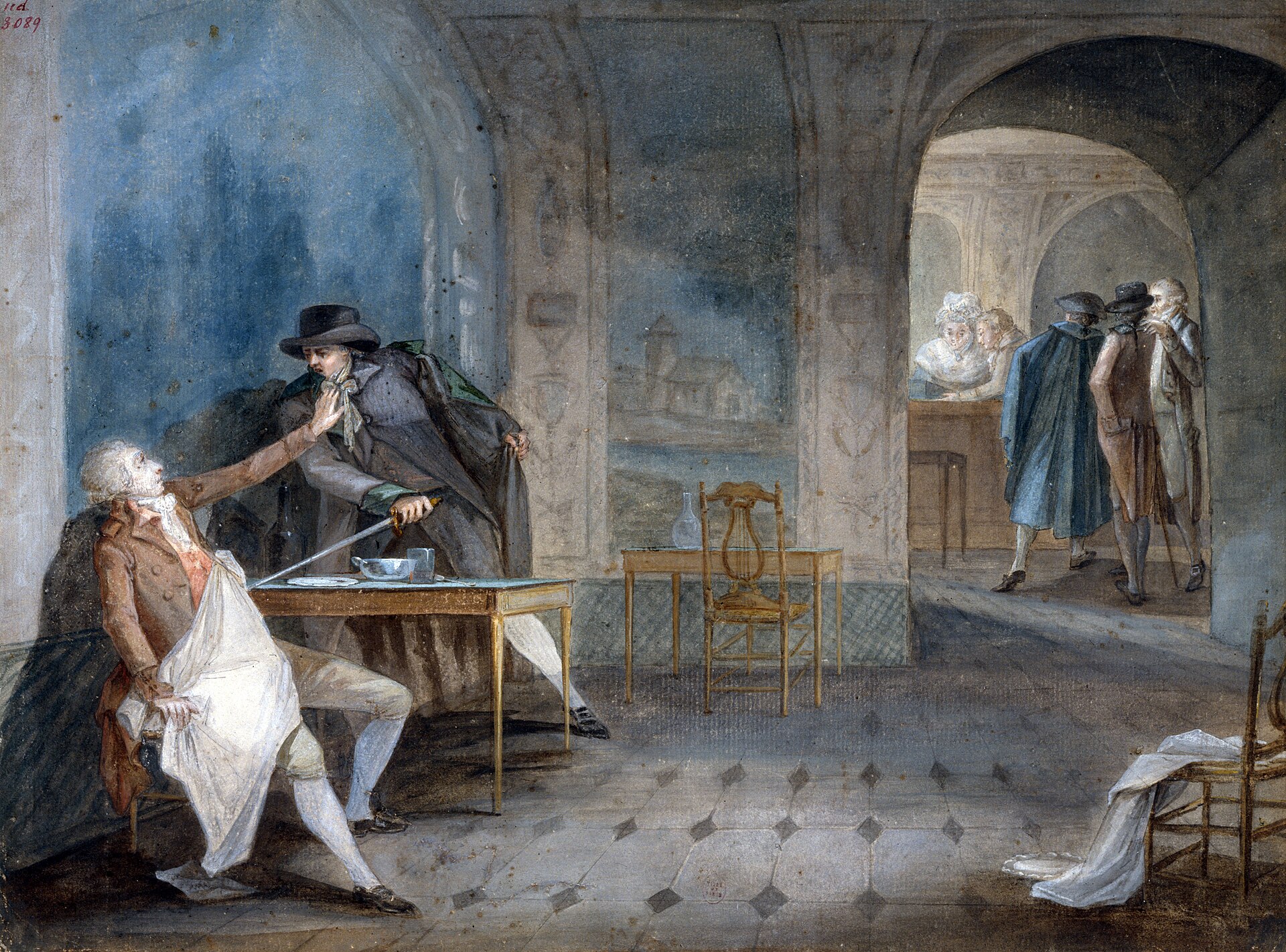
Louis Brion de la Tour (fils), “Assassinat de Le Peletier de Saint-Fargeau par Pâris, à la cave de Fevrier, restaurateur au 113, Palais Royal, le 20 janvier 1793,” circa 1793-1798. Public domain via Wikimedia Commons.

 Louis-Michel le Peletier was dubbed “the first martyr of the Republic” and was posthumously showered with a range of honors. Crucially for our story, however, Louis-Michel at his death left behind an underage daughter, Suzanne le Peletier de Saint-Fargeau. And Suzanne, as the orphan to a martyr, was passed to the custody not of her uncles but of France: a “Daughter of the State.” Suzanne le Peletier had a short marriage to a Dutchman named Jean-François De Witt, from 1798 to 1800. Years later, in 1806 she married her cousin, Léon Le Peletier de Mortfontaine, a royalist and former émigré. After re-marrying, Suzanne went by “Madame de Mortfontaine.”3
Right: Jacques-Louis David, “Suzanne Le Peletier de Saint-Fargeau,” 1804. Public domain via Wikimedia Commons.
But this, writes the 19th Century historian Ernest Daudet,4 is what misleads people. In his history of the trial of the ministers, Daudet writes that Polignac took refuge with “Madame de Morfontaine [sic], the daughter of the Conventionist Lepeltier [sic] de Saint-Fargeau.” Daudet continues to note that Madame de Morfontaine, for the purposes of this mission, traveled under “her family name, whose revolutionary popularity was intended to allay all suspicion.”5 So that seems simple enough: the Marquise de Saint-Fargeau who helped Polignac escape was Suzanne le Peletier, the famous daughter of the even more famous Louis-Michel le Peletier.
Except, that is, for one minor little wrinkle: Suzanne le Peletier died on August 19, 1829.6 So she definitely was not helping Jules de Polignac try to escape one year later in August 1830, whatever Ernest Daudet claims.
This, unfortunately, brings us right back to where we were: trying to identify the Polignac’s marquise. And every potential candidate from here on out is going to be more obscure, and harder to track down, than the last.
Marguerite and Suzanne
Suzanne le Peletier de Saint-Fargeau and Léon le Peletier de Mortfontaine had two daughters together: Marguerite in October 1809, and another Suzanne, Suzanne Françoise, in August 1811. When Jules de Polignac was captured in August 1830, Marguerite was 20 and Suzanne Françoise had just turned 19. Was the attempt to spirit Jules de Polignac out of the country the act of one of these two young women?
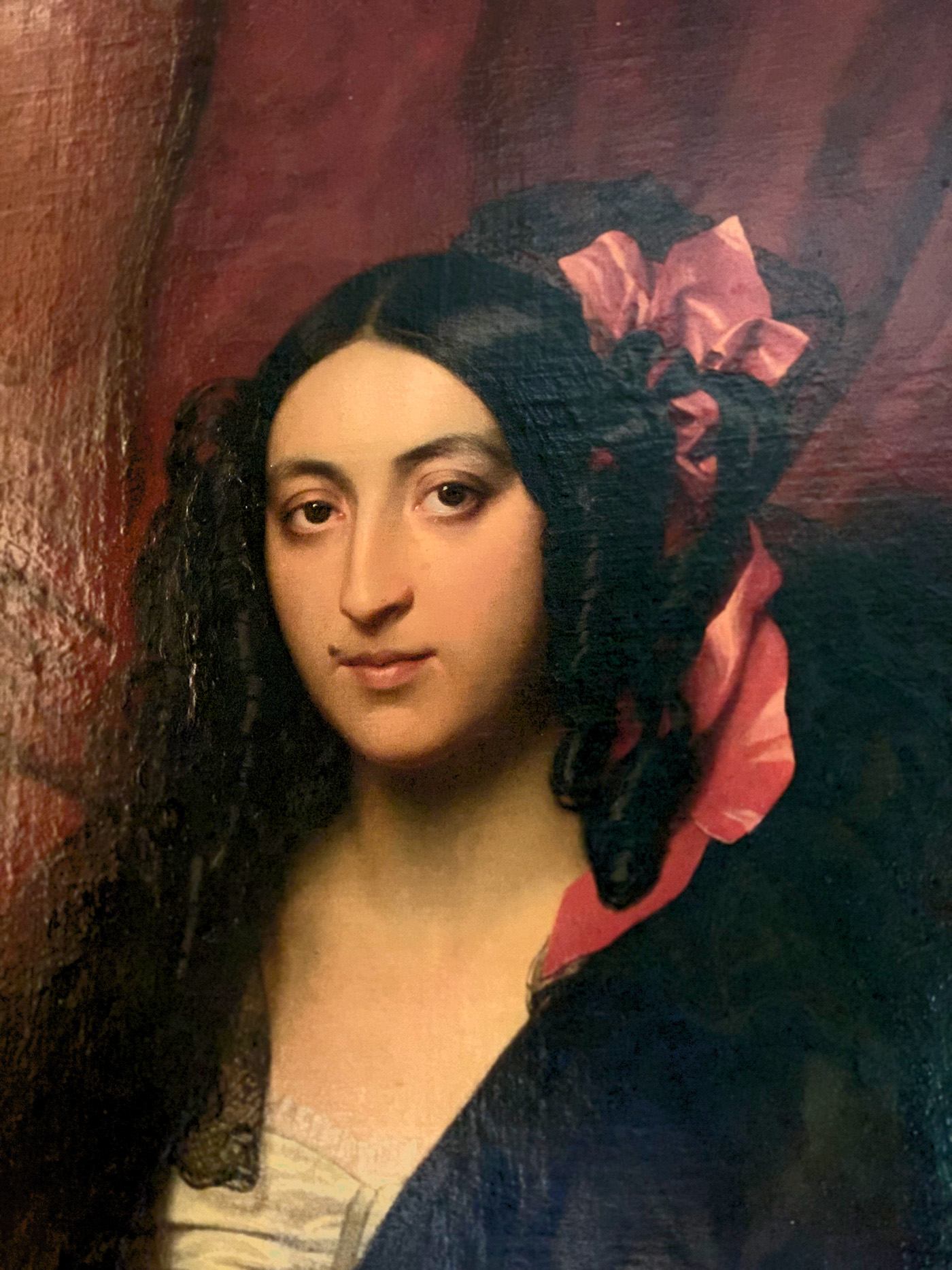 Of the two, Marguerite seemed like the better bet. We know very little about either, but one thing we do know is who they married. In 1832, Suzanne-François married Ernest de Talleyrand-Périgord, a relative of the famous diplomat Talleyrand. Ernest, notably, was a supporter of the July Monarchy and Louis-Philippe.7 Now, spouses don’t always agree on politics, but it would seem a little odd for someone so devoted to the Bourbons that they would try to help the hated Polignac to marry an Orléanist. Especially because her sister Marguerite in 1827 married Marquis Édouard de Boisgelin, a former member of Louis XVIII’s royal guard — a more likely background for a Polignac loyalist.
Right: Paul Delaroche, “Marguerite de Boisgelin,” circa 1830. Provided by Michael de Boisgelin. Used with permission.
Now, in France, noble titles do not descend through the female line. So neither Marguerite nor Suzanne Françoise were technically “Marquises of Saint-Fargeau.” But perhaps Daudet was on the right track when he suggested that the supposed “Marquise de Saint-Fargeau” was using an old family title for tactical reasons.
Seeking confirmation, I did more digging and discovered that there are living members of the Boisgelin family today. I sent an email to Michael de Boisgelin, the 7th and current Marquis de Boisgelin, laying out my theory and asking for his help. Unfortunately, he couldn’t confirm or reject my suspicion. But he did think it was plausible that his great-great-great-grandmother Marguerite had been the mysterious Marquise, writing that, “Everything suggests that Marguerite possessed a determined character — and the means to match her ambitions!” He also sent me a photo of the portrait of Marguerite hanging in the Boisgelin château that I’ve published with permission at thesiecle.com/factcheck4.8
So this seemed like a mystery solved, and I went on with the rest of the episode. But I couldn’t shake the feeling that something was off. I had a likely suspect, but not a proven one. Moreover, if Polignac’s helper wasn’t really the Marquise de Saint-Fargeau, why would every single contemporary source claim she was? The Marquise was interrogated in Granville by the same people who quickly unmasked Polignac’s secret identity — but none of them uncovered her own secret story?
Then my doubts grew when I found the memoirs of the Comte de Semallé.
Semallé
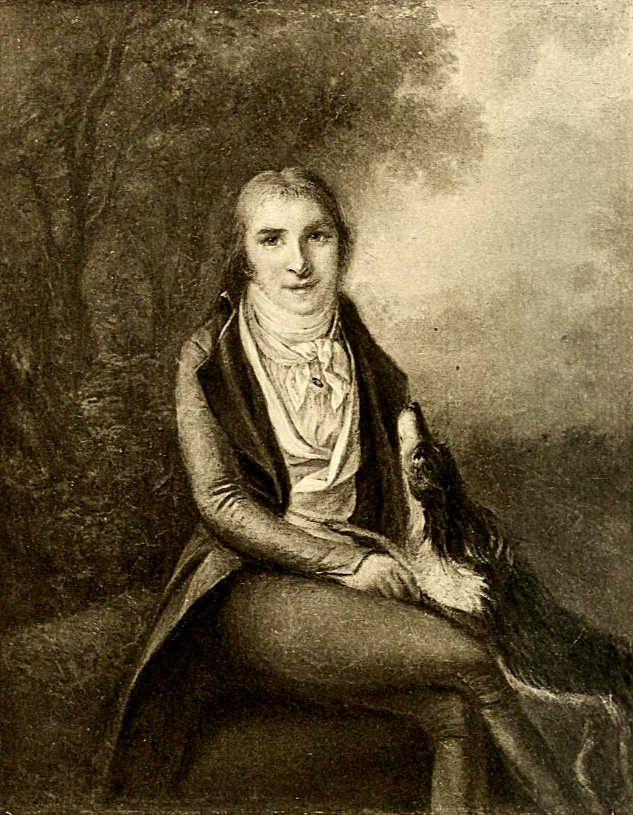 Comte Jean-René-Pierre de Semallé was an old-school aristocrat dating back to the ancien régime, when he was a page for Louis XVI, and lasting past the fall of the Bourbon Restoration in 1830. Semallé was also part of the conspiracy to sneak Polignac out of the country after the July Revolution, and he wrote it all down in considerable detail in his memoirs. Semallé escorted the incognito Polignac himself across much of northeastern France. Their trip included a memorable evening when one of Semallé’s friends went on a long rant at dinner, blaming everything that had happened on the incompetent Jules de Polignac, unaware that Polignac himself was sitting across the table from her. Eventually, however, Semallé began to attract suspicion, so he passed Polignac off to two noblewomen he knew: Madame de la Martinière, and her friend, Madame de Saint-Fargeau, who would see Polignac onto a ship at Granville.9 The story after that we already know.
Above: Artist unknown. Portrait of Jean-René-Pierre, Comte de Semallé, from the frontispiece of his memoirs, Souvenirs du Comte de Semallé, Page de Louix XVI. Public domain via Internet Archive.
Unfortunately for our purposes, the one detail Semallé did not include in this detailed account was the identity of the “Madame de Saint-Fargeau” who took part in the plan. He simply refers to her as “Madame de Saint-Fargeau” without explanation.10
This was in line with the literary custom of the time, by which aristocrats are referred to by their current and proper title without context. For example, many accounts of the time refer to Marshal Marmont simply as the “Duc de Raguse,” without bothering to explain that by this they mean the general born as, and largely known to history as, Marmont.
But Semallé’s scrupulous adherence to this code of referring to nobles by their current titles is revealing. Because earlier in his memoirs, he discusses Suzanne le Peletier, daughter of Louis-Michel. Over two pages, as he recounts Suzanne’s story, Semallé refers to her as the daughter of “Saint-Fargeau,” then after her first marriage as “Madame de Witt,” and then after her second marriage as “Madame de Mortfontaine.” It’s always her current and proper title for the moment he describes.11 Which makes it really interesting that his account of Polignac’s escape refers to “Madame de Saint-Fargeau.” Our scrupulously precise eyewitness source from inside the conspiracy confirms what our second-hand accounts in the newspapers say: Polignac’s helper was genuinely named “Madame de Saint-Fargeau,” not someone else, like Marguerite, borrowing the title for the purposes of camouflage.
And here we’d be stuck again, except for a few more oblique references Semallé makes. In describing how Suzanne and Léon came to marry, Semallé mentions how the new couple lived “with their Saint-Fargeau aunt, sister-in-law of the regicide and daughter of Madame Leclerc, born de Peyrac.”12 And Semallé also refers to a “Monsieur de Saint-Fargeau” active in ultraroyalist circles in 1815, which is a very important year: long before either of Suzanne’s daughters came of age and married — but after the 1814 death of Suzanne’s second husband Léon de Mortefontaine, in a horse-riding accident.13
So who is this Marquis de Saint-Fargeau? And who is his wife? Could she be our mysterious Marquise? By this point I was unsurprised to see that Semallé didn’t give a name for this woman. But he did give her maiden name, Leclerc, and her mother’s maiden name, Peyrac.
The brothers
If our Marquise de Saint-Fargeau was the sister-in-law of Louis-Michel le Peletier, that naturally has me looking for Louis-Michel’s brothers. And he did have brothers — notable ones.
,_by_Louis-Roland_Trinquesse.jpg) Technically these were half-brothers. Louis-Michel’s father, Michel-Étienne, married one Louise de Beaupré in 1755; they had Louis-Michel in 1760, and then two years later Louise was dead. In 1764, Michel-Étienne married again, to Louise-Adélaïde Randon. This second marriage had several children, including Felix le Peletier in 1767, and Amédée in 1770.14
Technically these were half-brothers. Louis-Michel’s father, Michel-Étienne, married one Louise de Beaupré in 1755; they had Louis-Michel in 1760, and then two years later Louise was dead. In 1764, Michel-Étienne married again, to Louise-Adélaïde Randon. This second marriage had several children, including Felix le Peletier in 1767, and Amédée in 1770.14
Felix shared Louis-Michel’s radical politics; he became an associate of the radical proto-communist Gracchus Babeuf, and stayed active in liberal and republican circles throughout the Restoration, where he was involved in the Carbonari, a friend of Lafayette, and one of the famous “221” deputies to defy Charles X in 1830.15
Above: Louis Rolland Trinquesse, “Félix le Peletier de Saint Fargeau,” circa 1790s. Public domain via Wikimedia Commons. Below: Unknown artist, “Amédée Louis Michel Le Peletier,” unknown data. Public domain via Wikimedia Commons.

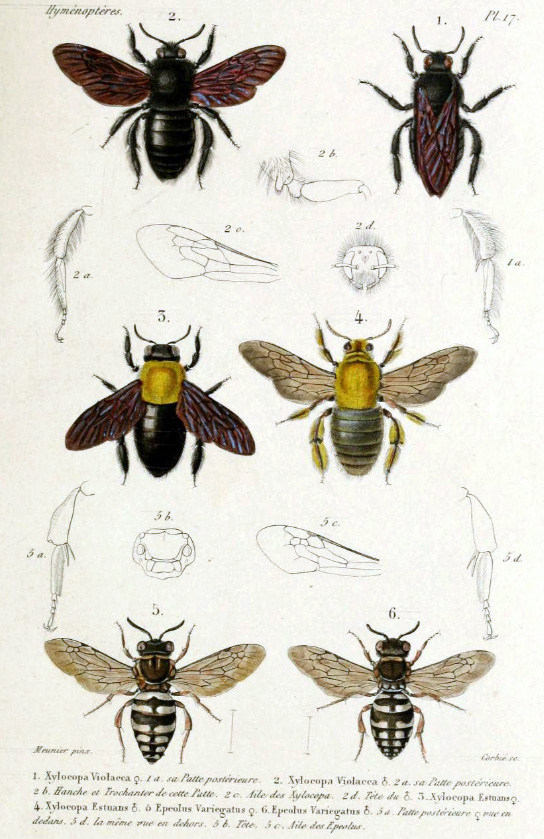
 Amédée had a long and distinguished career, but one lived in the shadow of his more politically active brothers. As a young man, Amédée worked with Felix to defend Louis-Michel’s legacy, but he soon stepped back from politics to pursue smaller interests. I mean that literally, because Amédée became a distinguished professor of entomology, the study of insects. A specialist in Hymenoptera — the order of insects that includes ants and bees — Amédée published several important scientific works and was active in scientific societies. A writer in 1986 noted that Amédée had written the first-ever “comprehensive study of the order Hymenoptera” and that his work “remains a standard reference to this day.”16.
 Of the two brothers, Felix never married. He was a notorious womanizer, especially in his younger years. According to some claims, he may have had an affair with one Josephine de Beauharnais, the future wife of Napoleon.17 He had a daughter, Félicité, out of wedlock with a woman named Marie-Adélaïde Guénon. Felix acknowledged his paternity, brought Félicité to live with him, and later named her his heir. But Felix never married Guénon — who later married another man — or anyone else.18 Felix, in other words, does not give us Semallé’s Le Peletier sister-in-law.
Right: Plate 17 of illustrations from Amédée Le Peletier’s work Histoire Naturelle des Insectes Hyménoptères, depicting Xylocopa violacae, the purple carpenter bee. Public domain via Internet Archive.
Amédée’s marital history is a little more complicated. The historian Laurence Constant-Ancet, who wrote a biography of Felix, says of Amédée that he “remained single,”19 which put me off the trail at first. But a contemporary obituary for Amédée, written by his colleague Jean Guillaume Audinet-Serville, states flatly that “providence blessed him with a wife who was as good as she was pious,” and that Amédée was the “father of two sons,” one of whom sent him insect samples from Algeria while serving in the military there.20 I have been able to turn up nothing else about Amédée’s apparent wife, including her name. But while Amédée had — unlike Felix — made his peace with the Bourbon Restoration,21 this “good” and “pious” wife of a professor of entomology doesn’t seem like an obvious candidate for defying mobs to help the notorious Jules de Polignac flee the country.
As it happens, there was something I was missing here. But I’d end up coming around to it by a roundabout way.
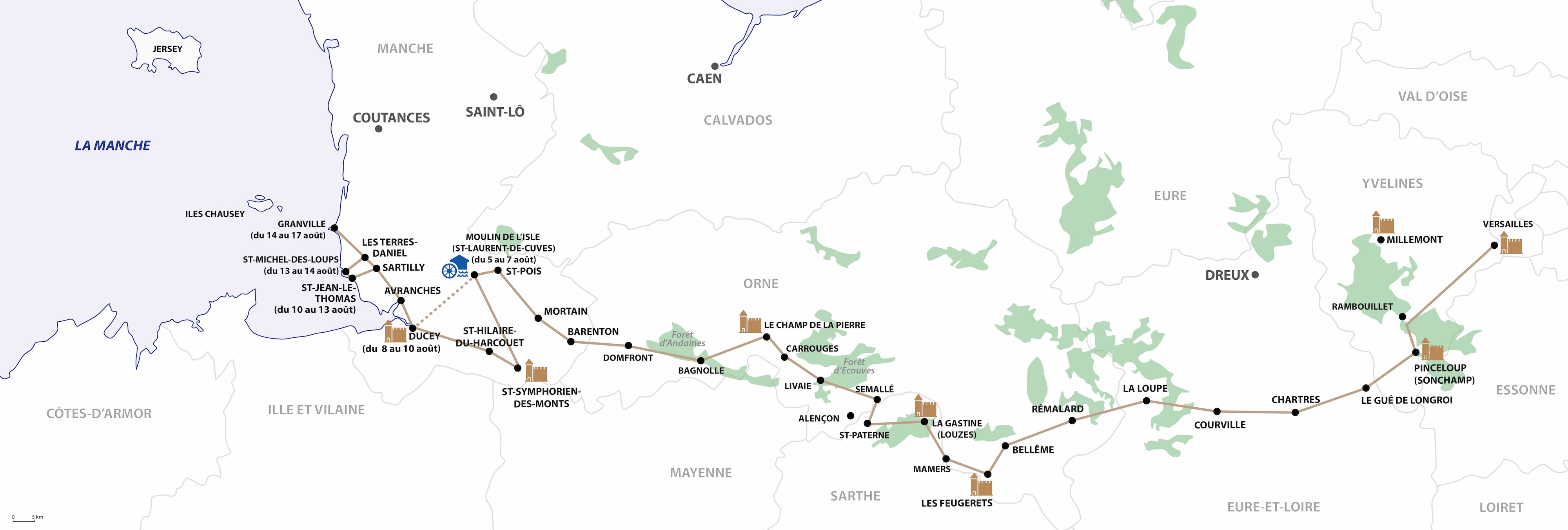
Annick Prial, map showing the key locations visited by Jules de Polignac in his attempted escape from France after the July Revolution of 1830, from Yves Murie, La fuite à Granville (self-published, 2025). Used with permission. See a larger version.
Aglaé-Isidore
Was Semallé somehow wrong in his description of the Saint-Fargeau aunt, born Leclerc, daughter of Peyrac? By this point, deep in research madness, I was beginning to consider the possibility. But then I found an 1829 book, a dry government document detailing the indemnities owed to the former property owners — that is, slaveholders — of the French colony of Saint-Domingue, by that point the independent country of Haiti. (I talked about this in Episode 36.) One table in it describes how one Jean-Joseph Peyrac’s estate had four living claimants. And one of those claimants, the table notes concisely, was a granddaughter of Jean-Joseph Peyrac’s, named Aglaé-Isidore Leclerc. She was married to a man named Lepelletier [sic] who was at the time of the book’s publication in 1829 the Marquis de Saint-Fargeau.22 So there we have it: a Peyrac who married a Leclerc, who had a daughter who married the Marquis de Saint-Fargeau — just as Semallé had described.
But was Aglaé-Isidore our 1830 marquise? And who was her Saint-Fargeau husband? She clearly had not married Felix. Had she married Amédée? If so, she was invisible in the sources. And our professor of entomology doesn’t exactly line up with Semallé’s description of the Marquis de Saint-Fargeau being an ultraroyalist. None of the sources I had looked at so far, from Semallé to Wikipedia and amateur genealogy sites, had answers.
And here it’s important to remember the downsides of user-edited sites like Wikipedia and genealogy pages. They can be incredible historical resources, but are particularly prone to what former U.S. Defense Secretary Donald Rumsfeld memorably called “unknown unknowns” — things their authors don’t know and don’t know that they don’t know. Because contrary to lots of genealogical listings and at least one academic publication, it turns out that the assassinated Louis-Michel de Saint-Fargeau had four half-brothers, not two. One of these half-brothers died in 1796, but the other lived into the 1830s.23 And this twisted journey is finally nearing its conclusion as we meet Daniel Le Peletier, Marquis de Saint-Fargeau.
Born in 1773, Daniel very much did not share the radical politics of Louis-Michel and Felix. To the contrary, he was an émigré who fled France in 1791, and fought against the revolution. By 1815, Daniel’s politics had not mellowed: he was part of the household of the ultraroyalist Comte d’Artois, the future Charles X, and worked on behalf of the Bourbons during their exile in the Hundred Days. Descriptions of Daniel’s life in modern historians like Laurence Constant-Ancet match up with the details Semallé provided for the “Marquis de Saint-Fargeau” who was alive during the Restoration.24
 I even found — so far down a rabbit hole I can’t even remember how I got here — a note in a 1908 publication from a regional French historical society, explaining the history of the Saint-Fargeau family’s ancestral castle, the Château de Saint-Fargeau. The château, this article said, was inherited in 1794 by one Daniel Le Péletier and his wife, Aglaé-Isidore. And in 1833, Daniel sold the château to none other than Victoire-Agnès Goval, Madame de la Martinière — the noblewoman who Semallé describes helping Madame de Saint-Fargeau with Polignac’s escape.25
Above: Victor Petit, “The Château de Saint-Fargeau,” 1845. Public domain via Wikimedia Commons.

So I can say at last that Jules de Polignac’s mysterious “Marquise de Saint-Fargeau” was in fact Aglaé-Isidore, born Leclerc, wife of the émigré and Bourbon loyalist Daniel Le Peletier de Saint-Fargeau. I don’t have a precise birthdate for Aglaé-Isidore, but she would have been in her 50s at the time she tried to spirit Polignac onto a ship bound for England. She had been married for 28 years to Daniel, a devoted servant of the man who became Charles X. Aglaé-Isidore was a “fervent royalist” herself. She also had a longstanding friendship with the Comte de Semallé: It was in her house, some 20 years before the July Revolution, that Semallé had met his future wife Zoé.26
Below: Unknown photographer, photograph of the port of Granville, circa late 19th Century. Public domain via Wikimanche.


Aglaé-Isidore proved no good at sneaking about, much to Polignac’s misfortune — though the lion’s share of the blame for the debacle at Granville has to go to Polignac, utterly miscast in the role of a common servant. But when everything had blown up and Aglaé-Isidore was being interrogated by a magistrate, she had a simple explanation for her role abetting the most wanted man in France: “He was in trouble.” For Madame de Saint-Fargeau, that was enough.27
You don’t need to worry about Aglaé-Isidore, by the way. While Polignac was arrested and put on trial for his life, the Marquise was released without charges, and quickly returned home.28
Six years later, on November 29, 1836, Jules de Polignac was released from prison as part of an amnesty decree by the July Monarchy, on the condition that he leave the country. On December 3, Polignac landed at Dover on the south coast of England, to finally begin the British exile to which he had come so close in August 1830.29
Three days after that, on December 6, 1836, Aglaé-Isidore, Marquise de Saint-Fargeau, breathed her final breath.30 She had lived just long enough to see her mission, at last, finished.
And just as finished is my own research into Aglaé-Isidore. It was a noble but probably misguided effort, and concluded with a somewhat anticlimactic unmasking. If nothing else, at least I have that much in common with the Marquise de Saint-Fargeau.
Thank you for sticking with me! If you want to learn more about Polignac’s escape and the Marquise de Saint-Fargeau — well, I hope you read French, because everything useful I found about this topic was in French. In particular, I’d recommend a recent book by a French local historian called Yves Murie; I discovered this book too late to save me from a research spiral, but it has a lot of details and context. Murie self-published his book, called La fuite à Granville or “The Flight to Granville,” and you can contact him to purchase it — I’ve included his contact information at thesiecle.com/factcheck4.
Now I’m halfway done with the next regular episode, which I hope to bring to you soon! So stay tuned for Episode 50: Movement and Resistance.
-
“Arrestation de M. Polignac,” Le National, Aug. 20, 1830, 2. ↩
-
Pierre Robin-Harmel, Le prince Jules de Polignac, ministre de Charles X: Sa vie de 1829 à 1847, Kindle Edition, 119-21. ↩
-
Jean-René-Pierre, Comte de Semallé, Souvenirs du Comte de Semallé, Page de Louix XVI (Paris: Alphonse Picard et Fils, 1898), 127. ↩
-
I have a fondness for Daudet because he wrote an entire book about the oft-overlooked Martignac ministry. ↩
-
Ernest Daudet, “Le Procès des Ministres, 1830,” Revue des Deux Mondes 47, no. 3 (1877), 86. After publishing this erroneous report, Daudet discovered the truth by interviewing the son of the Comte de Semallé, and corrected it in a new, book-length version of his history that I only discovered at the very end of my research. Ernest Daudet, Le Procès des Ministres (1830) (Paris: A Quantin, 1877), 96. Yves Murie, La fuite à Granville (self-published, 2025), 145. ↩
-
“Le Peletier de Saint-Fargeau, Suzanne Louise (1782-1829),” FranceArchives, accessed March 28, 2026. ↩
-
Adolphe Robert, Edgar Bourloton and Gaston Cougny, eds., Dictionnaire des Parlementaires Français […], vol. 5 (Paris: Bourloton, Éditeur, 1891), 361. ↩
-
Michael de Boisgelin, email message to author, November 17, 2025. ↩
-
Semallé, Souvenirs, 311-22. ↩
-
Semallé, Souvenirs, 319. ↩
-
Semallé, Souvenirs, 126-7. ↩
-
Semallé, Souvenirs, 127. ↩
-
Semallé, Souvenirs, 234-5. Laurence Constant, Félix Lepeletier de Saint-Fargeau: Un itinéraire, de la Révolution à la monarchie de Juillet (Paris: Association Découvrir, 1995), 137. ↩
-
Constant, Félix Lepeletier de Saint-Fargaeau, 7. ↩
-
Constant, Félix Lepeletier de Saint-Fargaeau, 150-2. ↩
-
Jean Guillaume Audinet-Serville, “Notice Nécrologique sur M. le Comte le Péletier de Saint-Fargeau,” in Annales de la Société entomologique de France, 2nd series, volume 4 (Paris: Lucien Buquet, 1846), 193-200. Jean Lhoste, Les Entomologistes Français (Versailles: INRA, 1987), 133-4. ↩
-
Josephine faced accusations that her second child Hortense — future wife of Louis Bonaparte, future Queen of Holland, and eventual mother of the future Emperor Napoleon III — was the daughter of one of her lovers and not Josephine’s husband Alexandre de Beauharnais. Even if true, however, Hortense’s 1783 birth does not appear to match up with when Felix was living the life of a playboy in Paris in the late 1780s and early 1790s — otherwise this little digression of an episode could have much more important! ↩
-
Constant, Félix Lepeletier de Saint-Fargaeau, 21, 111, 167-8. Felix does appear to have spent his final years living with a “trusted female companion,” probably a spinster named Marguerite Cazin, who he named in his will but did not marry. 148. ↩
-
Laurence Constant-Ancet, “Félix Lepeletier de Saint-Fargeau: Un Personnage Ambigu de l’Histoire,” in Annales historiques de la Révolution française, no. 308 (1997), 323. ↩
-
Audinet-Serville, “Notice Nécrologique,” 195. ↩
-
Constant, Félix Lepeletier de Saint-Fargaeau, 136. ↩
-
État Détaillé des Liquidations Opérées à l’Époque du 1er Janvier 1829 (Paris: L’Imprimerie Royale, 1829), 258. ↩
-
Constant, Félix Lepeletier de Saint-Fargaeau, 175. Besides the omissions on genealogy sites, Jean Lhoste’s survey of French entomologists describes Amédée as being the younger sibling to two older brothers, Louis-Michel and Felix. Lhoste, Les Entomologistes Français, 133. ↩
-
Constant, Félix Lepeletier de Saint-Fargaeau, 136. Semellé, Souvenirs, 234-5. ↩
-
A. Peschot, “Montireau et ses anciens seigneurs (suite),” in Bulletin de la Société Percheronne d’Histoire et d’Archaéologie, volume 7, number 4 (October 1908), 199. ↩
-
Semallé, Souvenirs, 127. Murie, La fuite à Granville, 72. ↩
-
Murie, La fuite à Granville, 137-8. ↩
-
Murie, La fuite à Granville, 138. ↩
-
Robin-Harmel, Le prince Jules de Polignac, , 200. ↩
-
Famille Guichard-Schmitt, “Aglae Isidore LECLERC,” Geneanet, accessed March 27, 2026. ↩