Episode 50: Movement and Resistance
This is The Siècle, Episode 50: Movement and Resistance.
Welcome back, everyone!
I’ve got a great episode for you today, though as usual it’s twice as long and twice as late as I initially planned. (I’m sure those facts are unrelated.) I’ll get right into things, after a few quick thanks!
Thank you Ben for agreeing to swap promos with me, as Battle Royale crosses paths with The Siècle. If you want to hear another take on the reigns of Louis XVIII and Charles X — plus Napoleon, the Sun King, and more — check out Battle Royale. I’ve linked to them in the show notes and at thesiecle.com/episode50.
Thank you especially to the show’s supporters on Patreon, who make The Siècle possible. All patrons get access to an ad-free feed of this show. Since the last episode, new patrons include Daniel Boline, Doug, Jim, Daniel Marchant, Sean Moriarty, Matt Byrne, Daniel Berman, Vivek Dandekar, Sam Rutzick, Ernest Ialongo, and Yvy. You can join them for as little as $1 per month — find out how at thesiecle.com/support.
Special thanks to Robey Pointer, the show’s returning President of the Council of Ministers — the patron with the highest monthly donation — and to the newest members of The Siècle’s Pantheon: Amy Wren and Alexander Smithers, who’ve each given more than $400 to the show over the years.
If want to support the show but can’t commit to a monthly donation, The Siècle also has a page on Ko-Fi, where John B. donated last month. Thank you John! You can also find the Ko-Fi page at thesiecle.com/support. There’s also a link there where you can buy books for me off the show’s wish list, as listener John Robinson did. Thank you John!
Finally, as always, I want to thank this show’s network, Evergreen Podcasts, and all of you for listening and spreading the word. Reviews and discussions on social media are the best way this show can grow!
Now, let’s get into the episode.
Defining July
To understand the range of political opinions in the July Monarchy, I find it helpful to look at people’s answers to a simple question: what happened in July 1830?
For people today, the answer is simple: the “July Revolution,” in which King Charles X of France was dethroned and replaced with his cousin Louis-Philippe. But in the years immediately after the July Revolution, not everyone agreed.
 Take, for example, the Bourbon loyalists. In this period, their dedication to the so-called “legitimate” Bourbon line of kings will give them the name “Legitimists.” And while Legitimists might well call the July Revolution a “revolution” — not a term of endearment to these folks — they are more likely to call it something else entirely: a “usurpation.” This de-emphasizes the role of the Parisian insurrection in the whole affair, and centers the role of Louis-Philippe in taking Charles’s throne. At the very least, in this mindset, Louis-Philippe had committed a vile betrayal in accepting a throne that was not his. Many Legitimists believed the former Duc d’Orléans had gone further and actually orchestrated the whole insurrection. Regardless, for these Legitimists, the July Monarchy’s true roots were in one man’s treachery, rather than a popular uprising.1
Above: Unknown artist, Henri d’Artois, duc de Bordeaux, the heir to the main Bourbon line of kings, circa 1833. Public domain via Wikimedia Commons.

On the opposite end of the political spectrum were the radical republicans. Like the Legitimists, they weren’t especially fond of Louis-Philippe. But where the Legitimists viewed Louis-Philippe with hatred and disgust, the radical republicans tended to view him with dismissive contempt. The uprising of the Three Glorious Days had been, well, glorious, but Louis-Philippe wasn’t much better than Charles X. All the so-called July Revolution had done, these radicals said, was “swap one Bourbon for another.”2 Other republicans admitted that July 1830 had been a revolution, but they termed it “une révolution escamotée” — a hard-to-translate term that refers to how a magician might make something disappear through sleight-of-hand. For these republicans, the real revolution had been stolen, snatched away, leaving the July Monarchy in its place in the hopes that the gullible crowd wouldn’t notice the switch.3
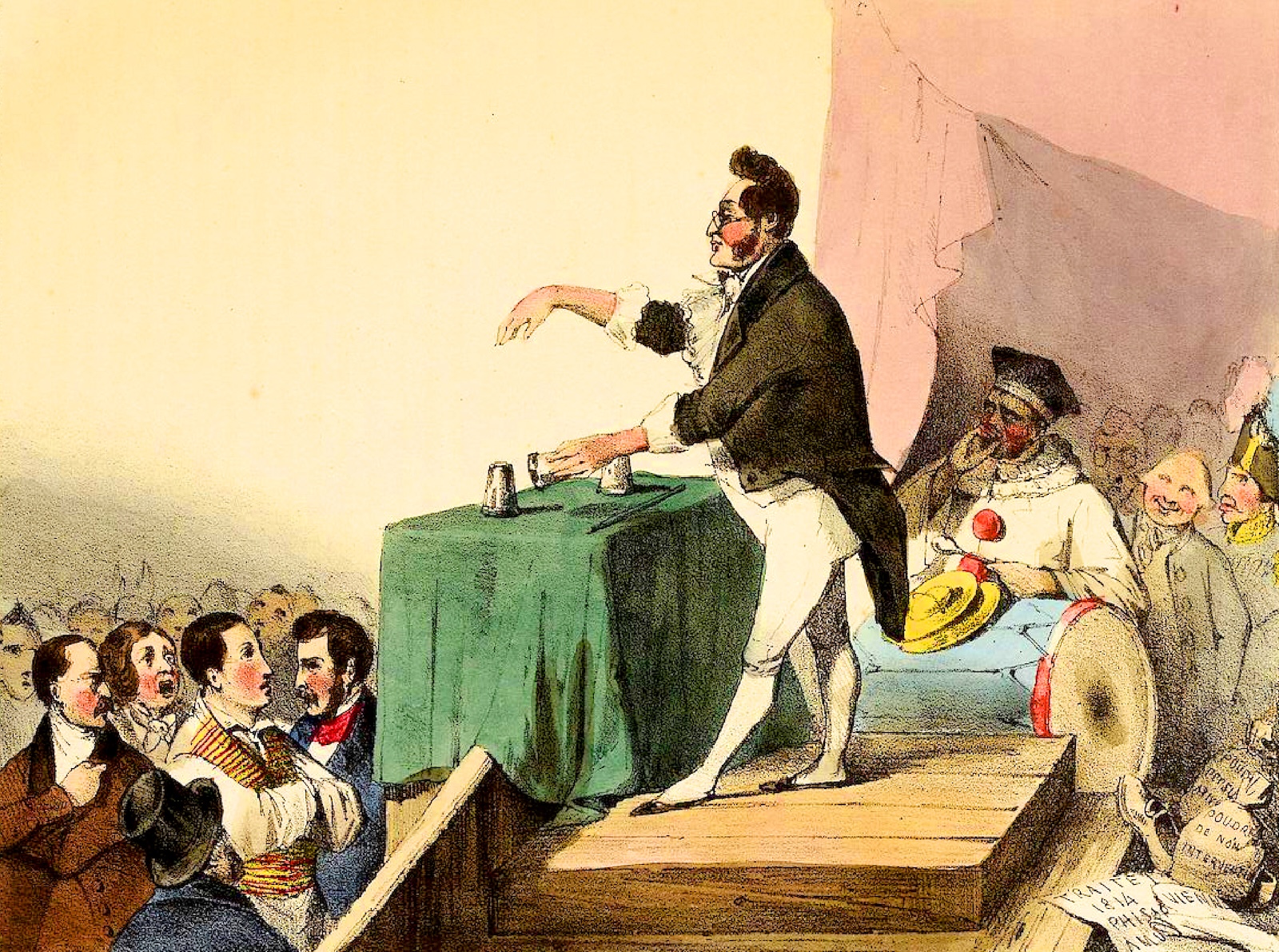
A cartoon from the May 12, 1831 edition of La Caricature, a left-wing satirical weekly begun in 1830. It depicts Louis-Philippe as a street magician running a shell game for a crowd. A caption accompanying the cartoon reads:
Here, gentlemen, here are three nutmegs, the first is called July, the second Revolution, and the third Freedom; I take the Revolution which was on the left, I put it on the right, what was on the right I put on the left, I make a muddle which the Devil himself can’t understand — and neither can you. I slip it all under the cup of the juste milieu [happy medium], and with a little powder of non-intervention, I say “pass”, “impasse” and “counter-pass”… everything has vanished, gentlemen! No more Freedom or Revolution left, not even enough to cover the palm of my hand. Try someone else, gentlemen!
Jules David, “Tenez, Messieurs, voici trois muscades,” 1831. Public domain via Paris Musée.
The Legitimists and the radical republicans were both outside the mainstream of the July Monarchy political world. Both movements had their spokesmen and elected representatives and were capable of biding their time, but at their core, each fundamentally denied the July Monarchy’s legitimacy and sought to overthrow it by whatever means necessary.4
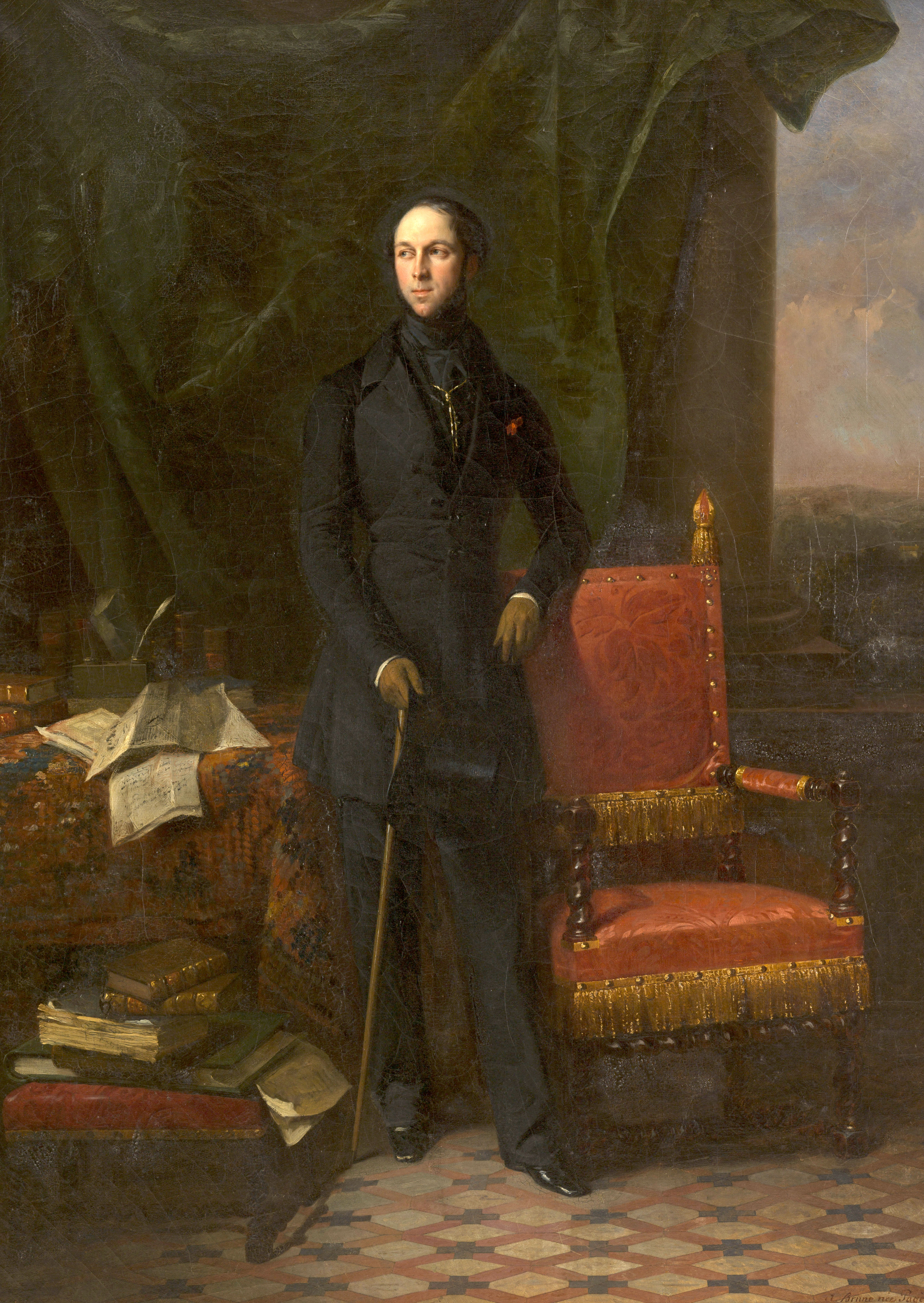 In contrast were the moderate or “constitutional” republicans. Like the radical republicans, the constitutional republicans wanted to establish a republic. But they wanted to do so inside the system, through legal means. The plan was something like this: Popularize their ideas through the press, run for the Chamber of Deputies, win seats, and pass a law to let poorer people vote. Then use this expanded suffrage to win more elections. Repeat until you have a majority in parliament willing to abolish the monarchy. Far-fetched, perhaps, but this movement was determined, and proved the most vibrant and popular opposition movement throughout the July Monarchy. These constitutional republicans saw the July Revolution not so much as a stolen revolution as an incomplete one. Yes, the revolution had not created a republic — yet. But there was still time to bring it about.5
Right: Aimée Brune, “Portrait of Louis-Antoine Garnier-Pagès,” circa 1840. Garnier-Pagès was the primary leader of the constitutional republicans during the July Monarchy. Public domain via Wikimedia Commons.
_-_P2829_-_Mus%C3%A9e_Carnavalet.jpg)
One step to the right was the so-called “Dynastic Left,” of whom Odilon Barrot was the principal leader. These were men who wanted to expand the electoral franchise, secularize the country, and in general do many of the same things the constitutional republicans wanted. But unlike the republicans, the Dynastic Left fundamentally accepted the legitimacy of Louis-Philippe as a constitutional monarch. They wanted to reform the July Monarchy in a progressive direction, not overthrow it. For these men, the July Revolution had been a real revolution with a real result, one they liked and wanted to defend — just with a few improvements.6
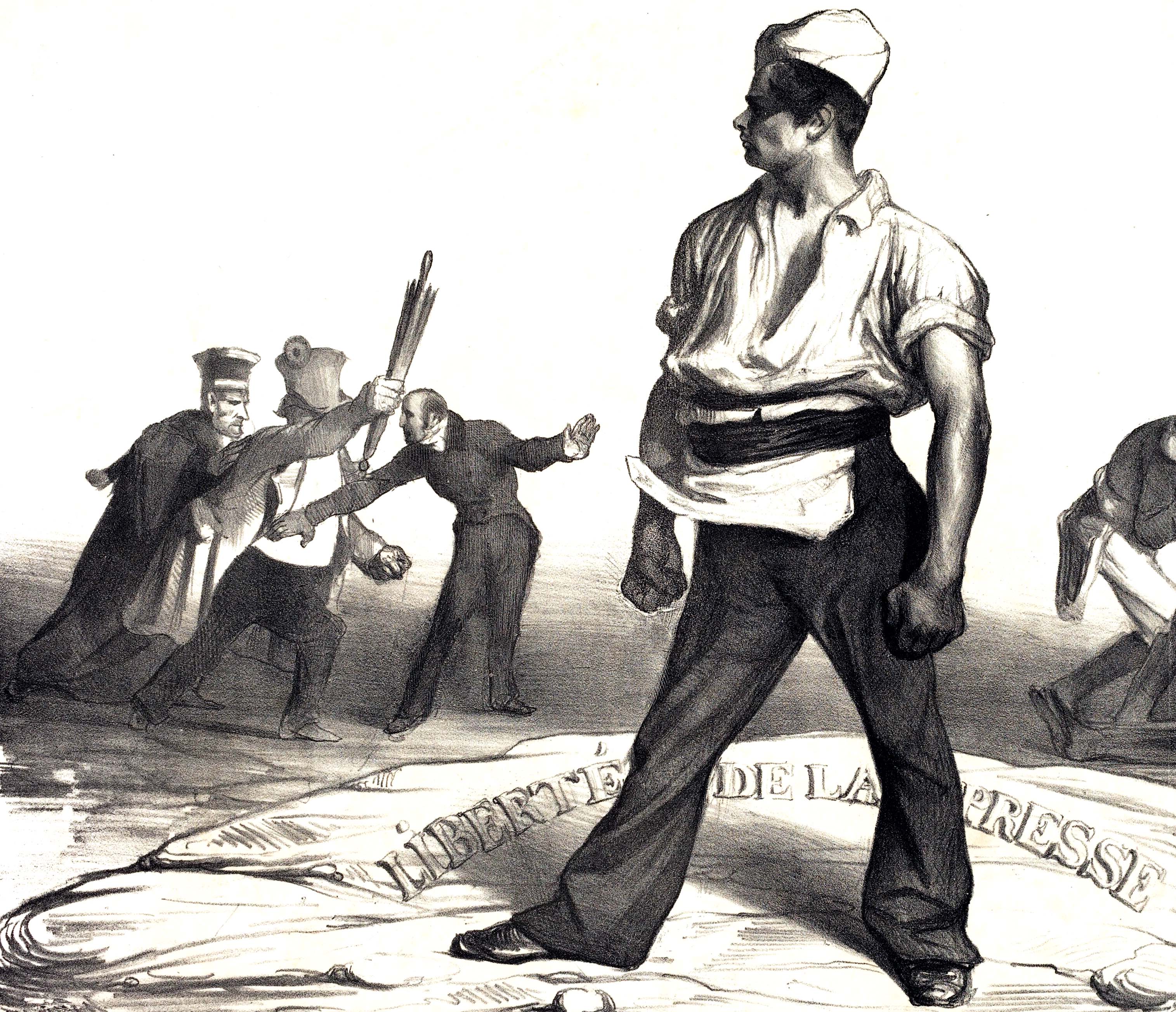
Honoré Daumier, detail from “Ne vous y frottez pas!! (Don’t You Meddle with It!!),” 1834. Dynastic Left leader Odilon Barrot (third from left) tries to prevent Louis-Philippe (second from left, identified by his signature umbrella) from menacing the freedom of the press, as represented by the burly print-shop worker at right. This captures Barrot’s role as a reformer who wanted to work with Louis-Philippe and steer him in a progressive direction, rather than overthrow him as republicans wanted. Public domain via National Gallery of Art.
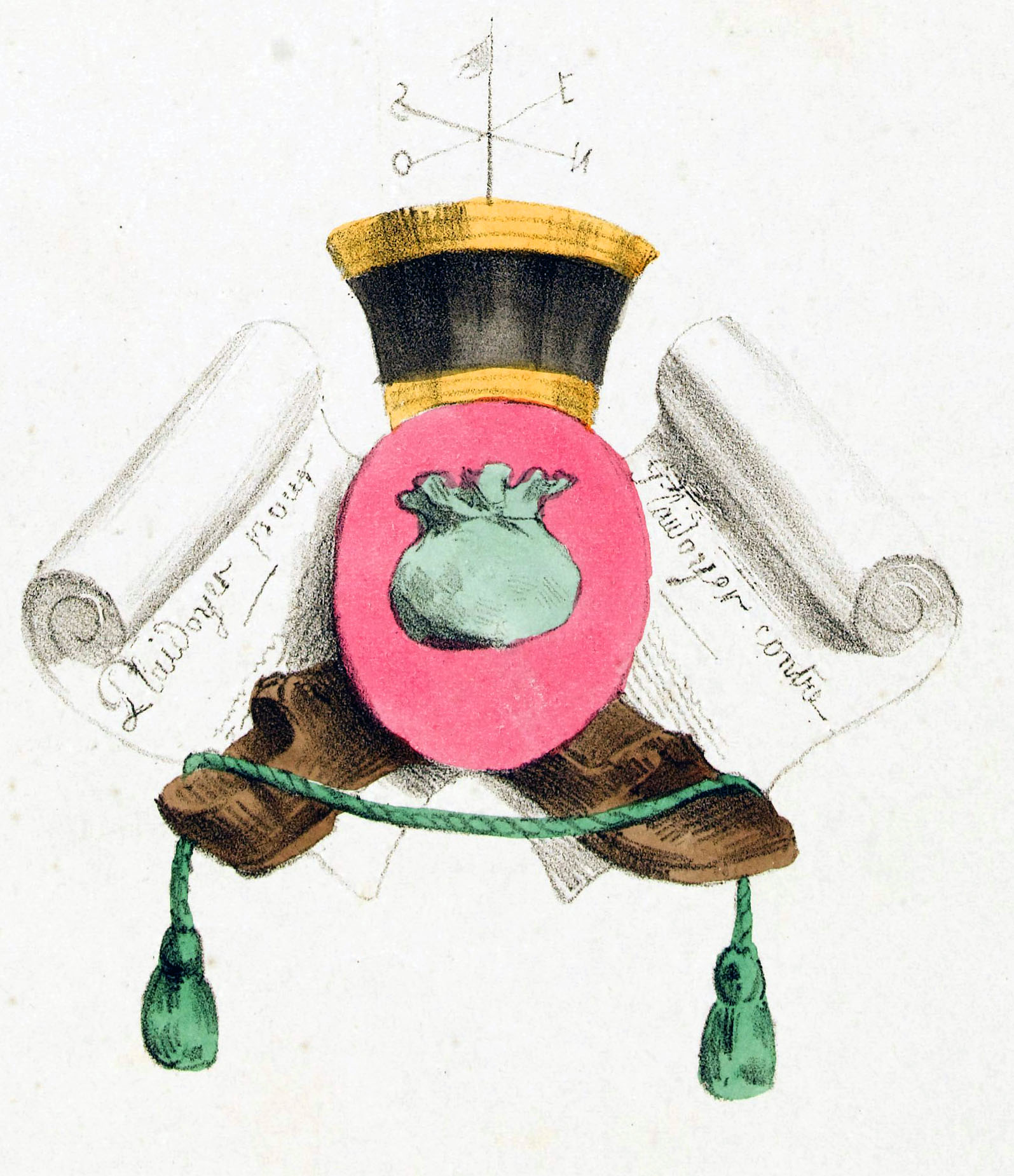 At the political center of the July Monarchy was the so-called “Tiers Parti,” or “Third Party” — politicians who could side with either the conservatives or the progressives, depending on the issue or personalities at stake. I should note that “Tiers Parti” is spelled t-i-e-r-s — different from the last name of the politician Adolphe Thiers, t-h-i-e-r-s. Confusingly, Adolphe Thiers will sometimes — but not always — be associated with the Tiers Parti, and contemporaries will not hesitate to make puns about it.7 These Third Party centrists had disdained the “placid conservatism” of the July Monarchy’s right wing — more on them shortly — but also “found the radical programs of the extreme Left even more abhorrent.” They will sometimes be in opposition and sometimes in government over the course of the July Monarchy.8 For the men of the Tiers Parti, like their primary leader André Dupin, the July Revolution was both real and a good thing. While Dupin was not a fan of left-wing interpretations of the July Revolution, he also took pains to defend the July Revolution against more conservative Orléanists, who he called “quasi-Legitimists.” These men, as we’ll see shortly, downplayed the significance of the July Revolution and its changes. In rebuttal to claims that Louis-Philippe was chosen as king because he was the next-in-line, Dupin will insist that the Duc d’Orléans was chosen because he was the best man for the job — not because he was a Bourbon but despite the fact that he was a Bourbon.9
Above: Horace Daumier, excerpt from “Dup…,” 1832. Daumier’s satirical coat of arms for André Dupin features a weathervane on top and two scrolls reading “Argument for” and “Argument against” — satirizing the centrist Dupin’s willingness to repeatedly switch sides between the Movement and the Resistance. Public domain via Wikimedia Commons.

The constitutional republicans, the Dynastic Left, and sometimes the Tiers Parti combined to constitute a broad coalition dubbed the “Parti du Mouvement,” or “Party of Movement.” We can think of the Party of Movement as the center-left of the July Monarchy, those who had “discontent with the limited political changes of 1830.”10
Opposing the Party of Movement on the center-right was the “Parti de la Résistance,” or “Resistance Party,” a loose group of men who were determined to resist further efforts at political reform. Some leading Resistance figures acknowledged the July Revolution but took pains to downplay its radicalism. It was a “strictly legal” political handover, wrote Duc Victor de Broglie: “Charles X had violated his oath and had released us from ours. He had attacked the country by force of arms and had been beaten.”11
 More conservative figures in the Party of Resistance went further. Here the key figure is Casimir Périer, the stern banker-politician who was elected president of the Chamber of Deputies in August 1830. If Odilon Barrot’s account is to be believed, Périer said that: “The misfortune of this country is that there are many men who… imagine that there has been a revolution in France. No, sir, there has been no revolution; there is only a simple change in the person of the head of state.”12 In public comments, Périer took a slightly less bold stance on the July Revolution, which he claimed “did not overturn the social order; it affected only the political order.”13
Above right: Louise Adélaïde Desnos, portrait of Casimir Pierre Périer, 1843. Public domain via Wikimedia Commons. Below right: Jehan Georges Vibert after Paul Delaroche, portrait of François Guizot, original painted circa 1837. Public domain via Wikimedia Commons.

 Another leading figure of the Resistance, François Guizot, acknowledged that France had had a revolution in July 1830, but minimized its scope. “What is the character of that revolution?” Guizot said in a speech to the Chamber of Deputies. “It has changed a dynasty. It has sought the substitute as near the superseded family as possible; and it is the public instinct that has prompted the country to restrict this change within the narrowest limits.”14 (These are the type of comments that André Dupin of the Tiers Parti was so incensed by.)
Neither the Party of Movement nor the Party of Resistance were organized political parties in the modern sense. Instead they were broad factions, alliances of men who shared some common goals. Inside each were an array of smaller committees and societies — sometimes permanent, sometimes ad hoc — that organized electoral campaigns or tried to coordinate strategies in parliament. But both the Movement and Resistance could splinter on any particular issue — or when prominent leaders within each party had personal conflicts with each other.15
With all that in our heads, we can understand in a broad sense that the first ministry of the July Monarchy was a unity government not part of any faction. The second ministry, under Jacques Laffitte, was a government of the Party of Movement. And the third ministry — which we’ll meet today — is going to be led by the Party of Resistance.
Laffitte
 Jacques Laffitte has been a recurring character on this podcast, and you are probably familiar with the broad strokes of his life: a wealthy banker and a liberal politician who played a leading role in putting Louis-Philippe on the throne after the July Revolution. But he is now finance minister and prime minister of France, and I think it’s time to finally sketch out his biography a little more fully.
Right: Unknown artist, portrait of Jacques Laffitte, circa 1830-1844. Public domain via Wikimedia Commons.

Laffitte was born in 1767 in Gascony, the far southwest corner of France. Unlike many other leading French politicians, Laffitte came from humble origins: his father was a carpenter. But Laffitte was talented and likable from a young age. As a boy, he worked for a local merchant, who was impressed by Laffitte’s interest in commerce. In 1787, the 20-year-old Laffitte moved to Paris to apply for a job with Jean-Frédéric Perregaux — the leading banker in the ancien régime.16
It’s said that Perregaux turned Laffitte down — only to change his mind when he saw the young man bend down to pick up a single pin off the ground. Anyone so frugal and detail-oriented, Perregaux reasoned, would be a good addition to his financial operation. So he offered him the job on the spot.17
Below: Louis-Léopold Boilly, presumed portrait of Jean-Frédéric Perregaux, circa late 18th Century. Public domain via Wikimedia Commons.
.png) Among the people who said this story was Laffitte himself — despite the fact that it’s completely untrue. Laffitte’s boss in Gascony had arranged for Perregaux to hire his young clerk in advance. And Perregaux was wise to take him on: Laffitte was clever, bold, and a trained clerk. This last is worth noting. The banking world in the late 18th Century was a much less specialized place than it is today — or was even a few decades later. The young Jacques Laffitte knew how to keep a ledger, calculate currency exchanges, and draw up a balance sheet, and we’re told these basic skills “instantly elevated” him “above all his colleagues.” Within a few months, Laffitte shot up the ranks inside Perregaux’s firm. The older banker in turn swiftly adopted Laffitte as a protégé.18
Among the people who said this story was Laffitte himself — despite the fact that it’s completely untrue. Laffitte’s boss in Gascony had arranged for Perregaux to hire his young clerk in advance. And Perregaux was wise to take him on: Laffitte was clever, bold, and a trained clerk. This last is worth noting. The banking world in the late 18th Century was a much less specialized place than it is today — or was even a few decades later. The young Jacques Laffitte knew how to keep a ledger, calculate currency exchanges, and draw up a balance sheet, and we’re told these basic skills “instantly elevated” him “above all his colleagues.” Within a few months, Laffitte shot up the ranks inside Perregaux’s firm. The older banker in turn swiftly adopted Laffitte as a protégé.18
Under Perregaux’s wing, Laffitte quickly began to rise, even as the French Revolution broke out around him. He attended early meetings of the Jacobin Club, where he met and befriended the Duc de Chartres, an aristocrat six years younger who you may recognize better for his given name, Louis-Philippe of Orléans. Both men would later be expelled from the radicalizing Jacobin Club, but Laffitte’s politics would remain left-of-center his entire life — even if he found ways to lend money to the Republic, Empire, and Restoration in succession.19 In 1806, Perregaux’s old partner died, and Laffitte was appointed to take his place with a 25% share in the bank. Two years later, Perregaux himself died, and Laffitte struck a deal with Perregaux’s two children to reorganize the bank into a new company named “Perregaux Laffite and Company,” which Laffitte managed and owned 50% of, while Perregaux’s son and daughter had 25% each. Ten years after that, the company was reorganized again, with a new name that made it official who was in charge: “Laffitte and Company.”20
 One of Laffitte’s signature traits as a financier was an appetite for big, brash bets. In early 1814, for example, as Napoleon and the invading Allied armies battled across France, Laffitte noticed that British pounds were undervalued in France because the war and blockade curtailed trade. Correctly convinced the war was about to end, Laffitte bought 400,000 pounds at a discount and waited. As the Allied armies drew closer to Paris and other people realized the end was near, there was a sudden panicked demand for British currency — and Laffitte had effectively cornered the market. Having bought at a discount he now sold at a markup, making a new fortune in a single day.21 Laffitte also provided financing for business investments as the Industrial Revolution first began to stir in France. In these early days, business loans were seen as highly risky — a risk Laffitte was willing to take, especially since he could get away with charging a high fee for his risks.22
Above: Artist unknown, drawing of a younger Laffitte, circa early 19th Century. Public domain via Wikimedia Commons.
But Laffitte’s other signature trait was a willingness to make himself useful to powerful men. Much of Laffitte’s success was tied up in his deals with rulers and governments. During the Hundred Days he sold bonds for Napoleon; and when the emperor fled after Waterloo, he first deposited 3 million francs with Laffitte. But Laffitte was also happy to do business with the Bourbons, too, both taking their deposits and offering them credit. In 1816, to give one example, he was the only banker willing to make an emergency 10-million-franc loan to Louis XVIII’s unsteady government.23
 Even after he became rich and powerful, Laffitte remained proud of his humble origins, and adopted a kind of performative frugality. “I had no need for the dancers of the Opera, nor for high-stakes gambling, nor for sumptuous carriages,” he wrote. “I visited every government minister in a hired cab.” But Laffitte was as eager to turn his money into social standing as any other nouveau riche. His crowning triumph came in 1828, when Laffitte married his daughter Albine to Napoléon-Joseph Ney, son of Marshal Michel Ney and holder of the Imperial title “Prince of the Moskva.” The son of a carpenter was now the father of a princess.24
Right: Gustave Le Gray, portrait of Napoléon Joseph Ney, 1857. Public domain via Wikimedia Commons.
Laffitte served in the Chamber of Deputies for most of the Restoration, sitting on the left. He also served as governor of the Bank of France off-and-on — ostentatiously declining the position’s 100,000-franc salary — and took pride in helping to shape France’s fiscal policy. Most notably, despite being a leader of the opposition, Laffitte broke with the Left in 1824 to support Joseph de Villèle’s attempt to cut the interest rates on French bonds. This wasn’t because Laffitte was a big fan of compensating French émigrés for their losses during the Revolution — the cause Villèle wanted to use the freed-up money for. Rather, Laffitte recognized that France’s over-generous bond payments were driving up interest rates for commercial loans, where the market rate could be as low as 3.5%. If investors could earn 5% returns simply by parking their money in government bonds, why would they lend to an industrialist for any less? But as I covered in Episode 25, Villèle’s bond conversion failed despite Laffitte’s support, rejected by a Chamber of Peers packed with bondholders who weren’t keen to slash their own incomes for the sake of the émigrés.25
This temporary alliance with Villèle was an exception, of course. Laffitte was not only a vocal opposition deputy for most of the Restoration, he also seems to have been active in the kind of plots and conspiracies that the French Left spent much of the 1820s enmeshed in. In 1820, Laffitte seems to have bankrolled massive street protests against the Law of the Double Vote, protests that as I covered in Episode 15 came close to open revolution. In 1823, some sources claim Laffitte was active in a planned coup, in which his money would bribe several regiments to defect. This alleged conspiracy fell apart when their replacement king — Louis-Philippe, the duc d’Orléans — declined to participate: “The time for grand speculation has not come for me,” the duke supposedly said.26
But for Jacques Laffitte, it was always time for grand speculation. And as we saw, in July 1830 he saw his moment and struck. This time, he managed — with much effort — to persuade his old friend from the Jacobin Club to say yes. Once again, Jacques Laffitte had bet big and won.
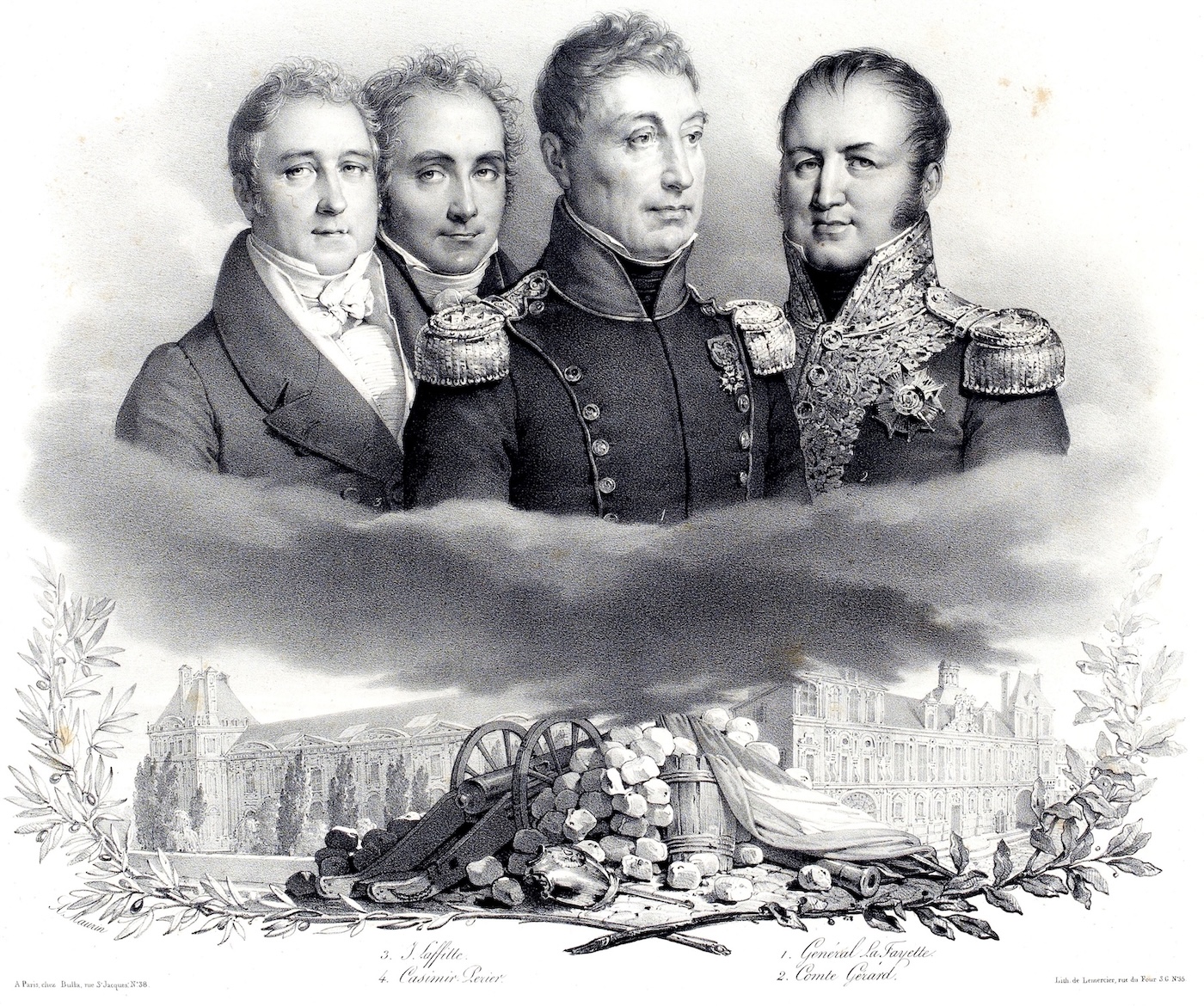
After Nicolas Eustache Maurin, engraving of (left to right) Jacques Laffitte, Casimir Périer, General Gilbert du Motier de Lafayette, and General Étienne Gérard, over scenes of the July Revolution, circa 1830. Public domain via Wikimedia Commons.

The Laffitte Ministry
In November of 1830, King Louis-Philippe turned to the 63-year-old Laffitte to form a new government as prime minister. This was not an easy assignment. After just one month on the job, Laffitte had to deal with the trial of Charles X’s ministers, as I covered in Episode 49. This crisis could have brought down the regime. It did bring down General Lafayette, France’s most prominent left-wing leader — he was forced out of his job as commander of the French National Guard the moment the dust settled. But Laffitte — who had tried to keep Lafayette from resigning27 — was still in charge.
 In charge, perhaps, but Laffitte was in a precarious position. It was increasingly clear that a majority of the Chamber of Deputies was of a conservative, Resistance bent. Moreover, for all that Laffitte was a leading figure of the Movement, many of the ministers under him were further to the right — especially as the months passed and individual ministers were replaced for one reason or another. For example, the progressive Minister of Justice, Jacques-Charles Dupont de l’Eure, resigned in protest at his friend Lafayette’s dismissal. Dupont’s replacement Joseph Merilhou was a fellow progressive, but one without Dupont’s fame and stature. On the other side, the new Minister of the Marine was the Comte d’Argout, a conservative. The new Minister of War was Marshal Jean-de-Dieu Soult, a famed Napoleonic commander. Soult wasn’t dogmatic in his politics, but he did believe firmly in discipline and order, which historian Hugh Collingham notes wryly that Soult imposed “with an efficiency he had not always shown on the battlefield.” To Laffitte, it seemed like d’Argout and Soult were his “supervisors much more than his colleagues.”28
Above: Unknown artist, drawing of Joseph Mérilhou, 1835. Public domain via Wikimedia Commons. Below: Unknown artist, drawing of Odilon Barrot, circa 1830s. Public domain via Wikimedia Commons.
 The most important Movement figures in the government weren’t ministers, but prefects: Odilon Barrot as Prefect of the Seine, the department that included Paris, and the newspaper editor-turned-revolutionary Jacques Baude as Prefect of Police. These two men ostensibly reported to the more conservative Comte de Montalivet at the Interior Ministry, but they often ignored or even countermanded Montalivet’s orders. The more conservative figures inside Laffitte’s ministry wanted to deal with disorder on the streets with a firm hand: bans, investigations, criminal charges, and shows of force aimed at anyone fomenting dissent or conspiracy. Barrot and Baude, in contrast, while not radicals themselves, sympathized with people turning out onto the streets to demand political rights. Where the Resistance looked at street protests and saw the specter of the Reign of Terror, Barrot believed the French people were benevolent liberals at heart.29
Now you may be wondering, if parliament was dominated by the Resistance and Laffitte was part of the Movement, then why was he prime minister?
The answer is not simply because the king had appointed him. All these men had lived through the political crisis of 1830, sparked by a king’s attempt to keep a prime minister that parliament didn’t support. From Louis-Philippe on down, everyone in the July Monarchy’s political establishment was determined to not repeat that blunder.30
 No, Laffitte was still prime minister because parliament was supporting him — despite disagreeing with many of his policies. All these Resistance deputies thought that in the aftermath of the revolution, they had no choice but to accommodate the demands of the crowds, or at the very least to not overtly antagonize the crowds. Laffitte had connections with left-wing leaders and was popular among the ordinary working Parisians who were liable to start throwing up barricades if things went south. Keeping him as prime minister, many conservatives thought, was a way to appease these potentially revolutionary factions and prevent future disorders.31 Everyone knew that in 1789, the storming of the Bastille had been sparked by King Louis XVI firing his popular finance minister, Jacques Necker. The Resistance deputies did not want the firing of finance minister Jacques Laffitte to spark a similar uprising.
Above: After Joseph-Siffred Duplessis, portrait of Jacques Necker, circa 1781. Public domain via Wikimedia Commons.
So Laffitte endured with the reluctant support of parliament. He became prime minister in November 1830, and almost immediately was faced with the crisis of the Trial of the Ministers that I covered in Episode 49. As we saw, that crisis concluded “without a shot fired or a barricade raised,” and with the reliability of the National Guard reinforced. On December 30, the Journal des Débats newspaper declared that the revolution had finally ended.32
As it happened, this victory had not meant an end to the unrest in the streets of Paris. But lots of people thought it had at the time — or at least hoped it had. And so while law and order will end up being the defining issue of Jacques Laffitte’s ministry, he spent much of his time in power trying to pass laws to fulfill the promises of the July Revolution.
Nice policies
In some cases, those “promises” were literal. In Episode 47 I discussed Article 69 of the revised Charter of Government — a tacked-on article at the end which promised that new laws would be swiftly passed on nine different topics, including re-organizing the French National Guard, setting up some form of local government, and reforming national elections. France’s new regime generally took these promises seriously, and action was taken on many of them while Laffitte was prime minister.
,_mar%C3%A9chal_de_France.jpg) For example, under Laffitte, France passed a new law organizing the French National Guard. I talked about that bill briefly in Episode 49, because its provision barring one man from overseeing the entire country’s National Guard was the weapon conservatives used to maneuver Lafayette out of power. But this was a real law that did lots of other things besides serve as a political cudgel. The National Guard had been dissolved for years, and had to be reconstituted for a new regime. The new law set out who could be an active member of the Guard, put them under the civilian authority of mayors and prefects, and forbade Guard units from debating public policy — it being seen as dangerous for military units to take official positions on political issues. The law also carefully tried to delicately back away from the open-door policy the National Guards had had immediately after the July Revolution. In theory, all French men between 20 and 60 were members of the National Guard, but the law shunted most of these men into the reserves. The “active” National Guard required people with the time to spend on drills and the money to equip themselves. As a result, there were around 3.5 million eligible active Guardsmen — about 20 times larger than the 166,000 or so eligible voters, but one-third the size of the roughly 10 million adult French men.33
For example, under Laffitte, France passed a new law organizing the French National Guard. I talked about that bill briefly in Episode 49, because its provision barring one man from overseeing the entire country’s National Guard was the weapon conservatives used to maneuver Lafayette out of power. But this was a real law that did lots of other things besides serve as a political cudgel. The National Guard had been dissolved for years, and had to be reconstituted for a new regime. The new law set out who could be an active member of the Guard, put them under the civilian authority of mayors and prefects, and forbade Guard units from debating public policy — it being seen as dangerous for military units to take official positions on political issues. The law also carefully tried to delicately back away from the open-door policy the National Guards had had immediately after the July Revolution. In theory, all French men between 20 and 60 were members of the National Guard, but the law shunted most of these men into the reserves. The “active” National Guard required people with the time to spend on drills and the money to equip themselves. As a result, there were around 3.5 million eligible active Guardsmen — about 20 times larger than the 166,000 or so eligible voters, but one-third the size of the roughly 10 million adult French men.33
Above: Ary Scheffer, portrait of Marshal Georges Mouton, Comte de Lobau, 1835. Public domain via Wikimedia Commons.
That said, the clause barring an overall commander of the French National Guard was never anything more than simple politics. After Lafayette resigned, his immediate replacement was the liberal but considerably less radical General Georges Mouton, Comte de Lobau. Once Mouton was in charge, the lawmakers thought things over and decided that actually, it was perfectly okay for one man to command the entire French National Guard; they repealed the ban.34
Laffitte’s ministry also took the lead in perhaps the most important post-revolutionary reform: the new electoral law I discussed in Episode 47. This law loosened the requirements to vote and hold office from what they had been under the Restoration — but only by a little. Voters had to be 25 years old instead of 30, for example, and they had to pay 200 francs in direct taxes instead of 300 francs. The July Monarchy also created a relatively small group of exceptions, men who didn’t meet the wealth requirements but were granted the vote by virtue of other achievements, such as being members of Institute of France, the national scientific society. The overall electorate more than doubled, from about 1% of adult males in the Restoration to perhaps 2.5% in the July Monarchy. I mention this only briefly because while Laffitte’s government introduced this law, it wasn’t passed until after he left office.35
But Laffitte’s government did successfully pass another important electoral law: one governing local elections. This was also one of the Article 69 promises, and it had the potential to be thorny. Anything dealing with voting rights was inherently high stakes, of course, but you might also remember from Episode 33 that a local government bill had been the issue that undid the Martignac ministry back in 1829. As we’ll see, radicals dismissed the 1831 local government law as too timid, and conservatives thought it went too far — the Laffitte ministry in microcosm.
In essence, the law set up elected local governments, replacing the Restoration’s system of royally appointed local governments. What made it especially interesting, though, was that the July Monarchy set the voting requirements for these local elections much lower than they did voting in national elections.
The total size of each town’s electorate was set at 10% or more of its population, and men 21 and older were chosen in order of wealth until this threshold was reached. All in all, around 30% of all adult French men had the right to vote in local elections —
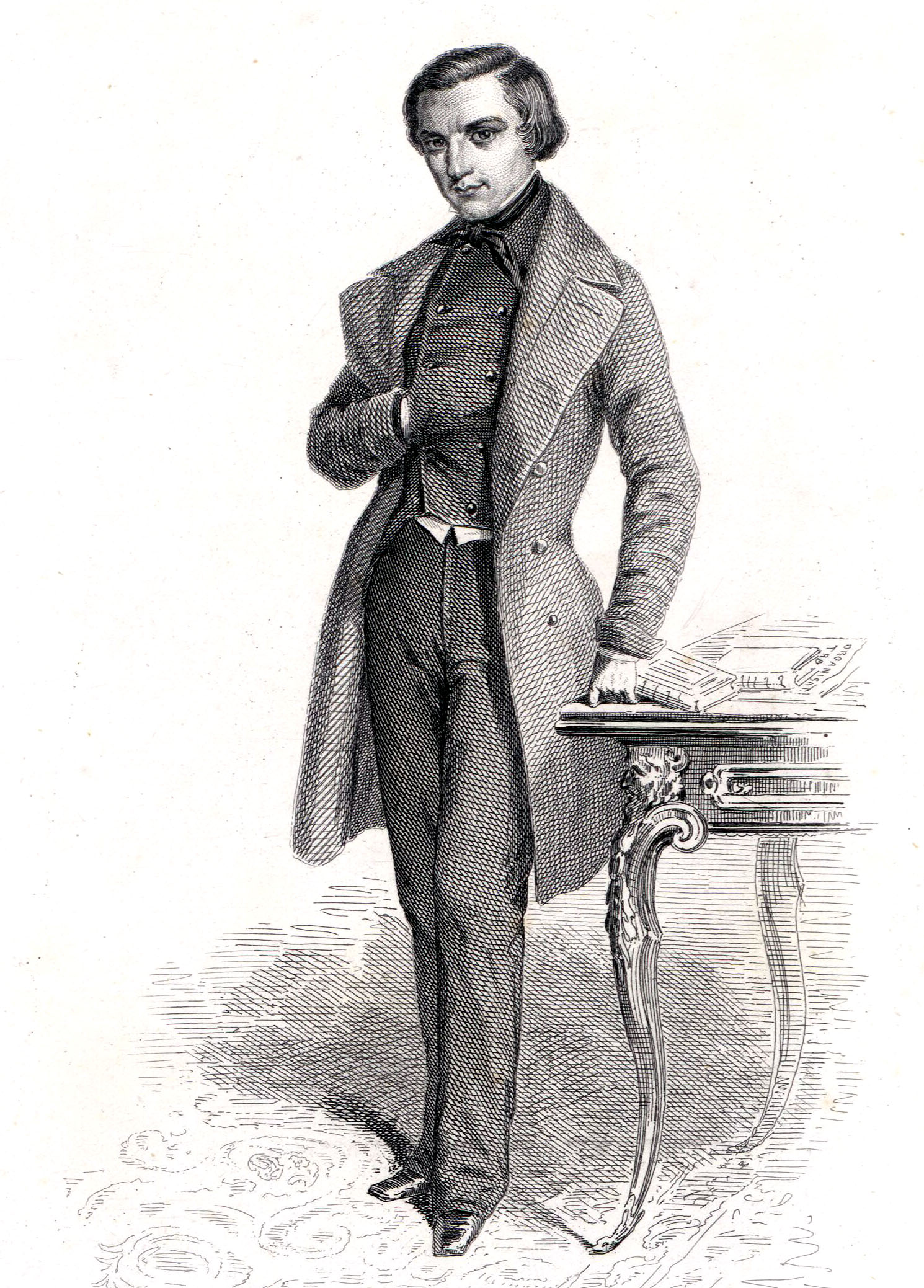 Adult men who were among the richest 10% or more of all a town’s residents were allowed to vote for these councils — 10 times larger than the national electorate. Like the national bill, there were also exceptions who were granted the right to vote even if they didn’t pay enough taxes, but this pool of local exceptions was broader — officers of the National Guard, practicing lawyers, doctors, retired civil servants, and Justices of Peace were all granted local votes.36
Right: Jules Rebel, drawing of Louis Blanc, circa 1848. Public domain via Wikimedia Commons.

The contemporary socialist historian Louis Blanc sneered that this somewhat expanded electoral system was “an assembly of notables, elected by another assembly of notables,” nothing more than “little bourgeois oligarchies.”37 But conservatives thought it went too far — or at least, farther than they preferred. Montalivet said it went “beyond even the most stringent demands” and that it “establishes — or nearly establishes — universal suffrage.” Another conservative said he supported it only with “some hesitation” and that he and others were already contemplating having to strip away this expanded local franchise “should the outcome fail to meet our expectations.”38
We’ll talk a lot more about voting and the electoral franchise in future episodes. For today, I think it’s worth noting that it was Laffitte’s ministry that pushed the conservative deputies into giving far more Frenchmen the right to vote in local elections than they would have preferred.
“The greatest act of justice in favor of the Jews”
Another major Laffitte policy — not one of the Article 69 promises — concerned religious affairs. As we’ve seen, especially in Episode 27, the Bourbon Restoration had openly supported the Catholic Church, while granting legal freedom of religion to members of all faiths. As a compromise, the 1814 charter had also agreed that Protestant ministers would also receive legal recognition and have their salaries paid by the state: “the ministers of the catholic, apostolic and Roman religion, and those of the other Christian sects alone receive stipends from the royal treasury.” In Episode 47, I discussed how the 1830 revisions to the Charter added the phrase calling Catholicism “the religion of the majority of Frenchmen” instead of “the religion of the state.” But that article of the Charter received another change I didn’t mention: in the clause saying that the state would pay the salaries of leaders “of the other Christian sects alone,” the word “alone” was struck. This wasn’t an accident. It came following a request from leaders of France’s Jewish community.39
The 1789 French Revolution had led to the abolition of most of France’s old anti-Jewish laws. But the revolutionaries had only emancipated Jews as individuals. Jewish religious communities were treated differently from those of Catholics and even Protestants, which many French Jews “saw as evidence that they were second-class citizens who still had to achieve full emancipation.” Special quasi-governmental groups of Jews, called “consistories,” oversaw public affairs of local Jewish communities, including collecting taxes just from the Jewish community to pay rabbis and cantors. Now, with the more liberal July Monarchy in power, many Jewish leaders saw an opportunity to change this.40
Eliminating the word “only” from the Charter opened the door to taxpayer funding for Jewish rabbis, but it didn’t implement it. Louis-Philippe, shortly before becoming king, had met with Jewish leaders and pledged his support: “I promise you a special law that will do justice to your just claim.” That task fell to the Laffitte ministry. The bill to pay rabbinical salaries was introduced on November 13, just over a week after Laffitte took office. It faced “spirited” opposition, especially in the Chamber of Peers, where Laffitte’s minister of public instruction and religion felt “compelled” to defend the bill at length, “extolling the Jewish genius and invoking the famous Jewish philosophers Philo, Maimonides, and Mendelssohn.” With this forceful government backing, the law passed 89 to 57, and Louis-Philippe gave it royal assent on February 8, 1831.41
Contemporary Jewish leaders described this law as “a great event in Jewish history.” One Jewish writer called Louis-Philippe “the first constitutional King of France, when tolerance became a truth”; while the Chief Rabbi of Metz said the law was “the greatest act of justice in favor of the Jews since the destruction of the Second Temple.”42
I will note that while Laffitte’s ministry saw this law passed, it did have the personal support of Louis-Philippe, as well as backing from more conservative Resistance leaders like Victor de Broglie and the Comte de Molé.43 So another ministry might very well have passed this law. But then again, maybe not. Laffitte was the one who got it done.
An inclination to draw near the people
All these were important laws. But none of them are what has come to define Laffitte’s ministry in the public eye — then or since. Instead, Laffitte’s ministry would be consumed by a single overriding issue, one we began this episode with: What exactly was the July Revolution?
That is, was the July Revolution’s work still unfinished, or had it gone quite far enough? Or even more simply: Movement, or Resistance? Significant shares of the French population thought more reforms were needed, and were aggressively working to promote them — including by petitions, protests, demonstrations, and in some cases by actual or threatened street violence. Another significant share of the population just wanted things to calm down again.
Caught in the middle was Jacques Laffitte, who was neither as committed to reform as the radicals wanted, nor as committed to maintaining order at all costs as the conservatives wanted.
Laffitte’s position is captured well by a speech he gave to the Chamber of Deputies in the middle of the Trial of the Ministers — a moment where there was a genuine possibility of a new revolution in the streets. In the speech, we see Laffitte trying to gesture to both sides of the debate. As prime minister, Laffitte said, he was committed to upholding both “the laws” and “public liberties.” He insisted that “a government that fails to enforce the laws is derelict in its most essential duties” and promised that his government would do this “to the very fullest extent.” He also said he trusted “the brave and magnanimous people of Paris” and was convinced that the people as a whole were defenders of public order, not a threat to it. Any threats, he said, came from agitators, and were in any case “exaggerated” — but he promised to respond to those “exaggerated” threats as if they were real.44
One view of Laffitte is that he basically agreed with the more conservative Resistance types on policy. For example, the contemporary republican writer Louis Blanc said that Laffitte “did not differ essentially in opinion from the majority of the chamber,” but that he did differ in temperament: instead of sternness, Laffitte had “an honorable inclination to draw near to the people, to serve its cause timidly, and to merit its esteem.” “For this,” Blanc added wryly, “he was not forgiven.”45
Many conservatives had a similar view of Laffitte. He shared their goals — but was too weak, soft, and indecisive. As modern historian Hugh Collingham phrased it, he “had disapproved of riots but had tolerated them.” Worse than Laffitte for these men, arguably, were the other figures he appointed in his ministry, like Barrot and Baude, who were neglecting their supposed responsibility to maintain order in the streets.
This was a lot to stomach for the Resistance deputies sustaining Laffitte’s government. After all, no one likes appeasement. It’s something you do if you think you have no other choice. In the heady months after the July Revolution, many Resistance deputies thought they had no other choice than to tolerate a Movement figure like Laffitte. But as the July Monarchy slowly stabilized, these conservatives became less willing to endure concessions. In December 1830, they purged Lafayette after concluding he was no longer indispensable.46 How much longer would Jacques Laffitte survive?
Altars overturned
All this brings us to February 1831, the second great showdown on the streets of Laffitte’s premiership. But this particular confrontation will play out very differently than the Trial of the Ministers in December 1830.
Our action unfolds on February 14. For modern Americans, February 14 is notable primarily as Valentine’s Day. But for a key group of French people in 1831, February 14 had much more recent implications: it was on this date in 1820 that the Duc de Berry, son of the future King Charles X, died after being stabbed outside the Paris Opera. I talked about this in Episode 14. Throughout the rest of the Bourbon Restoration, February 14 had been marked by religious services commemorating the Duc de Berry. That was all normal and to be expected when Berry’s uncle and then father had been on the throne. But Legitimists wanted to carry through with the commemorations in February 1831, under the July Monarchy. This was provocative enough in itself — but besides being a martyr, the Duc de Berry was also the posthumous father of Henri, the “miracle child” who many Legitimists recognized as the rightful King of France. I covered that in Episode 15.
 With all that in mind, Montalivet blocked the initial proposal to hold the ceremony at a church in central Paris. But the organizers of the Berry memorial managed to reconvene at a nearby church, Saint-Germain l’Auxerrois, by the Louvre. The parade of aristocratic carriages arriving at this church soon encountered onlookers, and before too long the growing crowds realized what was going on inside. Anti-Bourbon sentiment was still strong on the streets of Paris, but nothing happened until after the ceremony ended, when one of the attendees laid a portrait of Henri by the altar. When word of that reached the crowd, what had been a gathering almost instantly became a riot. Parisians smashed their way into the church and sacked it: “Altars were overturned, paintings slashed, statues and stained glass shattered and the cross on the roof torn off; some pranced through the streets in holy vestments.”47
Above: Claude Monet, painting of Saint-Germain-l’Auxerrois Paris, 1867. Public domain via Wikimedia Commons.
National Guards quickly assembled, and helped escort the attendees and clergy to safety. But the Guards took no action to stop the damage to church property. Unimpeded, the rioters kept going, turning their anger on the palace of the Archbishop of Paris, Hyacinthe-Louis de Quélen — a notorious Legitimist. Furniture, artifacts, and even the books from de Quélen’s extensive library were hurled into the Seine. The crowd was so dedicated to this sacking that rioters prevented some bibliophiles from trying to rescue books from the river.48 So with all this destruction, why did the National Guard — so vigorous just a few months earlier during the Trial of the Ministers — do nothing?
 In fact, far from being simply passive, the Guards were actively ordered to stand down. Which means it’s time again to talk about one of the most fascinating figures of this era, Adolphe Thiers.
Right: Tony Goutière, “Sketch of a young Adolphe Thiers.” Public domain via Wikimedia Commons.
The 33-year-old journalist had played a key role in the July Revolution, including writing the journalists’ protest of the Four Ordinances, persuading Louis-Philippe’s sister Adélaïde to support her brother’s bid for the throne, and writing Orléanist pamphlets. Afterwards, he had been elected to parliament despite having a fairly modest income that wouldn’t ordinarily qualify him to serve — even with the July Monarchy’s loosened requirements.49 But Thiers found a workaround via a wealthy patron, who worked out a sweetheart deal to “sell” Thiers a mansion whose property taxes met the voting qualifications. Just weeks after taking office in October 1830, Thiers was offered a job as Minister of Finance in the new Laffitte ministry. He declined this offer, figuring that he had been offered the post in part because he was expendable. But Thiers did agree to take a job as under-secretary in the department, where he would in effect run the ministry while the official finance minister, Laffitte, ran the country.50
So when Thiers showed up at the riot in progress, it was as the Under-Secretary of Finance and assistant to the prime minister. He found a National Guard commander about to order his men forward to suppress the riot, and Thiers told the officer to stop.51
According to Thiers’ friend Charles de Rémusat, who talked about the incident with him the next day, Thiers had been “profoundly struck by the irresistible speed with which this monumental act of destruction had been carried out.” With France still facing the threat of foreign war, Thiers told Rémusat, perhaps what France needed was to co-opt the energy of the crowds to defend the regime, not put the crowds down. “The sight of force… never leaves him unmoved,” Rémusat wrote of his friend. “His immediate second thought is not to resist it, but to seize it for himself.”52
Churches across Paris were damaged during these un-suppressed riots. But despite the efforts of republican agitators, the anti-clerical mobs never turned their anger on the government. Perhaps, historian Hugh Collingham notes, Thiers and others “were wise to not associate themselves with the unpopular Church.” Indeed, even many of the Resistance deputies were strongly anticlerical. This was no longer the Bourbon Restoration; the mass of conservatives increasingly dominating the July Monarchy were not Legitimists, and not defenders of the “alliance of throne and altar,” and many frankly thought the Church kind of had it coming. Guizot was furious about the unchecked riot, but had also declared that the July Revolution had “dethroned” the priests as well as the Bourbons. The Journal des Débats recounted the riot in the tone of “an amused spectator,” and Montalivet had the official Moniteur newspaper write that the people had been “carried away by a legitimate indignation.” The government paid no compensation to the Church for any of the damages.53
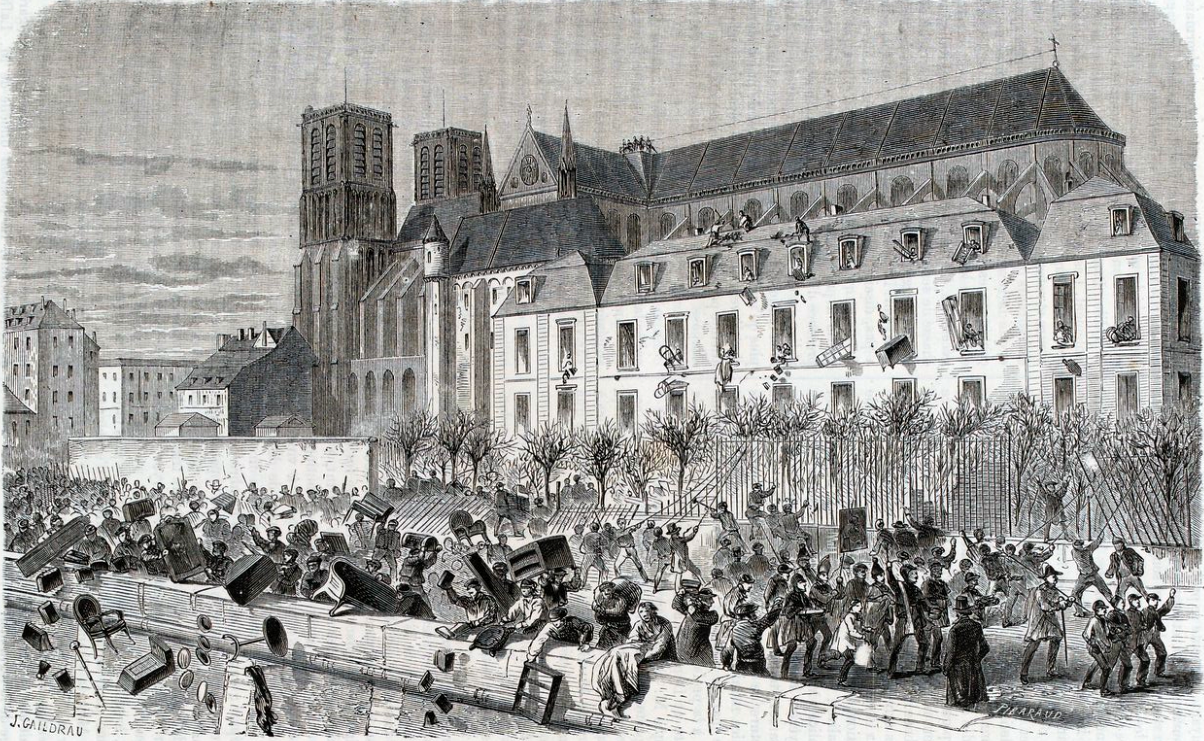
Above: Jules Gaildrau, Sacking of the Archbishop’s Palace (February 15, 1831), in Victor Duruy, Histoire populaire contemporaine de la France, vol. 1 (Paris: Ch. Lahure, 1864). Public domain via Bibliothèque Nationale de France.
But even if they may have thought the Church had provoked the riot, the Resistance deputies who dominated parliament were furious about the unrest. The Laffitte ministry had failed to prevent it from happening, and then, even worse, had failed to suppress it once it broke out. To add insult to injury, after the riots started, Laffitte persuaded Louis-Philippe to order that the Bourbon fleurs-de-lys symbols be taken down all across Paris, lest they provoke more popular anger. Figures as ideologically diverse as Lafayette and Périer both recoiled in disgust: If the fleurs-de-lys had survived a revolution, it seemed humiliating to banish it after a mere riot. The entire affair seemed to confirm every suspicion that the Resistance had about Laffitte and the Movement: that they were too weak and too sympathetic to the mob to be trusted to properly govern France.54
Jacques the Bankrupt
Even as his political fortunes dwindled, Laffitte’s actual fortune was doing the same. Because the thing about big bets is that while sometimes you win big, sometimes you lose big. And for several years Laffitte and Company had been losing.
It wasn’t one bad bet but a whole series of calamities all at once that brought down the man who had once been among the richest in France:
- Laffitte was heavily invested in Paris real estate during the 1820s, when the city was expanding rapidly. But this turned out to be a housing bubble that burst in 1825, causing widespread losses.
- In 1825, France coerced its former colony of Haiti into paying 150 million francs in reparations in return for France recognizing its independence. Haiti did not have that money, so it paid the reparations by taking out a loan from French banks — the Laffitte bank first among them. But as I recounted in Episode 36, Haiti defaulted almost immediately on that loan, after just a single payment
- The financial panic of 1825, followed by the widespread recession of the late 1820s, further battered business interests in France. I talked about this in Episode 35
- In 1818 Laffitte had purchased for his own use a 17th Century château for more than one million francs. Four years later he bought for 850,000 francs the spacious Parisian townhome on the Rue d’Artois from which he would coordinate the deputies’ response to the July Revolution. And in 1826 Laffitte bought the Forest of Breteuil for 5 million francs. The castle and forest both featured deferred payments that came due in the late 1820s — right as everything else was hitting his finances.
- On top of all of that, the chaos of the July Revolution upended the French economy — a sharp, final blow to Laffitte’s tottering finances.55
Out of gratitude to Laffitte, and to avoid the embarrassment of a bankruptcy, Louis-Philippe had given Laffitte a bailout after coming to power: He agreed to buy the Forest of Breteuil from him, at the inflated price of 10 million francs — twice what Laffitte had paid for it. This cash infusion helped stabilize Laffitte’s bank — but only insofar as it enabled affairs to be wound down in an orderly fashion, rather than a panicked collapse. On January 29, 1831, the bank owned by the French prime minister went into liquidation. Because he was preoccupied with affairs of state, Laffitte wasn’t able to tend to even this catastrophe himself — his nephew was put in charge of the bankruptcy. As he struggled to save his ministry, Parisian jokesters referred to Laffitte as “Jacques Laffaillitte” — Jacques the Bankrupt.56
From Movement to Resistance
After the February riots, the debate among the Resistance deputies was not so much whether to bring down Laffitte but when. François Guizot tried to organize deputies to attack the ministry, while Périer preached patience — partly because the middle of domestic unrest and foreign threats was “hardly the moment to provoke a ministerial crisis,” and partly because he thought Laffitte needed to twist in the wind longer, until “all cried out for order to be imposed.”57 Laffitte survived this crisis, but Odilon Barrot was forced to resign as Prefect of the Seine for his failure to maintain order.
No formal “vote of no confidence” had taken place, but it was clear to all observers that Jacques Laffitte no longer had support from a majority of the Chamber of Deputies. Either Laffitte or the Chamber needed to go.
Laffitte, at last, was spurred into aggressive action. Instead of trying to sooth Resistance concerns, he punched back. In a speech almost certainly written by Thiers, Laffitte told parliament that it was time to stay the course, and attacked Resistance policies as so unpopular they could only be implemented by using bayonets against the people. Laffitte called for dissolving parliament and holding new elections — elections he intended to fight in alliance with the Left.58
In a modern constitutional monarchy like the United Kingdom, a prime minister could simply do this. In France’s July Monarchy, as we saw in Episode 48, King Louis-Philippe had to be on board. And by all accounts the king did seriously consider Laffitte’s proposal. But only briefly. Louis-Philippe wasn’t fully on-board with the Resistance, but he was even less willing to get fully on board with the Movement.59
Things lingered uncomfortably for a few weeks. The ministry was effectively already dead, but no one wanted to make the first move. Laffitte didn’t want to resign. The other members of the ministry didn’t want to force him out. And Louis-Philippe, as he almost always did, hesitated before a decisive choice. As Rémusat said of the king: “To converse with everyone while postponing every decision for as long as possible — such was his strategy during ministerial crises.”60
But the stalemate could only endure for so long. The final blow came not over issues of public order, but of foreign policy.
Quitting time
I’ve been focusing mostly on domestic policy for now, but foreign policy has been a huge issue during this entire time, in ways that are connected to France’s domestic disputes.
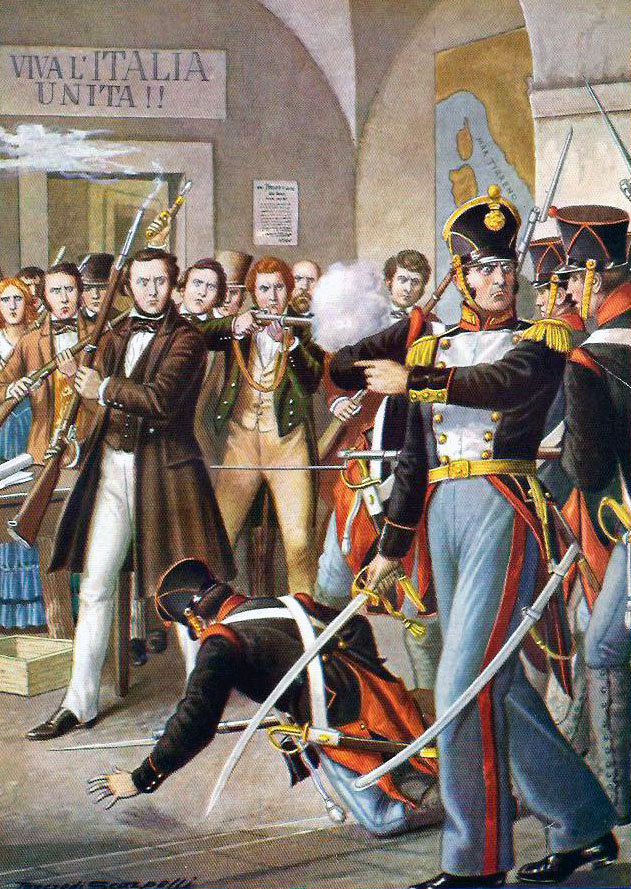 Besides the question of foreign recognition of France’s revolutionary government, which I mentioned in Episode 47, Europe was embroiled by several copycat revolutions in 1831. One was the ongoing Belgian Revolution, which I talked about in Episode 49. There was also a revolt in Poland, against the Poles’ Russian overlords, and a series of revolts in Italy. I’ll talk more about both conflicts soon, but for now the important thing to know is that Europe’s reactionary powers were trying to suppress the Polish and Italian revolts — and France was debating whether to let them.
Right: Tancredi Scarpelli, the February 3, 1831 arrest of the Modena revolutionary Ciro Menotti, 1932. Public domain via Wikimedia Commons.

In general, the Movement was supportive of an aggressive foreign policy, especially one in support of foreign revolutions. People like Lafayette thought France should stand up for liberty, even if that meant risking war with Russia or Austria. In contrast, the Resistance was much more skeptical of foreign intervention. Its leaders were not necessarily peace-at-any-cost types, but they definitely didn’t want to risk war standing up for rebels in some other country.61
Crucially for Laffitte, on the question of foreign policy, King Louis-Philippe was firmly in the anti-war camp. Laffitte himself wasn’t especially concerned with foreign policy, and mostly let Louis-Philippe do what he wanted with foreign rulers — an arrangement that the king liked just fine.62
But in the spring of 1831 France’s ambassador to Austria sent a letter to Louis-Philippe asking for permission to warn the Austrians against invading the small Duchy of Modena to suppress the rebels there. Louis-Philippe and his foreign minister Horace Sébastiani declined to do so. While they didn’t necessarily want Austria to expand her influence over Italy, neither Louis-Philippe nor Sébastiani were prepared to start a great-power war over an insignificant country like Modena. But crucially, the two men also decided not to tell Laffitte about the note. If Laffitte knew about the note, he might be tempted to leak it to the press — throwing fuel on the fires of war that were simmering on the streets of Paris.63
Their precautions were for naught, though: Laffitte found out about the note anyway. Armed with the ambassador’s request, Laffitte convened a cabinet meeting and demanded that France issue the ultimatum to Austria. There was a vigorous debate — and Laffitte lost. Louis-Philippe and most of the cabinet refused to support such an aggressive move. In response, Laffitte offered his resignation on March 12, 1831, and Louis-Philippe accepted it.64
Where historians differ is how we should interpret this showdown over the Modena ultimatum. Some historians describe it as a scheme by the king, such as Louis-Philippe’s biographer Munro Price: “Deciding that Laffitte had outlived his usefulness, Louis-Philippe maneuvered him into resignation over a minor matter of foreign policy,” Price wrote. Others identify Laffitte as the one making maneuvers, such as Hugh Collingham, who says a boxed-in Laffitte was seeking an excuse to resign. Rather than resigning because he had lost the support of parliament, in other words, Laffitte could claim the moral high ground and resign over “royal usurpation of ministerial authority.” You can’t fire me, I quit.65
Or maybe both interpretations are true: two men simultaneously seizing a chance to end a failed partnership on their own terms. The important thing is it happened. Jacques Laffitte had resigned. And to replace him, the king intended to turn to the Party of Resistance.
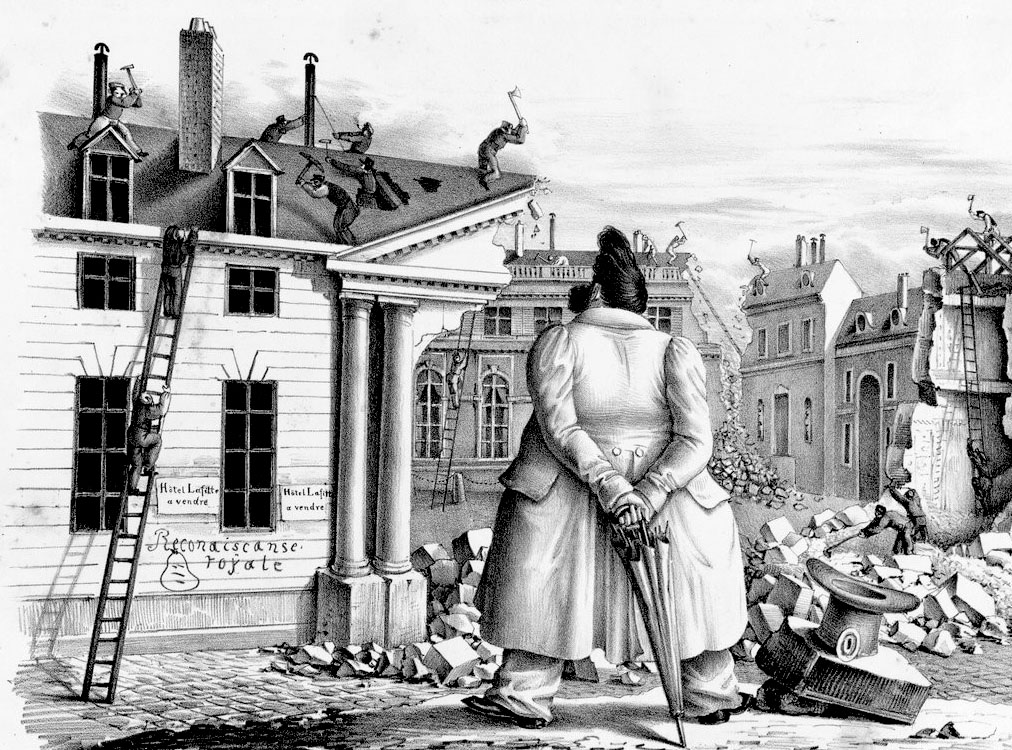
Unknown artist, “Hôtel Lafitte [sic],” published in Le Charivari, December 28, 1833. This caricature shows Louis-Philippe looking on as Jacques Laffitte’s house is destroyed by a team of workmen; graffiti on the wall reads “Reconaiscanse royale” [sic]. While the bankrupt Laffitte did put his Parisian townhouse up for sale, it still stands today; the destruction shown here is purely metaphorical for Laffitte’s personal and political downfall. Public domain via Wikimedia Commons.
.jpg)
Enter Périer
There was one man who seemed like the obvious choice to lead a new Resistance ministry in 1831: the stern, forceful Casimir Périer.
We saw Périer at the start of this episode, allegedly saying that the July Revolution hadn’t been a revolution at all, merely “a simple change in the person of the head of state.” In past episodes, we saw how Périer was uneasy about the July Revolution from the beginning, urging fellow deputies against violent resistance in Episode 43 and serving as a conservative member of the revolutionary Municipal Commission. In Episode 45, Périer was one of the politicians who Charles X was persuaded to belatedly appoint to the stillborn Mortemart ministry, which says a lot about Périer’s reputation: a royalist liberal who might be acceptable to both Charles and the opposition. In Episode 49, Périer was a minister-without-portfolio in Louis-Philippe’s first dysfunctional unity government, and resigned with the other conservatives in October 1830, after a mob marched to Vincennes to try to lynch Charles’s former ministers.
Early on in the July Monarchy, Périer had been elected as president of the Chamber of Deputies, a clear sign that he was in sync with the Resistance deputies who dominated the chamber. Though he and Laffitte were both bankers, they had very different personal styles. Laffitte had risen from rags to riches on the basis of big bets and chummy deals; money flowed as easily into his coffers as it flowed out. Périer had been born into money, had taken a big fortune and made it bigger; he had a cold, frugal demeanor like he was counting every franc. As Louis Blanc put it, “he took immense pride in doing little things.”66
But Périer wasn’t sure if he wanted to do a big thing: become France’s prime minister. When the king sounded him out, Périer complained about being asked to be the king’s hatchet-man: “now that it cannot be done without dirtying one’s hands, you want me to take it up!” He also felt a fatalistic certainty that the job would kill him, saying, “I will leave the ministry feet first.”67
For his part, Louis-Philippe had some doubts about Périer, too. Under the easy-going Laffitte, the king had been able to take a leading political role, especially in foreign policy. But Périer, the lover of little things, was not going to be so lax. If he was going to be prime minister, he insisted that he would run the whole government. This was a bitter pill for such a politically involved king to swallow. And frankly, Louis-Philippe didn’t get along well with Périer personally, saying Périer was impressive, but “had a narrow mind,” with “the soul of a banker, weighed down to earth like an iron chest.”68
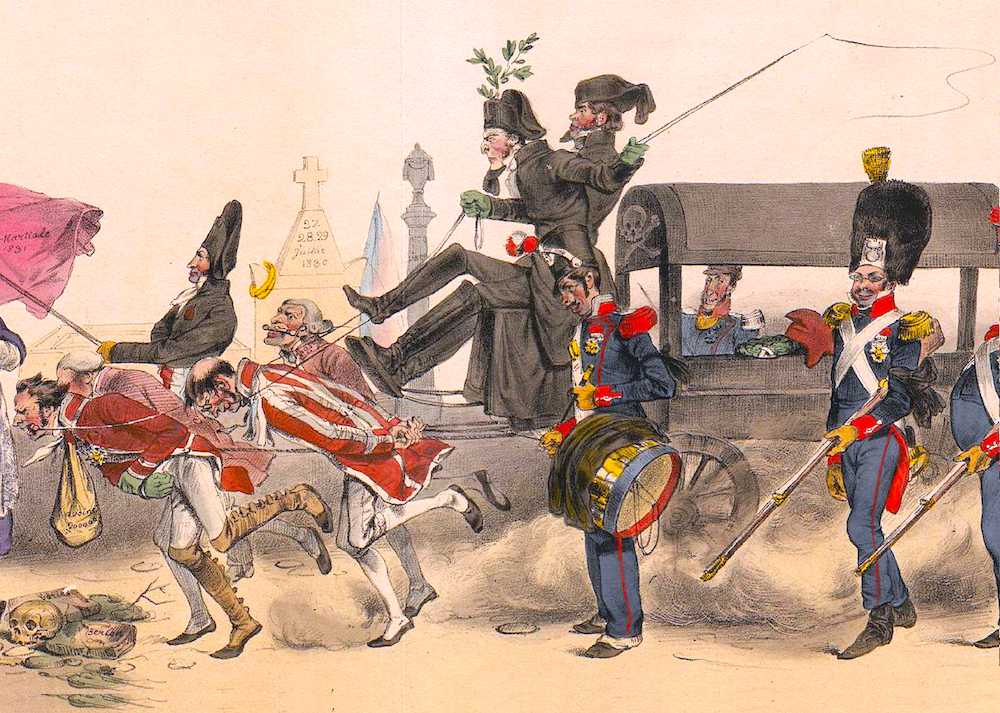
Above: Jean-Jacques Grandville, detail from an untitled caricature published in La Caricature, in which Casimir Périer rides atop a funeral hearse, containing Liberty, using a bullwhip to propel a team of harnessed men labeled with the names of French newspapers (Le Messager, Le Temps, Le Moniteur, Les [Journal des] Débats), 1831. Public domain via Paris Musée.
In the end, though, the force of events was enough to get past both men’s misgivings. Périer sincerely believed that the spirit of revolution needed to be exterminated in France, and he browbeat Louis-Philippe into accepting his terms. Then he took office as Interior Minister and prime minister, and immediately got to work.69
His first task was firing a lot of people. France was in a mess because of weak or radical public servants, he thought, and Périer meant to purge them in favor of good conservatives. Any vestiges of a post-revolutionary unity government were now gone, as Movement officials were pushed out of jobs as sub-prefects, mayors, military commanders and more. Périer’s administration would be “an arm of the [Resistance Party].” Périer took this work personally; declaring in a cabinet meeting, “Let us go and fight these scoundrels” — and doubled down when the more liberal-minded Duke Victor de Broglie suggested that perhaps it was fairer to call the French Left “adversaries.”70 And if this is how Périer thinks of Orléanist elites, you can imagine how he’s going to respond to protesters or rioters.
But that will have to wait for another day. Casimir Périer’s ministry is going to be extremely significant and includes some of the most famous events of the July Monarchy. He’ll get his due, and then some.
Instead, let’s close by returning to Jacques Laffitte. After resigning as prime minister, Laffitte spent some time rebuilding his shattered business. This took many years, but by 1837 he was back with a new bank that tried to democratize credit by offering loans to poorer Frenchmen. Laffitte also remained in politics, and he didn’t merely go into the opposition — Laffitte abandoned the cautious moderation of his actual ministry and swung hard to the left. Regretting his considerable role in creating the July Monarchy, Laffitte would team up with Lafayette to be standard-bearers of constitutional republicanism.71
Next time, we’re going to put one more piece onto the board before diving into the momentous Périer ministry. Because though Casimir Périer has vanquished Jacques Laffitte to take over as Louis-Philippe’s chief minister, he’s got other rivals for the king’s ear — and these particular “scoundrels” are already in the palace. Join me for Episode 51: The House of Orleans.
-
H.A.C. Collingham, The July Monarchy: A Political History of France, 1830-1848, edited by R.S. Alexander (London and New York: Longman, 1988), 55, 113. David Pinkney, The French Revolution of 1830 (Princeton: Princeton University Press, 1972), 52-3. André Marie Jean Jacques Dupin, Révolution de Juillet, 1830: Son Caractère Légal et Politique […] (Paris: Joubert, 1835), 23. ↩
-
While the phrase “one Bourbon for another” has been commonly used, I was unable to discover its origins. It has been in use for some time; among other sources I found it in a historical novel, Leopold Infeld, Whom the Gods Love: The Story of Evariste Galois (Reston, Va.: The National Council of Teachers of Mathematics, 1948), 139. ↩
-
Robert Tombs, France 1814-1914, Longman History of France (Harlow: Addison Wesley Longman, 1996), 356. ↩
-
Sherman Kent, Electoral Procedure Under Louis Philippe (New Haven: Yale University Press, 1937), 132-9. ↩
-
Kent, Electoral Procedure, 139-40. ↩
-
Kent, Electoral Procedure, 140. Collingham, The July Monarchy, 114. ↩
-
J.P.T. Bury and R.P. Tombs, Thiers, 1797-1877: A Political Life (Boston: Allen and Unwin, 1986), 56-60, 175. That said, the strongest association between Thiers and the Tiers Parti will come in a later incarnation of the party, during the Second Empire. ↩
-
Kent, Electoral Procedure, 141. ↩
-
Dupin, Révolution de Juillet, 22-3. ↩
-
Pamela Pilbeam, The 1830 Revolution in France (New York: St. Martin’s Press, 1991), 151. ↩
-
Achille-Léon-Victor, duc de Broglie, Personal recollections of the late Duc de Broglie, 1785-1820, vol. 2, ed. and trans. Raphael Ledos de Beaufort (London: Ward and Downey, 1887), 352. ↩
-
Barrot, vol. 1, 215. ↩
-
Casimir Périer, “Policies of the July Monarchy, 1831,” in The French Revolution, ed. Paul H. Beik (New York: Walker and Company, 1970), 127-8. ↩
-
Louis Blanc, The History of Ten Years: 1830-1840, vol. 1, translator unknown (London: Chapman and Hall, 1844), 320. ↩
-
Robert Tombs, France 1814-1914 (Harlow: Addison Wesley Longman, 1996), 112-20. ↩
-
Fritz Redlich, “Jacques Laffitte and the Beginnings of Investment Banking in France,” Bulletin of the Business Historical Society 22, no. 4/6 (1948), 141. ↩
-
Louis Chardigny, “Jacques Laffitte,” Revue Des Deux Mondes (1829-1971) 81, no. 3 (1944), 310. ↩
-
Chardigny, “Jacques Laffitte,” 310. ↩
-
Laffitte was expelled from the Jacobin Club as an “aristocrat.” Chardigny, “Jacques Laffitte,” 313. Redlich, “Jacques Laffitte and the Beginnings of Investment Banking in France,” 138-40. Louis-Philippe and the rest of his family was unanimously expelled from the Jacobin Club in 1793 after Louis-Philippe emigrated. François-Alphonse Aulard, La Société des Jacobins, vol. 5 (Paris: Leopold Cerf; Paris: Noblet, 1895), 141-3. ↩
-
Guy Antonetti, “Laffitte (Jacques),” in Les ministres des Finances de la Révolution française au Second Empire (II) (Vincennes: Institut de la gestion publique et du développement économique, 2007). Mark Stokle, The Bankers of Brumaire: The Financiers Behind Napoleon’s Ascent, Ph.D. diss. (Glasgow: University of Glasgow, 2020), 591. Redlich, “Jacques Laffitte and the Beginnings of Investment Banking in France,” 142. ↩
-
Chardigny, “Jacques Laffitte,” 310-1. ↩
-
Redlich, “Jacques Laffitte and the Beginnings of Investment Banking in France,” 142. ↩
-
Chardigny, “Jacques Laffitte,” 313-5. ↩
-
Chardigny, “Jacques Laffitte,” 311. An added personal triumph came from the comparison to his old mentor Perregaux, whose daughter had married Marshal Auguste de Marmont — merely a duke. ↩
-
Redlich, “Jacques Laffitte and the Beginnings of Investment Banking in France,” 146-7. See also Jacques Laffitte, Réflexions sur la réduction de la rente et sur l’état du crédit (Paris: Firmin Ditot, 1824), especially page 16. ↩
-
Chardigny, “Jacques Laffitte,” 314-5. ↩
-
Collingham, The July Monarchy, 40. ↩
-
Collingham, The July Monarchy, 40-1. ↩
-
Pinkney, The French Revolution of 1830, 363-4. Collingham, The July Monarchy, 37, 41. ↩
-
Price, The Perilous Crown, 193. ↩
-
Pinkney, The French Revolution of 1830, 367. ↩
-
Pinkney, The French Revolution of 1830, 365. ↩
-
Price, The Perilous Crown, 213-4. France’s 1831 census reports 15.9 million men of all ages. I have a breakdown of its 1851 census by age and gender, which found 11.2 million men 20 and older out of 17.7 million total men. B.R. Mitchell, ed., European Historical Statistics: 1750-1975, 2nd Rev. Ed. (London: The MacMillan Press Ltd, 1981), 30, 45. ↩
-
Collingham, The July Monarchy, 40. Pinkney, The French Revolution of 1830, 362. ↩
-
Kent, Electoral Procedure, 19-22. Some 95% of all July Monarchy voters got their right to vote the normal way, by owning property. ↩
-
Loi du 21 Mars 1831 sur l’Organization Municipale. Christine Guionnet, L’Apprentissage de la Politique Moderne: Les Élections Municipales sous la Monarchie de Juillet (Paris: L’Harmattan, 1997), 10-11. ↩
-
Blanc, The History of Ten Years, 392. ↩
-
Guionnet, L’Apprentissage de la Politique Moderne, 10-11. ↩
-
Zosa Szajkowski, Jews and the French Revolutions of 1789, 1830 and 1848 (New York: Ktav Publishing House, 1970), 1025-6. ↩
-
Szajkowski, Jews and the French Revolutions of 1789, 1830 and 1848, 1024-5. ↩
-
Solomon Posener, “La Révolution de Juillet et les Israelites de France,” L’Univers Israelite 85:46 (August 15, 1930), 588-9. ↩
-
Note that the Chief Rabbi of Metz who made this comment, Lion Mayer Lambert, made it in 1840, looking back on this law. He was not yet Chief Rabbi of Metz at the time of the law’s passage. Jay R. Berkovitz, The Shaping of Jewish Identity in Nineteenth-Century France (Detroit: Wayne State University Press, 2018), 178. Szajkowski, Jews and the French Revolutions of 1789, 1830 and 1848, 1026-7. ↩
-
Broglie, Personal recollections, vol. 2, 445. Le Moniteur universel, February 2, 1831, 220-1. Accessed via Bibliothèque nationale de France. ↩
-
Le Moniteur universel, December 21, 1830, 1777-8. Accessed via Bibliothèque nationale de France. ↩
-
Blanc, The History of Ten Years, 403. ↩
-
See Episode 49. ↩
-
Collingham, The July Monarchy, 42. ↩
-
Collingham, The July Monarchy, 42. ↩
-
Loosened requirements that Thiers had in fact helped to write. Collingham, The July Monarchy, 70. ↩
-
Charles de Rémusat, Mémoires de ma Vie, tome II: La Restauration ultra-royaliste, la Révolution de Juillet (1820-1832), ed. Charles-H. Pouthas (Paris: Plon, 1959), 433-4. ↩
-
Rémusat, Mémoires de ma Vie, 431. Collingham, The July Monarchy, 43. ↩
-
Collingham, The July Monarchy, 43. Rémusat, Mémoires de ma Vie, 433. ↩
-
Antonetti, “Laffitte (Jacques).” Collingham, The July Monarchy, 41. ↩
-
Antonetti, “Laffitte (Jacques).” Collingham, The July Monarchy, 41-4. ↩
-
Rémusat, Mémoires de ma Vie, 434. Collingham, The July Monarchy, 59. ↩
-
Rémusat mentions that François Guizot was personally offended by the remark about bayonets and held a grudge against Thiers for it. Rémusat, Mémoires de ma Vie, 436-7. Collingham, The July Monarchy, 43. ↩
-
Collingham, The July Monarchy, 43. ↩
-
Rémusat, Mémoires de ma Vie, 446-7. ↩
-
Bernard Sarrans, Memoirs of General Lafayette and of the French revolution of 1830, vol. 1, translator unknown (London: Richard Bentley, 1832), 404-26. ↩
-
Price, The Perilous Crown, 218-19. Collingham, The July Monarchy, 59-60. ↩
-
Collingham, The July Monarchy, 43. Alan J. Reinerman, “Metternich, the Powers, and the 1831 Italian Crisis,” in Central European History, 10:13 (September 1977), 206-19. ↩
-
Collingham, The July Monarchy, 43. ↩
-
Price, The Perilous Crown, 226. Collingham, The July Monarchy, 43-4. ↩
-
Collingham, The July Monarchy, 60. Blanc, The History of Ten Years, 99. ↩
-
Collingham, The July Monarchy, 59. ↩
-
This description comes from an 1844 account by Victor Hugo. Victor Hugo, Things Seen (Boston: Estes and Lauriat, 1890), 71. Collingham, The July Monarchy, 60. ↩
-
Collingham, The July Monarchy, 59-60. ↩
-
Collingham, The July Monarchy, 60-1. ↩
-
Collingham, The July Monarchy, 114, 133, 335, 357. ↩