Episode 51: The House of Orleans
 On March 13, 1831, Casimir Périer was officially named France’s prime minister. On March 14, Périer went to King Louis-Philippe to hand in his resignation.
The issue was not political. As a condition of taking the job, Périer had already forced Louis-Philippe to accept all his terms, including the ability to hold cabinet meetings without the king, and Louis-Philippe giving up any ability to influence the content of the official government newspaper, the Moniteur.1 The prime minister also had ironclad support in the Chamber of Deputies. But he did not, Périer told a befuddled Louis-Philippe on the 14th, have ironclad support in the king’s own household.
Right: Louise Adélaïde Desnos, portait of Casimir Périer, 1843. Public domain via Wikimedia Commons.
“Enemies in the clubs, enemies in the court, it is too much, sire, it is too much,” Périer supposedly said. “To make head against so many hostilities at once is impossible.”
In particular Périer was concerned about hostility from two members of the king’s own family: his sister Adélaïde, and his oldest son, Ferdinand-Philippe, the new Duc d’Orléans. Both were notably sympathetic with the center-left Party of Movement, and had been bad-mouthing Périer in their influential salons. On this particular day in the Palais-Royal in central Paris, Adélaïde supposedly met Périer with a frigid demeanor, while Ferdinand-Philippe practically twisted his lip in disgust.
Casimir Périer was not treating this trash-talk lightly. He viewed it as a significant threat to his authority, in a political system where the king had considerable powers. He was responding to his enemies with the most potent play he had: threatening to resign immediately after being appointed.
And it should speak volumes about Périer’s influence in this particular moment that his gambit worked. Once the “perplexed” Louis-Philippe figured out that his prime minister was serious, he hastened to offer Périer assurances. When those weren’t enough, he called in his sister and son and forced them to promise that they would support Périer’s ministry. Périer watched this display of submission, and once satisfied told Louis-Philippe that he would stay on as prime minister after all.2
Adélaïde and Ferdinand-Philippe were beaten, but hardly vanquished. Both continued to hold Movement sympathies for years to come, even as Périer and other ministers championed the center-right Party of Resistance. And they were far from the only members of Louis-Philippe’s large family to have political opinions to accompany their august station. So it’s high time we meet the new French royal family.
This is The Siècle, Episode 51: The House of Orleans.
Welcome back, everyone! This episode is a kind of spiritual sequel to Episode 13, “Bourbons, Neat,” in which I introduced the members of the Bourbon Restoration’s royal family. Sadly, I’ll never repeat the glory that was a six-year setup for the title of Episode 44, “Bourbons on the Rocks.” But this one is full of lots of great anecdotes and should be a lot of fun.
First, I wanted to let you know about something new I’m trying with this episode. On Thursday, September 17, three days after I publish this episode, I’ll be hosting an “aftershow” livestream talking about this episode behind the scenes, and taking listener questions. If this works out, I might start doing something like it after every episode. I’ll post detailed information about the aftershow on the show’s Patreon page, linked at thesiecle.com/support, where you can sign up for free to get updates like this — or, if you feel like supporting The Siècle, make a monthly pledge of as little as $1 per month.
The latest patrons of The Siècle are Rob Mount, Oliver Reich, Pilfering Apples, vertexarray, Grunnar, Conrad Benedetto, Adrian Romero, John Folk-Williams, Luke Watson, and Aaron Olson. They and all other patrons get an ad-free feed of the show.
Special thanks for their exceptional support to the show’s current President of the Council of Ministers, Robey Pointer, and to the newest members of The Siècle’s Pantheon: John Anderson and Mirko Dautović. And thank you also to the show’s network, Evergreen Podcasts.
I hope to see all of you at the aftershow on September 17 at 6 p.m. U.S. Central Time, 7 p.m. Eastern Time, 11 p.m. UTC, and midnight British Summer Time. I’ll embed the video alongside this episode’s annotated transcript at thesiecle.com/episode51. Now, let’s meet some royals!
Family matters
In July 1830, the Bourbon royal family was chased into exile: King Charles X, his son and daughter-in-law the Duc and Duchesse d’Angoulême, his other daughter-in-law, the widowed Marie-Caroline, Duchesse de Berry, and Berry’s children: the 10-year-old Princesse Louise d’Artois, and the 9-year-old future of the dynasty Henri d’Artois, Duc de Bordeaux.
In their place in August came Louis-Philippe and a brand new French royal family. There was the new queen, the king’s sister, and the king’s eight living children3: five sons and three daughters. I’ll introduce them all here briefly, then talk more about each in detail:
- Queen Marie-Amélie, 48 years old in July 1830
- The king’s sister, Madame Adélaïde, age 52
- The eldest son was Ferdinand-Philippe, 19 years old, with the title of Duc de Chartres — but more on that shortly
- The second child and eldest daughter was Princesse Louise, age 18
- The third child and second daughter was Princesse Marie, age 17
- The fourth child and second son was Louis, Duc de Nemours, who was 15 years old
- The fifth child and youngest daughter was Princesse Clementine, age 13
- The sixth child and third son was François, Prince de Joinville, age 12
- The seventh child and fourth son was Henri, Duc d’Aumale, age 8
- The eighth child and fifth son, age 6, was Antoine, Duc de Montpensier
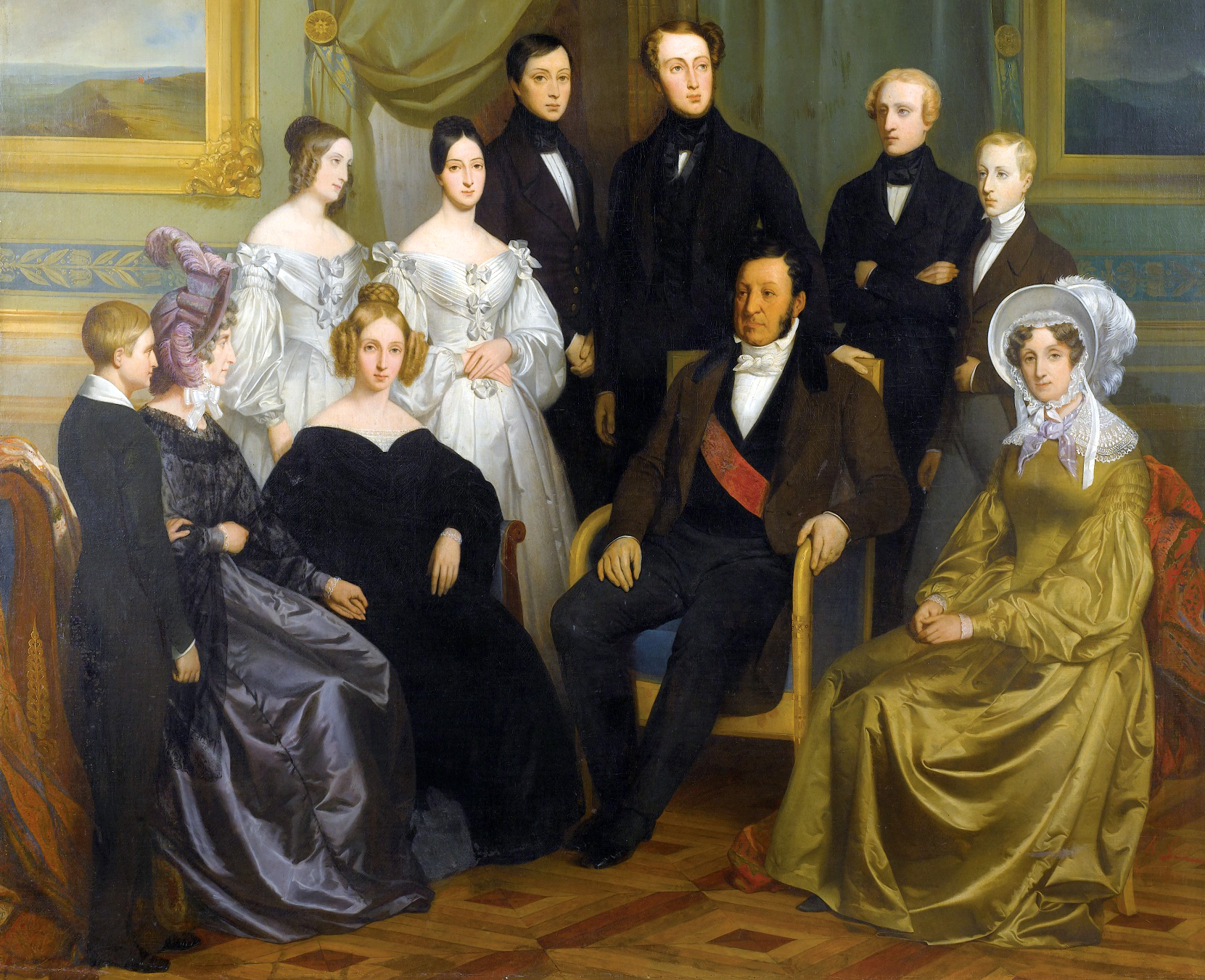
Above: Unknown artist, detail from portrait of King Louis-Philippe of France and his family, 19th Century. Public domain via Wikimedia Commons. I can’t with certainty identify every single member of the family, but my best guess is that it features in the top row from left to right, Clémentine, Marie, Louis, Ferdinand-Philippe, François and Henri, and on the bottom row from left to right Antoine, Marie-Amélie, Louise, Louis-Philippe, and Adélaïde.

If you’re curious about the naming conventions used here, they come from Louis-Philippe himself, in a royal decree issued after he assumed the throne in August 1830. Louis-Philippe declared his family would continue to use the name “Orléans,” rather than alternatives such as using the name “Bourbon,” or — as had been the tradition — dropping the family name altogether and having “of France” be their patronym. His daughters, and sister Adélaïde, would be known solely as Princesses of Orléans, “distinguishing themselves from each other by their first names.” This Princess of Orléans designation replaced the old title of “Princess of the Blood,” which was now abandoned. Adélaïde was also given the additional honorific of “Madame,” a title traditionally used for the sister of the king — much like how the king’s younger brother was called “Monsieur.” His sons, who already had titles, would keep them — with the exception of Ferdinand-Philippe, who gave up his old title of Duc de Chartres to inherit Louis-Philippe’s old title of Duc d’Orléans.4 This was an Orléans family tradition for the house’s first-born sons; Louis-Philippe himself had been Duc de Chartres as a boy, and then ascended to Duc d’Orléans after his father’s death.5
I haven’t been terribly consistent in the podcast so far about how I use noble titles. My intent going forward is to use a style that privileges aristocrats’ names over their titles. So, for example, I’ll try to mostly refer to “Duc Victor de Broglie” or even just “Victor de Broglie,” not “the Duc de Broglie.” Of course, for an episode like today where almost all the aristocrats in question are from the same family, I’ll often use only first names.
Note also that two of the Orléans children, Louise and Henri, share first names with the Bourbon princes, but in this episode I’ll only use those names alone to refer to the Orléans.
Now, I’ll give you brief biographies of all of these Orléans royals, though some of these backgrounds will be longer than others. Frankly, some of them come through my sources in vivid detail, like the third son François — who lost his hearing at a young age, joined the navy, sailed around the world, married a Brazilian princess, wrote books and trained as a painter, and much, much later volunteered to fight for the Union in the American Civil War. Others will be dealt with much more briefly, either because of their limited role in public affairs or because their personalities just aren’t that interesting. There is definitely more information out there about some of these lesser-known Orléans royals than I’ll give you today, but in the interests of keeping this podcast moving I’m going to refrain from spending months combing through 19th Century French-language memoirs to dig up colorful anecdotes about people who will only be minor figures in our narrative.
The Queen of the French
 Queen Marie-Amélie’s public image was that of a wife and mother, and that’s just how she liked it. Thrust into public life by birth, marriage, and revolution, Marie-Amélie disliked politics and had no talent for it. Where Marie-Amélie had political opinions, they were quite conservative — as befits a woman whose mother, Marie Carolina of Austria, was a Habsburg and sister to Marie-Antoinette. In the immediate aftermath of the July Revolution, for example, Marie-Amélie and her daughters visited the wounded in hospitals. There, she admirably but tactlessly wished speedy recoveries on the soldiers who had fought against the revolution — a red flag for radicals already concerned that the Orléans family were not committed to the revolution.6
Right: Louis Hersent, portrait of Marie-Amélie de Bourbon, princesse des Deux-Siciles, reine des Français, 1836. Public domain via Wikimedia Commons.
Instead, the queen devoted herself to private affairs, especially her large and spirited family. Marie-Amélie had been pregnant almost exactly 50% of the time over a 14-year period from December 1809 through July 1824, and now she was in charge of eight children while her husband spent most of his days on affairs of state. She was widely admired as a wife and mother by both her own family and by outside observers; the Orléans family remained unusually close and loving for an aristocratic family of their station.7

Above: Nicolas Gosse, the duchess of Orléans visits the wounded of the Three Glorious Days of the Revolution of July 1830, circa 1830-1848. Public domain via Wikimedia Commons.

Madame Adélaïde
 If the king’s wife shunned politics, his sister Adélaïde reveled in it. Unlike Marie-Amélie, Adélaïde had never married. She was a devoted aunt, and also a loyal confidant to her brother who followed politics as closely as he did. As a woman, Adélaïde was limited by the gender roles of the time from playing a public role in politics, but there were plenty of ways she could be involved. In Episode 44 we already saw her decisive action in July 1830, pledging her support to putting Louis-Philippe on the throne at a crucial moment when her brother was still wavering. But her involvement went far beyond that, and requires us to consider the very particular 19th Century concept of an “Egeria.”
In Roman mythology, Egeria was a nymph who advised Numa Pompilius, the second king of Rome. By the early 19th Century, any woman who was said to wield political influence over powerful men was dubbed an Egeria. Often Egerias were their men’s lovers, such as Adèle d’Osmond, the Comtesse de Boigne for the politician Baron Étienne-Denis de Pasquier, or Princess Dorothée de Dino for Talleyrand; Adélaïde was an unusual Egeria for being a sister.
Above: Copy of François Gérard, portrait of Adélaïde d’Orléans, before 1848. Public domain via Wikimedia Commons. Below: Auguste de Creuse after Léon Cogniet, portrait of Adélaïde d’Orléans, 1838. Public domain via Wikimedia Commons.

 Being an Egeria was not simply an epithet for women seen as having an unseemly interest in politics. It was an informal political institution that helped smooth the paths of back-channel politics. For example, Louis-Philippe’s ministers strongly frowned on the king holding meetings with opposition politicians. So when one of these men wanted to meet with the king, or vice versa, he might send his Egeria to go make a social call on Adélaïde. There was nothing untoward about Madame de Boigne visiting Madame Adélaïde — but once the door closed, the two would discuss politics instead of the domestic issues to which women were supposed to be limited. Other times the politicians themselves would call on Adélaïde — and then the king would just happen to walk down the hall to visit his sister at the same time.8
Adélaïde was also a prolific letter-writer, and in many of her letters to prominent men it’s clear that she is writing on behalf of her brother. This was especially true in foreign policy, Adélaïde’s particular passion. She was a close friend of Talleyrand, who was serving as France’s ambassador to Great Britain, and a lot of Franco-British diplomacy was conducted through Adélaïde and Talleyrand’s personal letters — much to the annoyance of Louis-Philippe’s official foreign ministers.9

Charles-Caïus Renoux, Madame Adelaide d’Orleans receiving queen Victoria and Prince Albert in her room at the Chateau d’Eu, 1844. Public domain via Wikimedia Commons.

Louis-Philippe and Adélaïde spoke constantly. While she wasn’t allowed to attend cabinet meetings, the king would often go directly from his ministers to Adélaïde, where he would recount everything that had happened. And the two would meet in private almost every night at 10 p.m., after Marie-Amélie had gone to bed. Comte Camille de Montalivet, a close confidant of Louis-Philippe, was one of the few to observe these meetings, and I’ll quote him at length:
Madame Adélaïde’s hour had arrived at last; she hurried to join her brother, with some needlework in her hand, and took a seat beside him… Silent when a piece of work absorbed all her brother’s attention, she was always happy when the king broke off to think out loud both before her and with her. Then she was no longer the silent witness and passive confidante that she was during those [afternoon] interviews… At this hour of the evening, when the king belonged wholly to her, she took her turn to speak, generally addressing questions in the order the king assigned to them, but sometimes bringing up subjects of her own. In this way, through this intimate conversation, mingled two streams of thought drawn from the same source…10
 When these conversations turned to domestic politics, Adélaïde’s advice generally encouraged her brother to tack to the left. Though brother and sister had generally similar views, Adélaïde was less worried about social change. Notably, she viewed the 1789 French Revolution in a more positive light than Louis-Philippe, not just supporting its initial ideals but going “as far as to excuse a good many of its excesses.”11
Right: Franz Xaver Winterhalter, portrait of Adélaïde d’Orléans, 1842. Public domain via Wikimedia Commons.
Additionally, like many other prominent women, Adélaïde exerted influence by hosting a salon — evening gatherings whose carefully invited guests would discuss public affairs. She made little effort to conceal the political nature of these gatherings. As one historian recounted:
The princess was often seated at her writing desk, and when she was installed in the deep armchair by the fire, she only rarely did needlework; she spent her time reading or going through the dossiers that her brother had entrusted to her. There was nothing feminine in the room, no flowers, no knick-knacks, but books and official papers.
The only thing that interrupted the political discussions at Adélaïde’s salons were the occasional noises of her pets: a small dog, and a parrot named Jacquot.12
Adélaïde’s regular guests included Talleyrand, and prominent politicians including Étienne Gérard, Horace Sébastiani, and André Dupin. These men were not radicals, but they were as a rule more progressive than the Doctrinaires like François Guizot and Duc Victor de Broglie. As Sébastiani once phrased it, they believed in “resistance without rigidity”: they wanted to preserve the current social order, but thought the best way to do that was flexible adaptation. They didn’t like the Left, but if push came to shove they’d rather work with republicans than open the door to the right-wing Legitimists. All this infuriated the sterner Resistance figures like Guizot, Broglie, and — as we saw at the start of this episode — Casimir Périer. These men thought that accommodating the Left only encouraged disorder and revolution. At the Doctrinaire salons— hosted by Broglie’s wife Albertine — a regular topic of conversation was the “inclinations and remarks of Madame Adélaïde.”13
Ferdinand, duc d’Orléans
 While Adélaïde and Louis-Philippe seemed like “two streams of thought drawn from the same source,” the king’s eldest son Ferdinand-Philippe could seem strikingly independent. He was the very image of a young prince: tall, elegant, and handsome, yes, but also hot-tempered, proud, and indiscreet. Before the July Revolution, he attended court functions and got on well with his Bourbon aunts, but alienated many conservative courtiers with loud expressions of what his mother delicately called his “ardent ideas.”14
Like all his brothers, Ferdinand-Philippe had been educated at the prestigious College Henri IV in Paris. As I recounted in Episode 34, this was controversial: princes like Ferdinand-Philippe were supposed to be educated in private by tutors, not at a school surrounded by boys without royal blood. King Louis XVIII was so horrified he lectured Louis-Philippe for this scandalous decision, but the then-Duc d’Orléans refused to back down. He told the king that his sons’ ideas “should be in harmony with those of the nation and of his generation.” This was a deliberate statement, though we should keep in mind the limits of Louis-Philippe’s democratic gesture. His sons were attending a school, yes, but it was an elite school, and the boys all had private tutors in addition to their normal teachers.15
Above: Jean-Auguste-Dominique Ingres, portrait of Ferdinand-Philippe d’Orléans, 1842. Public domain via Wikimedia Commons. Below: Horace Vernet, Ferdinand-Philippe-Louis, Duc de Chartres, as a child holding a hoop in the College Henri IV, 1821. Public domain via Wikimedia Commons.
 Ferdinand-Philippe was an indifferent student despite all these resources. When a topic interested him — such as history — he could do very well. But where it didn’t, Ferdinand-Philippe was hasty and sloppy. He was smart and could usually rely on a good memory of his lessons — but usually relied only on that memory instead of studying.16
What Ferdinand-Philippe did focus on as a young man comes down to two primary passions: women, and the army. In the summer of 1828, a 17-year-old Ferdinand-Philippe was passionately in love with the 34-year-old Countess Seweryna Sobańska, a beautiful Polish aristrocrat. How exactly their relationship progressed is a little murky, but before long Ferdinand-Philippe was spending afternoons at her home and hosting her at Palais-Royal salons in the evening. An Austrian diplomat, Count Rudolf von Apponyi, wrote that Seweryna “no longer [conceals] her passion for this handsome prince of the blood.” 17
Below: Alphonse-Léon Noël, drawing of Léontine Volynys, née Fay, after 1831. Public domain via Wikimedia Commons.

 But despite his older paramour, Ferdinand-Philippe was still a teenage boy. Apponyi’s account continues to say that Ferdinand-Philippe, “like all young men in such a position—came to feel that he had been excessively faithful by bestowing his attentions upon Madame Sobanska for a full year.” Soon Ferdinand-Philippe started to treat Sobanska more cooly, which mystified the countess until she learned about Léontine Fay, an acclaimed actress around Ferdinand-Philippe’s age. Ferdinand-Philippe was quite the theater-goer, often hitting shows in the company of his father’s secretary, an aspiring writer by the name of Alexandre Dumas. While Dumas would soon find his own fame as a playwright (followed by even bigger fame as a novelist) he and Ferdinand-Philippe’s discussions of contemporary plays in the Orléans library focused more on actresses than on scripts. Dumas — also a famous womanizer — was soon seeing the actress Virginie Bourbier, who performed in Dumas’s Henri III and his Court. Ferdinand-Philippe fell for Fay, famed for her expressive features and passionate performances, but also for her “confident stride” around Paris wearing the “shortest of skirts.”18
Léontine Fay would in turn be supplanted in Ferdinand-Philippe’s affections by Lady Harriet Blessington, and she in turn by a nearly endless parade of paramours — mistresses, in the parlance of the day. In 1835, Louis-Philippe wrote to Marie-Amélie that Ferdinand-Philippe’s affairs had left him in a “state of exhaustion.” Referring to his latest lover, the king wrote, “That wretched woman is tiring him out, a fact that she’s flaunting everywhere, and he doesn’t have the courage to break with her.” Which isn’t to say Ferdinand-Philippe couldn’t display courage with his affairs — allegedly one day, he was visiting a mistress in Paris when an insurrection broke out. The young prince, incognito, helped build a barricade until he found the opportunity to slip away — whereupon he went straight to military headquarters, reported for duty, and returned with soldiers to put down the revolt.19 If true, then this episode would have been a rare chance for Ferdinand-Philippe to partake in both of his favorite pastimes in one day. Because while mistresses came and went, Ferdinand-Philippe maintained a steady, lifelong love for the French Army.
The colonel of hussars
 At the age of only 14, King Charles appointed Ferdinand-Philippe to be the colonel of a regiment of hussar cavalry. This was obviously ceremonial, a bit of Old Regime nepotism to give a young prince a position with a military unit. The French Revolution had introduced promotion by merit and seniority as the basis of the French Army, and this had proven so successful that the Bourbons had kept it when they returned — sort of. But Louis XVIII had fought for the right to appoint as many officers as he could: he felt “that semi-automatic promotion would not make the promoted officers suitably grateful and attached to himself.” This was especially true for senior officers, colonels and above, who were appointed solely by royal decree, while lower officer ranks held out at least the possibility of merit-based appointment. Meanwhile royal princes like Ferdinand-Philippe were always an exception; Louis had appointed his nephew Louis-Antoine, duc d’Angoulême, to be Admiral of France, and then later gave him formal command of France’s 1823 invasion of Spain.20
Above: Horace Vernet, the Duc de Chartres on horseback, 1832. Public domain via Wikimedia Commons. Below: Julien, August 9, 1830: Monseigneur the Duc d’Orléans, after 1830. Public domain via Wikimedia Commons.

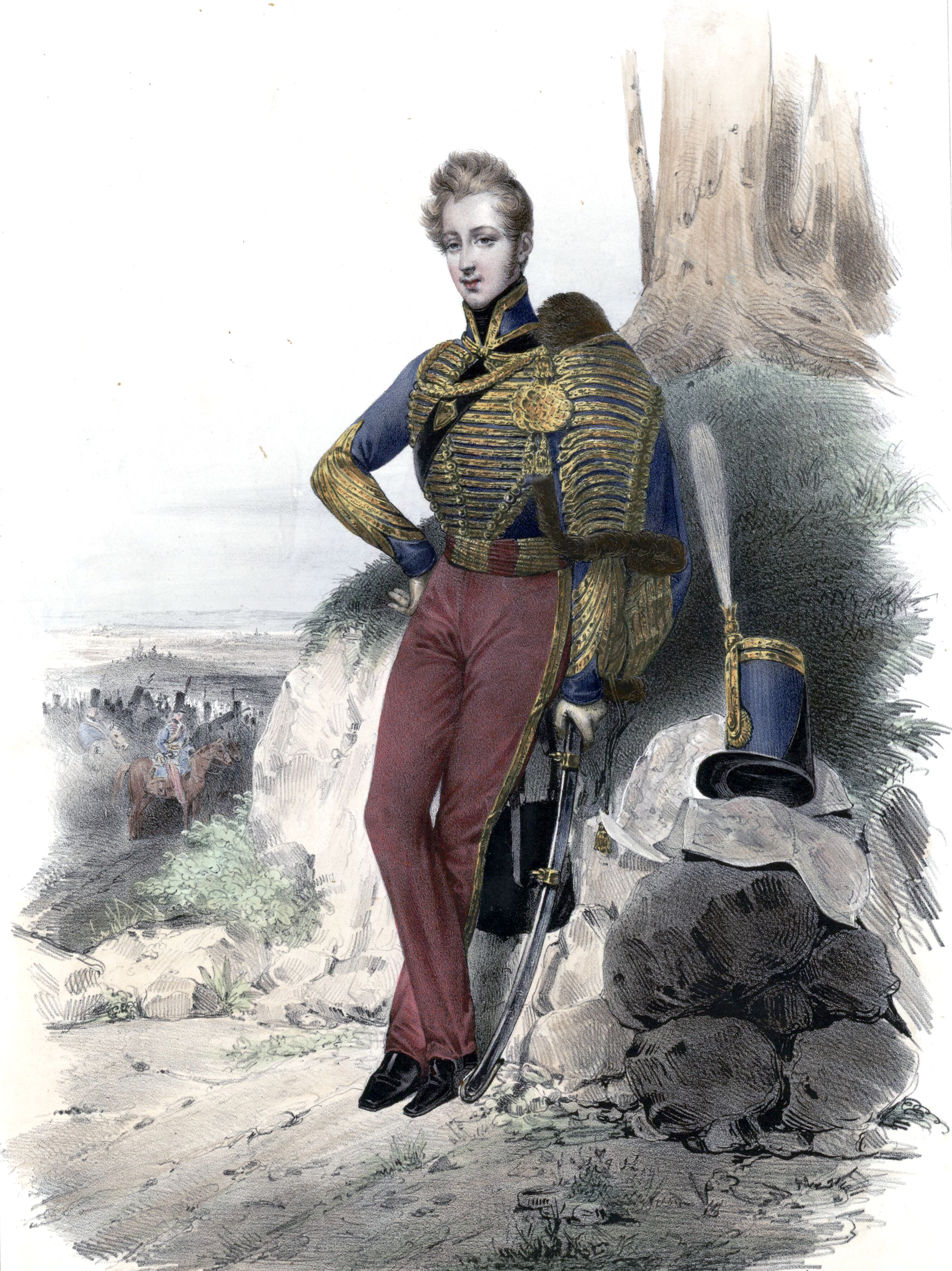 Ferdinand-Philippe’s appointment as a child officer was only ceremonial — for now. He was fitted for a uniform and introduced to his unit, but remained in school, where he now received military tutoring from a retired general who had fought at Waterloo. But Ferdinand-Philippe was determined to be an actual soldier, not merely a “parade-ground colonel.” Later, after coming of age and joining his regiment, he was upset to find that his royal blood meant he couldn’t even pretend to be a simple cavalry officer: He was immediately deluged with more social invitations than he could manage, and a flood of petitions asking him to intercede with the king on their behalf. Ferdinand-Philippe deeply wanted to fight, to win honor on the battlefield, but was seen as “an amateur colonel who has come to host dinners for the officers.” 21
Once Ferdinand-Philippe’s father became king, he remained in the army, and would serve in active combat. He refused to hang back safely in the rear and sought out the most dangerous areas of fighting. As Ferdinand-Philippe described it, “to be pardoned for his birth he needed to do more than others.” His parents weren’t happy about this recklessness, but he became genuinely popular among rank and file of the French Army.22
Man of the Movement
.jpg) Ferdinand-Philippe was by his father’s side as he took his oath in the Chamber of Deputies on August 9, five days after leading his cavalry regiment into Paris under the tricolor flag. He was fired with revolutionary fervor, sometimes ending letters with the following sign-off: “Ferdinand-Philippe d’Orléans, a French citizen and therefore a member of the National Guard…, a gunner in the National Guard and therefore a man of the Movement…”23 He lamented how Austria’s suppression of Italian revolutions were victories for “absolutism.”24
Ferdinand-Philippe was by his father’s side as he took his oath in the Chamber of Deputies on August 9, five days after leading his cavalry regiment into Paris under the tricolor flag. He was fired with revolutionary fervor, sometimes ending letters with the following sign-off: “Ferdinand-Philippe d’Orléans, a French citizen and therefore a member of the National Guard…, a gunner in the National Guard and therefore a man of the Movement…”23 He lamented how Austria’s suppression of Italian revolutions were victories for “absolutism.”24
Right: Louis Hersent after François Gérard, the Duc d’Orléans (right) and the ducs de Chartres (left) and Nemours (center), 1830. Circa 1832. Public domain via Wikimedia Commons.
Louis-Philippe invited his son to attend cabinet meetings, and in them Ferdinand-Philippe was a voice for the left. He argued for reforms to the Charter, for a clean break from Charles and the Bourbon Restoration, and that his father should take the royal name “Louis-Philippe I” and not “Philippe VII.” Outside of formal politics, he attended Lafayette’s salon, and served in the National Guard. Deputies thought the new Duc d’Orléans had “democratic zeal”; Louis-Philippe complained that his free-speaking son kept voicing his own views that diverged from his own. Moreover, beyond just being aligned with the Party of Movement against the Party of Resistance, Ferdinand-Philippe was also in tune with the spirit of youth, raging against the caution of their elders. His role in politics in these early years of the July Monarchy was seen as that of “a spokesman for discontented youth.”25
Part of that role as a spokesman for “Young France” involved warning his father about Casimir Périer. He passed on reports that his young friends had made “direst predictions should power pass into the hands of Casimir Perier.” When Périer was elected president of the Chamber of Deputies in November 1830, Ferdinand-Philippe called it a “step backward.” 26
This was the voice that Casimir Périer wanted to sideline when he marched into the Palais-Royal on his second day in office. And as we’ve seen, it worked. Louis-Philippe agreed to remove Ferdinand-Philippe from cabinet meetings, and forced Ferdinand-Philippe and Adélaïde to each promise to support Périer. Sidelined at court, Ferdinand-Philippe re-committed himself to a military career.
The other Orléans children
The rest of the Orléans children were all younger, and less involved in public life during the early years of the July Monarchy. So I’ll go through them more quickly.
Princesse Louise
 Princesse Louise was 18 years old in July 1830. She and her sisters had not been sent off to school like the boys in the family, but Louis-Philippe wanted them to get “as good an education as the boys” and arranged for a parade of illustrious tutors. Louise was intelligent, lively, and devoted to her family.27
Right: Claude-Marie Dubufe, portrait of Louise d’Orléans, 1830s. Public domain via Wikimedia Commons.
Throughout her life Louise was a prolific correspondent, much of which survives. So even where she wasn’t a direct participant in historical events, we often have her private thoughts on the momentous events surrounding her family. Sometimes these are little colorful glimpses into the family life, such as an 1826 letter describing how she walked in on a village priest using the bathroom, or when a young Louise wrote Adélaïde about an upcoming social call with the Duchesse d’Angoulême: “the prospect gives me very little pleasure,” Louise sniped. (Adélaïde, who also disliked the Duchesse d’Angoulême, would have certainly appreciated her niece’s remark.)28
When the July Revolution came, Louise did not have command of a regiment of cavalry, but she was with her parents as Louis-Philippe tried to decide how to respond. Louise joined Adélaïde in urging resistance to the Four Ordinances beyond strictly legal methods.29
We’ll hear much more about Louise in our narrative soon, where she’s about to play an important role. So we’ll leave her for now and move on to her siblings.
Princesse Marie
Compared to Louise, Princesse Marie — one year and nine days younger — was less outgoing. One historian describes Marie’s temperament as “neurotic”; years after the July Revolution, she told Charles de Rémusat that she always kept a set of portable valuables packed and ready to move, “should we fall.” But she was also highly artistic. Louis-Philippe had hired the famous painter Ary Scheffer to teach art to all his children, and Marie was one of only two of them who genuinely took to art. She had an art studio installed for herself at the Tuileries Palace, and practiced both drawing and sculpture. Some of her statues are on display to this day.30
Marie was also interested in current events. At the same Orléans family dinner where Louise urged extralegal resistance to the Four Ordinances, Marie went even further and endorsed popular insurrection.31
All of the Orléans children were Romantics — that is, fans of Romanticism in art, music and literature. Their father the king, in contrast, was a child of the 18th Century and maintained Classical preferences. But of all these Romantic royals, Marie went the furthest in her embrace of the new ideas, including open mysticism.32

Prosper Lafaye, Princesse Marie d’Orléans in her workshop in the Tuileries. Public domain via Wikimedia Commons.

Louis, duc de Nemours
.jpg#/media/File:Prince_Louis_of_Orl%C3%A9ans,_Duke_of_Nemours_by_Winterhalter_(cropped).jpg) Just as Marie, the second daughter, was less outgoing than Louise, the first daughter, so was the second son Louis a more reserved fellow than Ferdinand-Philippe. Louis, the Duc de Nemours, had “an excessively stiff dignity” and his salon followed strict rules of etiquette. No less than Louis-Philippe once quipped that his son Louis was “a born archduke,” referencing the famously hidebound Habsburg royal family. Also unlike Ferdinand-Philippe, who leaned to the Party of Movement, Louis was closer to Resistance figures. Due to all of these factors, Louis never enjoyed mass popularity.33
Just as Marie, the second daughter, was less outgoing than Louise, the first daughter, so was the second son Louis a more reserved fellow than Ferdinand-Philippe. Louis, the Duc de Nemours, had “an excessively stiff dignity” and his salon followed strict rules of etiquette. No less than Louis-Philippe once quipped that his son Louis was “a born archduke,” referencing the famously hidebound Habsburg royal family. Also unlike Ferdinand-Philippe, who leaned to the Party of Movement, Louis was closer to Resistance figures. Due to all of these factors, Louis never enjoyed mass popularity.33
Right: Detail from Franz Xaver Winterhalter, portrait of Prince Louis d’Orléans, duc de Nemours, circa 1830s. Public domain via Wikimedia Commons.

This stiff demeanor and unpopularity did not stop Louis from taking a string of lovers, both high- and low-born. He shared the physical bravery that marked all the Orléans. Like Ferdinand-Philippe, Louis joined the French Army and fought on the front lines in Algiera; on one occasion an enemy cannonball missed Louis by mere feet, killing another general walking next to him.34 But even being a war hero did not make Louis well-liked. All that would have been unfortunate if Louis had been the heir to the Orléans family, but fortunately he was the second son. This unpopularity would only come into play if something were to happen to Ferdinand-Philippe. But what are the odds of that?
Princesse Clementine
 The third daughter, Princesse Clementine, was only 13 at the time of the July Revolution. She had a passion for history, fostered by both her official education and her recreational reading. Louis-Philippe hired the the eminent — and eminently left-wing — historian Jules Michelet to tutor her in history. Michelet spent their lessons “glorifying the French Revolution.” Meanwhile, like the rest of the Orléans children, she was obsessed with the work of Victor Hugo; she and her younger brother François would wander around Paris looking for remnants of the old medieval Paris they had read about in works like The Hunchback of Notre-Dame.35
Left: Franz Xaver Winterhalter, portrait of Marie-Clémentine-Caroline d’Orléans, 1846. Public domain via Wikimedia Commons.
As an adult, she will be described as “a woman of formidable character and ambition.” She will marry a “wealthy but undistinguished” German prince, a marriage that she “dominated.” Much of her adult life will be devoted to plots to get a throne for one of her children — scheming that will see her son become Prince of Bulgaria in the 1880s, and in 1908 — one year after Clementine’s death — finally become a sovereign monarch as Tsar of Bulgaria.36
François, duc de Joinville
.jpg) I mentioned earlier that Louis-Philippe’s third son François, prince de Joinville, was a more vivid historical character than most of his siblings. Part of that is due to the fact that François wrote down his life’s story in very readable memoirs, which makes it easier to follow details of his life. But his life was also genuinely fascinating.
I mentioned earlier that Louis-Philippe’s third son François, prince de Joinville, was a more vivid historical character than most of his siblings. Part of that is due to the fact that François wrote down his life’s story in very readable memoirs, which makes it easier to follow details of his life. But his life was also genuinely fascinating.
Right: Franz Xaver Winterhalter, portrait of François-Ferdinand-Philippe d’Orléans, Prince de Joinville, circa 1844-1847. Public domain via Wikimedia Commons.
While his brothers were made dukes as their courtesy titles, François was named Prince de Joinville. Joinville is a town in northeastern France that was made a principality in the 1500s, before being inherited by the Orléans family in the 1600s. Louis-Philippe revived the title for François.
Like Ferdinand-Philippe and Louis, François attended school at the Collège Henri IV. Despite his private tutors, François was not a good student, calling the school “that learned prison in which I spent three years,” and saying that, “My life there was mortally tedious, and I did no good whatsoever.” He was intelligent and could absorb a topic when motivated, but found the tedium of translating Greek or Latin unbearable. But his status as a “day boy” who commuted to and from the school each day meant the 12-year-old François got an eyewitness view of the early stages of the July Revolution — groups of young men muttering angrily on street corners, and soldiers spilling out into the streets. He was kept home on Wednesday as the fighting intensified, witnessed fleeing soldiers from the Orléans estate at Nouilly, and finally traveled with the rest of his family through the barricades to join Louis-Philippe on the evening of Saturday July 31.37
Unlike Ferdinand-Philippe and Louis, François did not join the French Army. Instead, he joined the Navy. There were no shortcuts in the navy such as Ferdinand-Philippe had experienced in the Army — an unqualified princeling in the Army might get away with hosting dinners for local dignitaries, but anyone who remembers the wreck of the Medusa from Episode 36 knows what damage an unqualified naval officer can do. So while François got help climbing the ladder in the French Navy, he still did have to climb the ladder. In 1834, after cramming for mandatory exams, François traveled to a port in Brittany to join the frigate Sirène as a midshipman. Royal blood or not, François had to climb the masts, stand his watches, and endure storms just like all the other junior officers.38

François d’Orléans, Prince de Joinville, “Naval student,” 1834. Public domain via Wikimedia Commons.
 François worked his way up the naval ranks, from midshipman to ensign to lieutenant, as he journeyed around the Mediterranean, including Algeria, Anatolia, and Jerusalem. Later journeys will take him across the Atlantic to the Caribbean, Brazil, and the United States, where he described asking a pilot on the Chesapeake River if he spoke French. The man responded in English: “No, I only speak American.” François will cross the Atlantic on many more occasions, including a return to Brazil in 1843 to marry Princess Francisca, the sister of the Brazilian emperor Pedro II, and a trip to the island of St. Helena that we will discuss in a future episode.39
Above: François d’Orléans, Prince de Joinville, the Belle Poule and the Cassard in Newfoundland Bay afte a storm, before 1900. Public domain via Wikimedia Commons. Below: François d’Orléans, Prince de Joinville, grand bazaar of Constantinople, before 1900. Public domain via Wikimedia Commons.

Besides his naval adventures, François also had a passion for art, like his sister Marie. Whereas Marie became a sculptor of note, François’s medium was watercolors; he painted depictions of many of the dramatic events of his life, from the July Revolution to his travels around the world. You can see a few of these paintings alongside the annotated transcript of this episode at thesiecle.com/episode51.
We should also talk about François’s disability. He was born with functional hearing but started to lose it as a young adult. To try to restore his hearing, François underwent an agonizing surgery that involved boring “holes in his skull and ears,” but this did nothing. In the 1840s, Victor Hugo wrote of François, “Sometimes it saddens him, sometimes he makes light of it … Since he cannot talk as he wants to, he keeps his thoughts to himself, and this sours him.” But François persisted in his naval career, finding inspiration in an older French officer who had also lost his hearing. And sometimes he used his partial deafness to his advantage to pretend not to hear people he didn’t want to talk with.40
As an adult, François was conservative politically, writing in his memoirs that the July Revolution was “a great misfortune” that “gave a fresh blow to the monarchical principle” and “unfortunately encouraged those who speculate in insurrection” — quite a different view from Adélaïde or the young Ferdinand-Philippe. François was in this a man of the Resistance. But his was a flexible conservatism, open to both technological and artistic innovations, and he will later grow frustrated with the hardline no-compromises stance taken by some July Monarchy politicians.41
Though it is far beyond the scope of my current narrative, I will add that when the American Civil War broke out in 1861, François wrote to U.S. President Abraham Lincoln, offering his services in putting down the southern rebellion. He was appointed to the staff of General George McClellan, where despite his deafness he impressed everyone for both his character and his courage under fire. Though François would eventually resign his post amid diplomatic tensions between France and the United States, he remained sympathetic to the Union cause, writing, “Who knows what a free people is capable of, at a time of peril, when it is fighting for right and humanity?”42 As a final note of irony, another son of a key player in the July Revolution would also volunteer his services in the Civil War: Camille de Polignac, son of Jules. But while Louis-Philippe’s son backed the Union, Polignac’s son was a Confederate major-general.

François d’Orléans, Prince de Joinville, “At the Army of the Potomac,” circa 1860s. Public domain via Wikimedia Commons.
Henri, duc d’Aumale
_.jpg) We’re nearing the end of this very fertile family. The fourth son was Henri, duc d’Aumale, only eight years old in July 1830. Unlike his older brothers, Henri was a boarding student at the College Henri IV, living on site instead of at home. And unlike his brothers with their indifferent approach to academics, Henri was a brilliant student, called “intelligent, talented, and courageous” by a later historian. He will join the army, like most of his brothers, and eventually will be appointed to govern France’s newly conquered Algerian territories — a task Henri will perform well despite being only in his 20s.43
We’re nearing the end of this very fertile family. The fourth son was Henri, duc d’Aumale, only eight years old in July 1830. Unlike his older brothers, Henri was a boarding student at the College Henri IV, living on site instead of at home. And unlike his brothers with their indifferent approach to academics, Henri was a brilliant student, called “intelligent, talented, and courageous” by a later historian. He will join the army, like most of his brothers, and eventually will be appointed to govern France’s newly conquered Algerian territories — a task Henri will perform well despite being only in his 20s.43
Right: Louis Hersent, Queen Marie-Amélie and her sons Henri, Duc d’Aumale, and Antoine, Duc de Montpensier, 1835. Public domain via Wikimedia Commons.
Antoine, Duc de Montpensier
Finally we come to the youngest of the Orléans children: Antoine, Duc de Montpensier. Only six years old when his father comes to the throne, Antoine won’t play an important role in events for many, many years. Like Henri, he will be a boarding student and excel academically. Antoine is noted as being the Orléans child most like Louis-Philippe in personality. He also had the quirk of being a fan of thrifting — “dressing in an old and dirty cloak and hat to search the shops of the sellers of bric-à-brac, hunting for bargains.”44
The goods of the House of Orléans
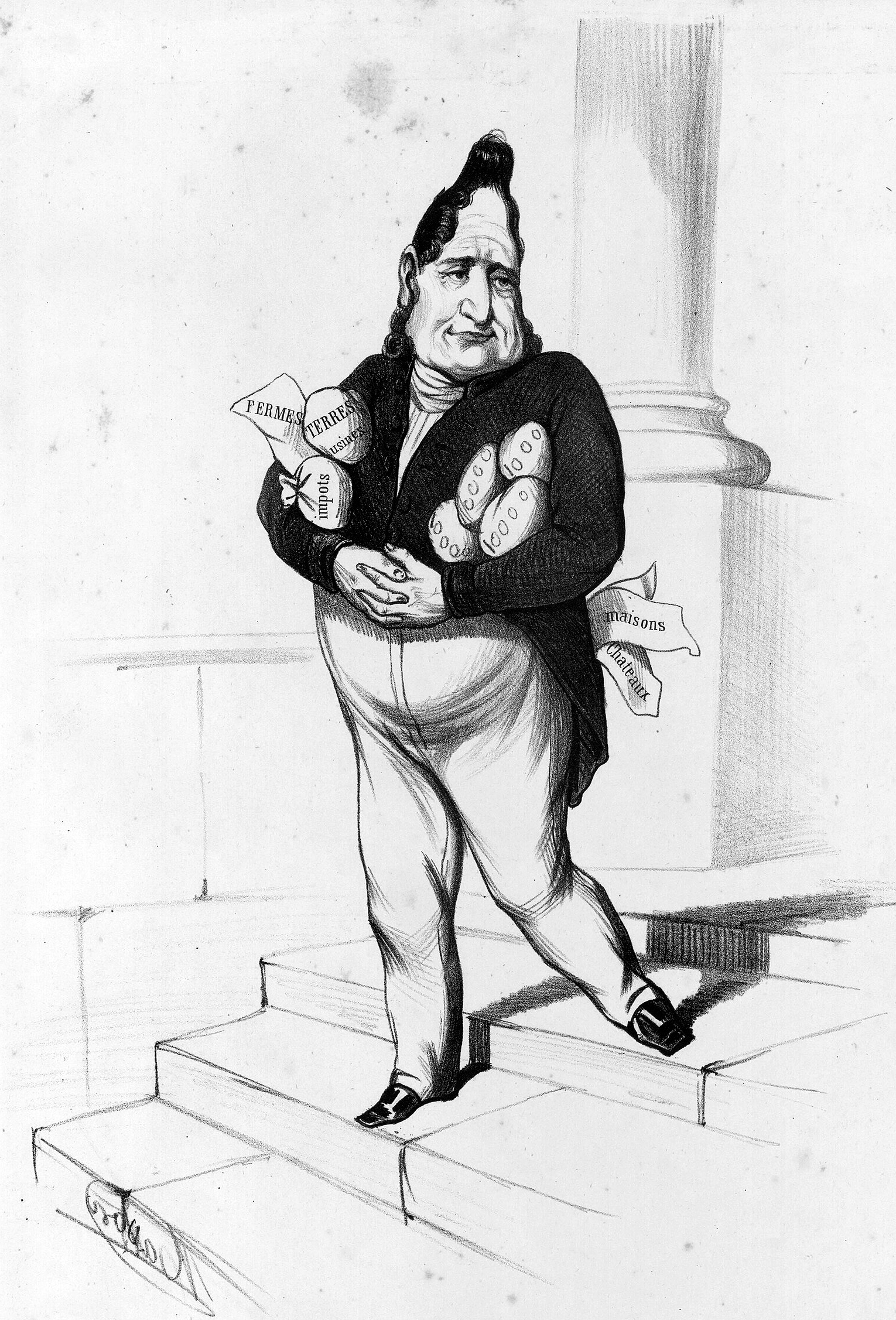
Antoine’s bargain-hunting may have been a mere quirk, but it does highlight a real issue for Louis-Philippe that I haven’t had a chance to discuss yet: his public image as simultaneously greedy and miserly. This is relevant because the primary occasion when Louis-Philippe asked parliament for money was to pay for his family.
 Under both the Restoration and July Monarchy, the treasury of the French state was not the monarch’s personal property. It was appropriated and budgeted through the legislative process. But a portion of that national budget was the “civil list” — money appropriated for the king’s personal use. This could be spent on just about anything. Louis XVIII, for example, had spent civil list money on pensions for émigrés, paying for the costs of the post-Waterloo occupation of France, ordering silk garments from Lyon to stimulate the silk industry, expanding the Royal Guard and Paris gendarmerie, lavish gifts for foreign ambassadors, and maintenance for royal palaces, museums, and other buildings.45
Right: Jean-Vincent-Marie Dopter, “I have always loved the good of the people, and that of their children,” thinks Louis-Philippe with satisfaction as he descends a staircase, his arms loaded with bags of money. Public domain via Wikimedia Commons.

The independence of the civil list was reinforced by the fact that it was voted once for the monarch’s entire reign, rather than having to be re-authorized every year — unless lawmakers voted to give the king even more money. Louis XVIII had received a massive civil list of some 30 million francs per year, plus extra funds to the king’s brother to pay for his own household. Periodic increases had led to Charles X receiving around 32 million francs per year in 1827.46
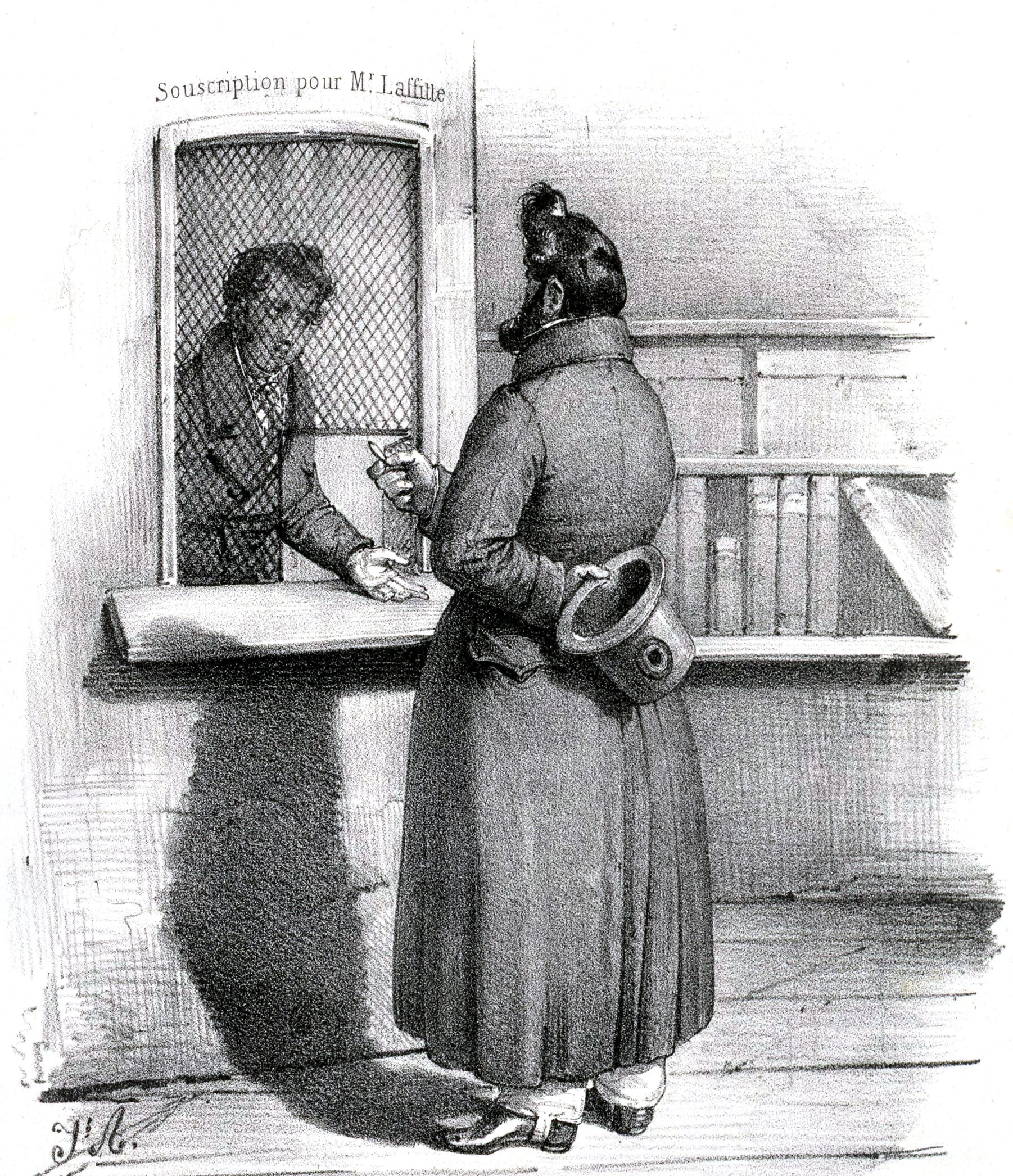 Taking the throne as a Citizen King, Louis-Philippe wanted to abolish the lavish royal court of the Bourbons. He cut off the pensions they had paid to émigrés unless they produced a certificate of poverty. And so Louis-Philippe asked the Chamber of Deputies for a considerably reduced civil list of 18 million francs. This seemed fair to Jacques Laffitte, who promised the king he would secure this money. But it went down like a lead balloon in the Chamber of Deputies. Lavishing taxpayer money on the king seemed very ancien régime, not at all in keeping with the new liberal order. And having just faced down one royal coup d’état, some deputies thought limiting Louis-Philippe’s revenues would keep him in check. Instead of the 18 million francs per year Louis-Philippe asked for, parliament gave him 12 million.47
Louis-Philippe was furious at this slight, taking it as both insult and injury. But there was little he could do. The populist fury about Louis-Philippe’s civil list meant neither Laffitte nor Casimir Périer were willing to expend their political capital on extra money for the king.48
Now keen listeners might remember that Louis-Philippe was not exactly hard up. Before becoming king, he was the richest man in France, with a vast portfolio of investments and real estate. He had received 13 million francs alone from the 1825 “émigré’s billion,” as I covered in Episode 28. Why was the richest man in France quibbling over a few million francs per year? The answer is, unsurprisingly, complicated.
First, when he assumed the throne, Louis-Philippe no longer possessed his great fortune — technically. Under traditional French law, when a new king ascended to the French throne, “his personal estate merged with the royal domains.” So two days before becoming king, Louis-Philippe on August 7, 1830, signed an “act of donation and partition” that distributed much of his fortune to his children. Part of Louis-Philippe’s fortune were the traditional lands of the Orléans family, and these he kept to merge into the royal estates. But all his other millions of francs of wealth, acquired from inheritances and investment profits and other sources, these he gave away to keep them safe. But I said Louis-Philippe “technically” didn’t possess his fortune any more. That’s because while he gave his children ownership of this property, he maintained for himself the right to use it — what in property law is called “usufruct.”49
The Orléans lands that had been turned over to the state generated revenue, but it flowed into the state treasury. The upkeep of these royal lands, on the other hand, had to be paid for out of the civil list. The partitioned property did generate income for Louis-Philippe, though he studiously paid taxes on his property and didn’t skimp on the upkeep. So while the king did have his own resources to draw on in addition to the civil list, they were more limited than one might have assumed.50

François d’Orléans: “In May 1830, my father gave a great celebration at the Palais-Royal in honor of the King of Naples. The illumination had drawn a huge, lively crowd into the garden, which made all kinds of confused cries heard. Charles X introduced himself to this crowd, shouting: ‘Hello my people!’” Visible are Louis-Philippe (second from left), Charles X (center, standing), François (the child on the balcony), and Ferdinand-Philippe (third from right). This celebration was described in Episode 38. The Palais-Royal in central Paris was a key part of the Orléans family property. François d’Orléans, Prince de Joinville, “Bonjour, mon peuple!,” before 1900. Public domain via Wikimedia Commons.
From this civil list and personal income, Louis-Philippe paid for a similarly wide range of expenses as his Bourbon predecessors had. He paid off the debts of politicians like Jacques Laffitte. He also secretly paid off the debts Charles X had left behind. Louis-Philippe used his civil list to pay for the restoration of the Palace of Versailles into a museum devoted to “all the glories of France”; that museum continues to occupy parts of the palace to this day. The king also donated up to 43 million francs to charity over the course of his reign. Perhaps half of that charity was politically motivated, such as public gifts to repair local hospitals and churches. But the rest was given secretly, include large sums to aid the poor in the “appalling winter of 1830-31.”51
But what of Louis-Philippe’s family? The king’s accounts paid for Queen Marie-Amélie’s expenses, and those of his underage children. Adélaïde had inherited independent wealth from other relatives and was — after spending much of her life dependent on others — doing just fine.52 But Louis-Philippe was determined to secure suitably large inheritances for all of his very large family. Ferdinand-Philippe, as the eldest son, would presumably become king and inherit the royal estates. And Louis-Philippe’s fourth son, Henri, duc d’Aumale, had in 1829 been named the heir of their wealthy cousin Louis-Henri, Duc de Bourbon. When the Duc de Bourbon died suddenly in 1830 — as I discussed in Episode 49 — Aumale’s future was set.
But that still left six other children. Louis-Philippe tried repeatedly throughout his reign to get parliament to approve one-time gifts or ongoing incomes for his children — and few of his policies provoked more popular opposition. A proposal in 1840 to give a pension to the second son Louis, duc de Nemours, was so controversial it caused the collapse of the ministry. Louis-Philippe was still trying to get Nemours a state-provided income, with no more success, four years later. Princess Marie refused to allow Louis-Philippe to ask parliament for a dowry because it would have opened her up to attacks in the Chamber of Deputies; the king ended up paying her dowry out of his own money.53
 Historians have noted that despite the unseemly appearance of Louis-Philippe seeking taxpayer-funded inheritances for his large family, his reign was comparatively cheap — costing France just two-thirds of what Queen Victoria and her own eight children cost British taxpayers. But whether or not you find Louis-Philippe’s efforts here sympathetic, they were something the king expended a lot of his political capital trying — and usually failing — to achieve. Not only were the requests unpopular, but Louis-Philippe resented “being obligated to ask [for] financial favors and so became domineering and tactless.”54 Perhaps Antoine’s love of discount shopping was not so silly after all.
Right: The 1845 meeting of the French and British royal families during Queen Victoria’s state visit to France. Franz Xaver Winterhalter, “Family reunion in the Victoria gallery at the Château d’Eu, September 8, 1845,” 1845-6. Public domain via Wikimedia Commons.
Thank you everyone for your support of the show. As is often the case, this was intended to be a short episode before ballooning into a long one as my research kept uncovering fascinating stories. And this episode would have been even longer had I not cut out a long segment about Ferdinand-Philippe — one you’ll hear soon as a bonus episode.
But the next thing you can see is the livestreamed aftershow I’m hosting for this episode on Thursday, September 17, at 6 p.m. U.S. Central Time or 11 p.m. UTC. Visit The Siècle’s Patreon page in the coming days for links — whether or not you’re a paying patron.
After that, the next main episode will be sticking with Louis-Philippe’s large family. Because Louis-Philippe had one more family member who was profoundly shaping the king’s mindset — despite having been dead for 40 years. Join me next time for Episode 52: Philippe Égalité.
-
Comte de Montalivet, Fragments et Souvenirs, vol. 2 (Paris: Calmann Lévy, Éditeur, 1900), 288-9. H.A.C. Collingham, The July Monarchy: A Political History of France, 1830-1848, edited by R.S. Alexander (London and New York: Longman, 1988), 60. ↩
-
Louis Blanc, The History of Ten Years: 1830-1840, vol. 1, translator unknown (London: Chapman and Hall, 1844), 418. Collingham, The July Monarchy, 60. ↩
-
Two more children had died young: Françoise (1816-1818) and Charles (1820-1828). ↩
-
“Ordonnance du Roi qui détermine les Noms et les Titres des Princes et Princesses de la Famille royale,” 13 August 1830, no. 30, in Bulletin des lois du Royaume de France, IXe série, tome 1, no. 2 (Paris: Imprimerie royale, 1830), 19. ↩
-
Munro Price, The Perilous Crown: France between Revolutions (London: Macmillan, 2007), 19, 197. ↩
-
Collingham, The July Monarchy, 24. ↩
-
Price, The Perilous Crown, 45, 99-100. ↩
-
Price, The Perilous Crown, 198-9. ↩
-
Price, The Perilous Crown, 201-2. ↩
-
Montalivet, Fragments et Souvenirs, vol. 2, 29-30. Price, The Perilous Crown, 199. ↩
-
Price, The Perilous Crown, 207. ↩
-
Price, The Perilous Crown, 202. ↩
-
Price, The Perilous Crown, 201, 202-3. Charles de Rémusat, Mémoires de ma Vie, tome II: La Restauration ultra-royaliste, la Révolution de Juillet (1820-1832), ed. Charles-H. Pouthas (Paris: Plon, 1959), 373. ↩
-
Joëlle Hureau, L’Espoir Brisé: Le Duc d’Orléans, 1810-1842 (Paris: Perrin, 1995), 157-164. ↩
-
Price, The Perilous Crown, 99-100. ↩
-
It’s worth noting, however, that Ferdinand-Philippe had poor eyesight from a young age. A biography of him by Joëlle Hureau does not mention him wearing glasses or spectacles, but does describe him using a “lorgnette” — a kind of fashionable pair of glasses held up by a handle instead of sitting over the ears. It’s unclear if Ferdinand-Philippe used vision correction in private to help him read books. Hureau, L’Espoir Brisé, 91-3, 176. ↩
-
Seweryna’s exact birthdate is unknown, besides the year 1794. At some point in 1828 she would have 34. Note that Seweryna Sobańska is a different person from the similarly aged Countess Karolina Sobańska. Rudolf Apponyi, Vingt-cinq ans à Paris: Journal du Comte Rodolphe Apponyi (Paris: Librairie Plon, 1913), 218-9. Hureau, L’Espoir Brisé, 122-3. Price, The Perilous Crown, 171. Andrzej A. Zięba, “Sobańska (z domu Potocka, 2.v. de Colloredo) Seweryna,” Internetowy Polski Słownik Biograficzny, Narodowy Instytut Audiowizualny, accessed August 29, 2026. ↩
-
Apponyi, Vingt-cinq ans à Paris, 219. Hureau, L’Espoir Brisé, 124-6. ↩
-
Lady Harriet Blessington, as Hureau refers to her, was legally named Harriet Gardiner, after her father Charles Gardiner, later created Earl of Blessington. She married the French Comte Alfred d’Orsay in 1827, but the couple soon separated. Hureau, L’Espoir Brisé, 126-7. Price, The Perilous Crown, 271. Collingham, The July Monarchy, 104. ↩
-
Hureau, L’Espoir Brisé, 102-3. Philip Mansel, Louis XVIII, rev. ed. (Phoenix Mill: Sutton, 1999), 354. William Serman, “La noblesse dans l’armée française au XIXe siècle (1814-1890),” in Les noblesses européennes au XIXe siècle: Actes du colloque de Rome, 21-23 novembre 1985 (Rome: École française de Rome, 1988), 551–58. ↩
-
Hureau, L’Espoir Brisé, 102-3, 147. ↩
-
Collingham, The July Monarchy, 104. ↩
-
Hureau, L’Espoir Brisé, 175-7, 342n74. ↩
-
Duc Ferdinand-Philippe d’Orléans, Lettres: 1825-1842 (Paris: Calmann Lévy, 1889), 17-18, 22. ↩
-
Hureau, L’Espoir Brisé, 180-2. Collingham, The July Monarchy, 104. ↩
-
Hureau, L’Espoir Brisé, 181. ↩
-
Price, The Perilous Crown, 99, 222. ↩
-
Price, The Perilous Crown, 98, 102-3. ↩
-
Price, The Perilous Crown, 148. ↩
-
Collingham, The July Monarchy, 105. ↩
-
Collingham, The July Monarchy, 105. Price, The Perilous Crown, 148. ↩
-
Collingham, The July Monarchy, 105. ↩
-
Collingham, The July Monarchy, 105. Price, The Perilous Crown, 310, 312. ↩
-
Price, The Perilous Crown, 277. Collingham, The July Monarchy, 105. ↩
-
François d’Orléans, Prince de Joinville, Memoirs (Vieux Souvenirs) of the Prince de Joinville, trans. Mary Loyd (London: MacMillan and Co., 1895), 68-9. ↩
-
Roderick J. Barman, Citizen Emperor: Pedro II and the Making of Brazil, 1825-91 (Stanford, Calif.: Stanford University Press, 1999), 156. Philip Mansel, Paris Between Empires: Monarchy and Revolution, 1814-1852 (New York: St. Martin’s Press, 2001), 311. ↩
-
Joinville, Memoirs, 66-8. My comment about the importance of skill preventing unqualified naval appointments notwithstanding, François’s account of his voyage on the Sirène makes it clear that its captain, André-Charles Théodore Du Pont d’Aubevoye, the comte d’Oysonville, was incompetent and indecisive. ↩
-
Harry G. Lang, “A Deaf Prince in Art and War: The Prince de Joinville, French exile and military advisor,” Military Images 35, no. 3 (2017): 74–78. Joinville, Memoirs, 74-5, 358. ↩
-
Joinville, Memoirs, 38-39. Price, The Perilous Crown, 324. ↩
-
Lang, “A Deaf Prince in Art and War.” François d’Orléans, Prince de Joinville, The Army of the Potomac: Its Organization, Its Commander, and Its Campaign, trans. William Henry Hurlbert (New York: Anson D.F. Randolph, 1862), 100. ↩
-
Price, The Perilous Crown, 99. Collingham, The July Monarchy, 105. ↩
-
Collingham, The July Monarchy, 105. ↩
-
Mansel, Louis XVIII, 303-7. Charles added to this list, notably, secretly buying opposition newspapers. Irene Collins, The Government and the Newspaper Press in France, 1814-1881 (London: Oxford University Press, 1959), 43. ↩
-
Philip Mansel, The Court of France: 1789-1830 (Cambridge: Cambridge University Press, 1988), 178-84, 191. ↩
-
Collingham, The July Monarchy, 98. Mansel, The Court of France, 191. ↩
-
Collingham, The July Monarchy, 98. ↩
-
Guy Antonetti, Louis-Philippe (Paris: Fayard, 1994), 608-9. ↩
-
Collingham, The July Monarchy, 98. ↩
-
Collingham, The July Monarchy, 98-9. ↩
-
Price, The Perilous Crown, 100-1. ↩
-
Collingham, The July Monarchy, 98. ↩
-
Collingham, The July Monarchy, 98. ↩