Episode 52: Philippe Égalité
This is The Siècle, Episode 52: Philippe Égalité.
Welcome back, everyone! Today we’ve got a fun look at the life of Louis-Philippe’s famous father — the duke who changed his name to Philippe Equality, “one of the great enigmas of the French Revolution,” as you’ll soon hear.
But first, a little personal announcement: My wife and I are expecting our second daughter in a few months. We’re of course overjoyed, but this will have some impacts on the show. It hopefully won’t affect release rate — after my experience the first time around, I’ve proactively stockpiled a few interviews that I can release during those first few months when a screaming potato won’t leave me much time to focus on writing. I’m also taking a weekend writing retreat before the baby arrives to make some headway on future scripted episodes.
What this will mean, though, is that in a few months we’re going to have two children in day care. And let me tell you, child care in the United States is not cheap. Which brings me to the show’s Patreon. The Siècle will always be released for free, but its generous supporters make the show possible — including helping me buy some 300 books on his period over the years.
Now, with my childcare expenses about to skyrocket, I’m making a few changes. First, I’m adding some new incentives to try and make the Patreon more worthwhile for you. The sole benefit I’ve offered so far is an ad-free feed, and all patrons at whatever level will continue to skip the ads. But I’m also starting to post some bonus episodes as temporary Patreon exclusives. If you were a patron, then a few weeks ago you could have listened to Fact Check 5: The Rebel Prince — in which I explore what exactly Louis-Philippe’s oldest son was doing during the July Revolution, and how that wasn’t leading a cavalry regiment to the aid of the Paris rebels. These bonus episodes will eventually make it onto the main feed, but not for many months.
I’ve also created a private Discord server for patrons at the $5 per month level or higher. We’re already talking on there about Les Mis, the first books I bought for The Siècle, and whether a Discord server for The Siècle will inevitably end in revolution. Come join us! $10 per month patrons will get a code for discounts on merch, and $20 per month will get free swag like t-shirts or tote bags. Check out patreon.com/thesiecle to learn more and sign up.
Alongside this, I’m also changing one aspect of the show’s Patreon that I’ve promoted for years: that all patrons giving “as little as $1 per month” can get an ad-free feed of the show. Unfortunately, the way Patreon calculates its fees, I get charged a flat fee of 30 cents per transaction (plus 1.6 percent). What that means is that for a $1 transaction, 37 percent of your contribution goes to fees. That falls to 22 percent for a $2 transaction, and just 13 percent for a $5 charge. So I’m going to set the new baseline for getting an ad-free feed at $2 per month, up from $1.
But I want to do this generously. So all current $1 per month patrons will be grandfathered in, for as long as you stay on that tier. And I’ll keep this $1 tier open until January 1, 2027 — so anyone who wants to get a lifetime ad-free feed of The Siècle can do so for rock-bottom pricing if you sign up now. (But if you do sign up at the $1 per month tier, I’d ask if you consider doing an annual subscription instead of monthly — Patreon takes a much smaller share of one $12 payment than it does of 12 $1 payments.)
Thanks for bearing with me. Before we get to the history, I wanted to, as always, thank Evergreen Podcasts, the show’s network, and all the new patrons since the last episode: Patrick Conner, L., Mike, Stephanie Taylor, Hazem Eseifan, Jose Ferreira, William Napier, Willem Ripperda, Anderson, Joe Lo, Simon Ravn, and Laurent Callot. I also want to thank patron Robey Pointer for his service as The Siècle’s President of the Council of Ministers, and for his forbearance as I repeatedly mispronounced his name “Robbie.” But Robey can now recover from this indignity in peace and quiet, since he’s been supplanted by the show’s newest top donor: Justin Shoffstall. Congratulations Justin.
Duc Louis-Philippe II
Last time I talked about King Louis-Philippe’s wife, sister, and eight surviving children. Today I want to fill in the gaps on one more Orléans relative who was absolutely crucial in shaping the personality of France’s new king: his father.
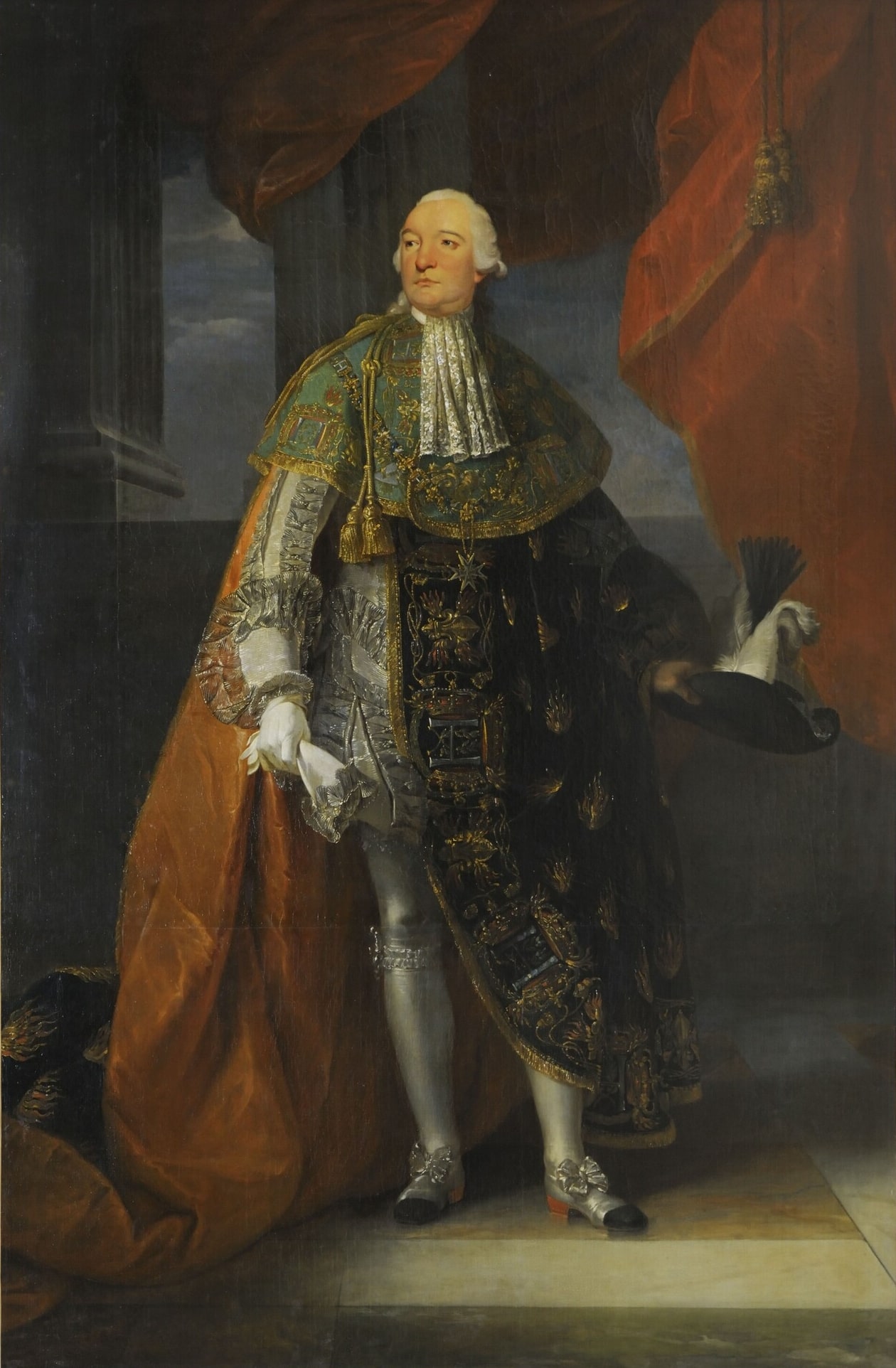 Born in 1747, Louis-Philippe’s dad was also named Louis-Philippe. He would become the second Duc Louis-Philippe d’Orléans, and his son the third. The way the dukes of Orléans handled their titles was that the eldest son of the Duc d’Orléans was called the Duc de Chartres. So Louis-Philippe’s dad spent much of his life as the Duc de Chartres. When his father died in 1785, he became the Duc d’Orléans, and his young son — the future king — became the Duc de Chartres, and would in turn become Duc d’Orléans in 1793 when his father met his end at a revolutionary guillotine.
Right: Antoine-François Callet, “Portrait of Louis-Philippe d’Orléans, Duc d’Orléans, in ceremonial robes of the Ordre du Saint-Esprit,” circa 1761-1793. Public domain via Wikimedia Commons.

With all those overlapping names and titles, for clarity’s sake, in this episode I’m going to call Louis-Philippe’s father “Philippe” or “the Duc d’Orléans,” and the son “Louis-Philippe.”
Philippe was a rich and powerful aristocrat, a Prince of the Blood and cousin of the Bourbon line of kings — next in line for the throne after King Louis XVI’s sons, brothers, and nephews. He played a prominent role in France’s political crisis of the 1780s and in the French Revolution that broke out in 1789 — though just how prominent is controversial, as you’ll see. Philippe may be most famous for two actions he took near the end of his life: he legally changed his name to “Philippe Égalité,” or Philippe Equality, at the height of the French Revolution. And as a member of France’s National Convention, Philippe Égalité voted for the death of his cousin Louis XVI.
Today, we’re going to talk a lot more about the life and career of Philippe Égalité, and how this affected his son Louis-Philippe. To do this, I’ll be joined by friend-of-the-show Will Clark, host of the podcast Grey History — a detailed narrative history of the French Revolution and beyond. You can check it out at greyhistory.com.
You can watch a video version of this interview on The Siècle’s YouTube page, youtube.com/@thesiecle — that’s an @ sign — or embedded at thesiecle.com/episode52.
Now, onto our conversation.
The miseducation of Philippe Égalité
THE SIÈCLE: Will, welcome to The Siècle.
WILL CLARK: Thank you for having me, David. It’s a pleasure to be here.
SIÈCLE: So in The Siècle, we are currently covering the July Monarchy, France in the 1830s and ’40s, when the central character is Louis-Philippe, the former Duc d’Orléans, the current King of the French. And I just covered Louis-Philippe’s family in the last episode, but mentioned at the very end that there was one member of Louis-Philippe’s family who had a profound influence on him, even as he was king, despite having been dead for four decades. And as it so happened, you are an expert on the period of the French Revolution from your podcast and know quite a lot about Louis-Philippe’s mysterious family member, his father. What can you tell me about the Duc d’Orléans?
CLARK: The Duc d’Orléans, I mean, he is one of the great enigmas of the French Revolution. It’s a period of time that has no shortage of riddles and enigmas, but he is a fascinating character. I think before we can get to the period of time that he’s more famous for — you know, voting for the execution of his cousin or the conspiracies around whether he was trying to make himself king or regent or something to that effect — before we can talk about him in the French Revolution proper, it makes sense probably to go back to his childhood and introduce him as a young individual.
And I think if you’re going to do that, then actually it’s worth taking that little bit of extra time to compare the upbringing of the Duc d’Orléans to that of his far more famous cousin, the future King Louis XVI. Especially because both men, you know, they’re born into positions of power and wealth within the broader royal family. They’re both princes of the blood, but they do have some significantly different upbringings as well.
Below: Jean-Martial Frédou, “Portrait of Louis XVI of France while he was Duc de Berry, circa 1760. Public domain via Wikimedia Commons.”

 If you start with similarities, their education and I suppose their raising do have a lot of things in common. They’re both removed from female governesses at a young age — the Duc d’Orléans at five, Louis XVI at six — and they’re essentially educated by male tutors from that point in time. This tutelage, which is kind of under the supervision of governors, sub-governors, valets, etc., is essentially a 24/7 process. They are always under supervision. They are constantly surrounded by people, even if those people are not necessarily their immediate family members or members of the people, as in the general public. And there are aspects of their education that are the same. There’s lessons in horsemanship, in fencing, in dancing, in court etiquette, etc.
The thing is, though, is that it’s at about this point in time that we start to get some considerable divergence. If we start with Louis XVI, it’s important to note that he’s raised in Versailles and he’s raised in an incredibly isolated manner. He is cut off from the real world, and the environment that he grows up in is quite conservative. It’s very conservative. The circle that he is raised in is very austere, it’s reserved, it’s very religious. And, you know, if you met Louis XVI as a child, the words that would come to mind maybe to describe him would be something like timid or shy. And those characteristics are perhaps his own, but they also are being deliberately fostered through this deliberate education process. And I would note as well that this is a particularly religious and conservative environment. It’s hostile to many of the ideas espoused by the Enlightenment. Now, Louis XVI doesn’t absorb all these teachings. His father is quite hostile to, say, French Protestants and French Jews, for example, and Louis XVI does not have that same hostility, but we do get a man who is deeply religious, deeply devout, and in many ways quite conservative.
Below: Louis Tocqué, “Portrait of Louis Philippe Joseph d’Orléans,” 18th Century. Public domain via Wikimedia Commons.

 The Duc d’Orléans could not have a more different environment that he’s being raised in, in the center of Paris. He is [exposed] to aristocratic excess, if you like. His father, another Louis-Philippe, also known to history as Louis-Philippe the Fat, he’s a man that openly lives with many mistresses. He lives a life of grand excess and extravagance. And of course, you know, Louis XVI is exposed to some of this. His grandfather, Louis XV, is famous for his mistresses. But again, Louis XVI is being raised in that quite isolated, quite conservative circle, and in some ways deliberately in contrast to the excesses of his grandfather, where the Duc d’Orléans is seen firsthand and is experiencing it firsthand. At the age of 19, the duke’s father essentially arranges for his virginity to be taken by an opera dancer, and then will publicly boast about it for some time. So this is a very different upbringing if you think about the famous issues between Louis XVI and his relationship with Marie-Antoinette, and taking many years for that marriage to be consummated.
Another key difference, though, relates again to those kind of perspectives on Enlightenment ideas. The Duc d’Orléans is greatly influenced by his uncle, the Prince de Conti. He’s a bit of an anti-establishment figure, if you like. He’s a big proponent of Enlightenment ideals. He actively encourages his nephew to kind of defy the expectations and the traditions of Versailles, to embrace Enlightenment innovations, to embrace things like Freemasonry and the social scene in Paris.
The one thing I would say to that, though, is that even though the duke does flirt with Enlightenment ideals, the Duc d’Orléans, or the future Duc d’Orléans, he’s not the most enlightened. His education is very much focused on manners. It’s on posture. It’s on societal expectations about how he should behave. But he doesn’t even master French spelling, let alone other subjects. He does show some aptitude for a few mathematical fields. But, you know, his education is kind of famously limited. Talleyrand — you know, obviously the great diplomat of the late 18th century and early 19th century for the French — he says of the Duc d’Orléans that “all his youth passed without plans, without projects, without sequence and without any restraint.” And he goes on to say that “he learned nothing thoroughly. He began some sciences and some languages, but he could never even master the rules of spelling.”
So what you have there is two individuals only seven years apart in age with significant similarities in their upbringing, but also major differences. And the Duc d’Orléans is not a particularly good student by conventional standards, but he is a student of life. He will throw himself into the vices and the debauchery that has kind of opened up to him through his father’s actions. So he’s heavily involved in the theater, luxury, nocturnal activities, versus Louis XVI, who’s far more conservative and isolated in Versailles.
The Black Legend
SIÈCLE: You mentioned Marie-Antoinette earlier and her famous marriage with Louis XVI. But the Duc d’Orléans had a somewhat important marriage himself, didn’t he?
CLARK: A very important marriage, if you think about the trajectory of the House of Orléans. There’s two reasons why we need to focus on the marriage of the Duc d’Orléans. The first is to do with wealth and power, and the second is to do with really kind of the sinister Black Legend that surrounds his name — or begins to surround his name, and only gets darker over time.
 And if we start with the former, the key thing to know is that in late 1767, early 1768 — so a good 20 years before the revolution, and again when the duke is about 20 years old — the family enters marriage negotiations for the hand of Mademoiselle de Penthièvre. And Penthièvre is a descendant of one of the legitimized royal bastards of King Louis XIV. And so they are distant, distant cousins. But because she belongs to a legitimized royal bastard line, for lack of a better term, this is seen within some within the Orléans household as essentially a subpar match. And so negotiations stall and eventually they’re called off.
Upper left: Élisabeth Louise Vigée Le Brun, “Portrait of Louise-Marie-Adélaïde de Bourbon-Penthièvre, Duchess of Orléans,” after 1789. Public domain via Wikimedia Commons. Bottom left: Jean-Baptiste Charpentier the Elder, “The Prince of Lamballe (detail from The Duke of Penthièvre and his family),” 1768. Public domain via Wikimedia Commons.


 However, this changes dramatically later in 1768. And that’s because his potential brother-in-law, a man named the Prince de Lamballe, who is the only surviving son of the Duc de Penthièvre, he dies suddenly at the age of 20. Now, I want you to note who dies and how he dies, because those things are going to be very important. But if we start with the who, the upshot of this death is that the Prince de Lamballe’s sister is now the sole surviving heir to the various fortunes of multiple royal bastard lines. And this sister is the individual that the Duc d’Orléans was courting. And so now that she’s the sole heir of this significant wealth, the Orléans family, needless to say, they become suddenly interested again, and they immediately revive these marriage negotiations. The amount that they stand to benefit should they marry is significant. I mean, the dowry is in the multiple, multiple millions alone.
And of course, what we get from here is indeed a marriage the following year, in 1769, when the duke is 22 years old and his new partner is only 16. But there’s a couple aspects here that we need to unpack. One aspect is the fact of who the Duc d’Orléans is marrying. He’s marrying this sole surviving heir of substantial wealth, and this will be critical for kind of powering the political machine of the Orléans going forward, because it’s this kind of injection of wealth that makes the family essentially second only to the king in terms of the wealth of that household. They are the wealthiest private dynasty in France once this marriage occurs.
But I do want to loop back to the Prince de Lamballe as well, because I did say it’s important not only who died, but how he died. Essentially, the Prince de Lamballe dies in 1768 from a severe disease that we suspect is syphilis, contracted during intense, unchecked bouts of debauchery. And the reason why this is linked to the Duc d’Orléans is that these two were partners in crime, if you like. They both indulged in copious amounts of vice. And the rumor mill started to circulate that the Duc d’Orléans had essentially lured his friend, the Prince de Lamballe, into this lifestyle of vice and debauchery, and that he had intentionally corrupted him so that he could benefit from all this inherited wealth. And, you know, it doesn’t take too long before not only is the duke essentially deliberately trying to make Lamballe sick, but actually we get rumors that he’s been poisoned and murdered to eliminate him from the equation, and therefore to ensure that his sister inherits all that fortune and therefore it can go to the duke.
Now, it should be noted that the Prince de Lamballe definitely pursued a life of vice and pleasure independently of the Duc d’Orléans, and modern historians and even some contemporary observers, they state that there’s no evidence for any murdering or plotting or poisoning, etc. But the fact that the Duc d’Orléans profited so immensely and so publicly from his friend’s death, and displayed what was seen to be too little remorse about this death, does provide ammunition for the beginnings of this sort of anti-Orléans Black Legend.
SIÈCLE: There’ll be echoes of this years, years down the road, when the death of the Duc de Bourbon dumped another fortune on the Orléans family, [on] one of Louis-Philippe’s sons. There were rumors then that this was a very suspicious death that had been fortuitously timed, etc.
CLARK: Absolutely. There are so many parallels between the father and the son. And as we get into some of the conspiracies of the French Revolution, there’s actually a moment that reminded me so vividly of some of your recent episodes, of what the future King Louis-Philippe experienced several decades later.
If I am allowed one indulgence — because my listeners know that I love going off-piste and taking the car off the road, to mix my metaphors — this one is for the French Revolution diehards out there. That name, Lamballe, might ring a bell for some individuals. And the widow of the Prince de Lamballe — so she will go on in subsequent years — she’s also associated with kind of late-night vice and debauchery. She will go on in future years to become an associate, a confidante, if you like, of Queen Marie-Antoinette. And as a result of that, she will be imprisoned after the fall of the monarchy in 1792. And during the September Massacres of that year, there is a particularly gruesome murder that is held up by royalists for centuries to do with the horrors of the French Revolution. And that murder, I’m not going to go into the details of, because it is particularly gruesome. But that is the Princesse de Lamballe. That is the widow of this individual. And famously, after the process of her mock trial and murder, her head is beheaded and paraded around where Marie-Antoinette is being held. So a grim link there. But for anyone that’s scratching their mind going, “I think I’ve heard that name before,” that is the link to what I would say is the most famous murder of the September Massacres.
Madame de Genlis
SIÈCLE: So this marriage to Louise, the princess of Penthièvre, did bring a lot of money to Philippe, to the Duc d’Orléans. It also brought a number of children. They had five children, four of them surviving to adulthood. But as someone who has studied the Orléans family a lot lately, the marriage of the Duc and Duchesse d’Orléans was not the happiest or most intimate marriage of all time. The duke, following in this life of debauchery that you’ve already talked about, had a lot of affairs. Perhaps the most notable or important, at least from my podcast perspective, being that with Stéphanie Félicité de Genlis, better known as Madame de Genlis, who was a noblewoman, served as one of Louise’s ladies-in-waiting, and apparently almost immediately began sleeping with the duke.
 Madame de Genlis was beautiful and brilliant. She was a famous writer. She published a number of books. But perhaps most importantly, the Duc d’Orléans gave Madame de Genlis total control, basically, over the education of his children — which has some interesting parallels to the duke’s own education that you described, because there’s nothing lax about the way that Madame de Genlis educated the Orléans children.
Left: Marie-Victoire Lemoine, “Stephanie-Félicité de Genlis,” circa 18th Century. Public domain via Wikimedia Commons.
So there was Louis-Philippe, the oldest son, who was the Duc de Chartres at the time, would later become Duc d’Orléans and then King Louis-Philippe. Two boys, Antoine, the Duc de Montpensier, and Louis, the Comte de Beaujolais. And then two twin girls, Adélaïde and Françoise. Now, Françoise would die from measles at age five, but the rest of the children would outlive their father, although not all their mother.
So, going back to Madame de Genlis, she had custody of now the four Orléans children, and she set up this absolute boot camp for many years. It was inspired by Jean-Jacques Rousseau and some other 18th-century writers. She’s trying to mold the Orléans children, and especially the boys, who had a bit more of an intense education than the girls did — although by the standards of the day, the girls did — it came out quite well as well.
Below: Auguste de Creuse after Jean-Antoine-Théodore Giroust, “Louis-Philippe d’Orléans as Duc de Chartres,” circa 1839-1848 copy of a work of circa 1790s. Public domain via Wikimedia Commons.

So, 6 a.m. to 10 p.m. every day, with basically no breaks, the children would be drilled in all sorts of subjects. There’s the academics: literature, history, natural sciences, modern languages. Madame de Genlis taught all of those subjects herself. There’s also math, physics, Latin and Greek, for which she consented to have tutors help out. But for modern languages, she taught them as living languages, not as academic subjects. And so, as part of her experiment, she hired an English valet, a German valet and an Italian valet to live with the children, with instructions to only speak in their native language to the children. So they’d be immersed, as we would now say, in the language. And for Louis-Philippe, at least, that worked. He spoke multiple languages as an adult.
CLARK: To be fair, my French would be significantly better if I could, you know, have a valet here to speak French to me at any given time. So, you know, I’m all on board.
SIÈCLE: It was physically rigorous. They were trying to be not just trained as students, but [to] train their bodies as well — a big contrast to the life of debauchery and luxury that the duke had lived. The children, especially the boys, would sleep on wooden boards with a straw mat, a single blanket in the winter. They had to drill and train in a gymnasium where Madame de Genlis made them wear clogs with lead soles to weigh them down and force them to build muscles.
And there was also another quirk, where she brought several lowborn foundlings into this house where she was educating the children, to be educated alongside them, so they’d be exposed to different walks of life. There’s some speculation that maybe some of these children had illegitimate connections to Madame de Genlis or the duke or someone else in the household. But the net effect was this astonishing experimental education that Louis-Philippe at least would look back on in later life as having been ferocious, as he called it, but also deeply transformative — something that made him into a tougher, more resilient, better-educated person.
And it’s really a striking contrast to the very lax education you described the duke himself getting. As near as I can tell, the duke did not involve himself personally in his children’s education, or not to any great degree — which, again, is a big contrast to what Louis-Philippe did, as he would later borrow many, although not all, of Madame de Genlis’s techniques for his own large brood of children, including being their own history teacher, because that was a subject that he knew well. [That] doesn’t appear to be something that the elder Duc d’Orléans had any interest in.
CLARK: No, I mean, the elder Duc d’Orléans — you know, my Duc d’Orléans, if you like — he’s just… what was that Talleyrand quote? You know, he kind of masters nothing. He’s just not detail-orientated. He’s not, like, in the thick of it. He’s just not that kind of individual. And I think it’s interesting that you say Louis-Philippe credits his upbringing for kind of making him the man that he is and giving him the skills that he will need ultimately to seize the crown. Because, as we’re going to discuss later in this episode, you know, my Duc d’Orléans doesn’t really have that skill set. He’s not able to shape events the way that one would need to if you were going to make a daring play for executive power of some form.
Orléanist bastards
SIÈCLE: I just want to take one tangent here. We talked about the Duc d’Orléans, Philippe’s, debauchery. I imagine that he had some illegitimate children coming out of this, or at least claimed illegitimate children, or reports. There’s one in particular I want to talk about, but I’ll let you go first here.
CLARK: As far as I’m concerned, there’s probably too many illegitimate children to keep track of, so I’ll leave this one to you.
 SIÈCLE: Sure. This may just be one example of many, but one of Louis-Philippe’s lifelong companions was a man named Jean Vatout, who served as Louis-Philippe’s librarian for many years, both before and after he became king — although Louis-Philippe’s son would note that Vatout didn’t actually do any librarianing. There was another guy who was sort of a sub-librarian who was hired to actually look after the books. He was very close to Louis-Philippe, worked with him for many years. He was an advisor during moments of crisis like the July Revolution. He was giving the duke and their family advice on what to do, where to hide, when to make a play for the throne — really significant stuff like that.
Left: Franz Xaver Winterhalter, “Drawing of Jean Vatout,” 1845. Public domain via Wikimedia Commons.

And Vatout liked to spread the word around that he was actually Louis-Philippe’s brother, that he was an illegitimate child of Philippe Égalité. And it seems — it’s not proven, but it seems plausible that it was the case. Vatout would later serve as a deputy in the July Monarchy, and it was sort of always understood that whenever he spoke to give a speech, that he was speaking on behalf of his employer and possible brother. I don’t know if there’s any other examples of this, but it’s really a striking example of familial connection that may not have come from the most familial of origins.
CLARK: You know, you said that the Duc d’Orléans — my Duc d’Orléans — that his marriage, you know, was not particularly the most happiest of places. I was reading in preparation for this episode about — now, every country calls them differently. I don’t know if you call them a stag do or a bucks party or a bachelor’s party, whatever term you want to use. But it was quite the talk of Paris immediately before his marriage. And so I don’t think that probably set the right tone for, you know, a loving and committed relationship.
Clout and conflict
SIÈCLE: We want to get to the juicy stuff with the French Revolution, but really quickly, can you sort of run through what happened in the duke’s life between his marriage in 1769 and the escalating crisis of the late 1780s?
CLARK: Yeah, so I suppose we’ve got about a 20-year gap between his marriage and the outbreak of the French Revolution. And there’s probably two consequential developments that you need to kind of touch on, if you like. The first is the growing kind of reputation — his growing reputation of being kind of a figure of the opposition against royal authority, be it the king or, more frequently, his ministers. And then second is probably a growing rivalry with the king and the monarchy, and the kind of detachment from the ruling branch of the dynasty.
So if we start with the former, it’s important to remember that the Duc d’Orléans was heavily influenced by his uncle, the Prince de Conti, and historically there had been, for quite some time, friction and rivalry between the various houses of the dynasty, and the Orléans had historically played a kind of leading role in the opposition. But this reasserted itself quite prominently at the start of the 1770s, just a few years after the duke’s wedding.
Essentially what happens is the ministry of Louis XV tries to suppress the parlements. That’s not parliament; those are the traditional courts of France. They play a very prominent role in the lead-up to the French Revolution. Louis XVI famously brings them back, just to only be undone by them later in his reign. But here at the start of the 1770s, the young duke, he essentially embraces that traditional role of the Orléans, and he leads a series of protests against the actions of the king and his ministers. Louis XV retaliates, cutting the Orléans off from a range of their kind of income-producing assets, domain revenues and the like, and eventually the household has to back down. But there is bad blood between Louis XV and the future Duc d’Orléans. He’s not yet the Duc d’Orléans, because his father, Louis-Philippe the Fat, is still alive.
If we fast-forward the clock, though, he does officially become the Duc d’Orléans in 1785, so just a few years before the revolution. And by this time we are seeing the transformation of the Palais-Royal, the duke’s home in the center of Paris. This is a palace that is the private domain of the Orléans family, and the grounds are being redeveloped to allow for shops, cafés, gambling houses, all sorts of vice, theaters, etc. And famously, this area is exempt from oversight of the local police. And so what we have is this center of growing kind of opposition to Versailles in the heart of Paris.
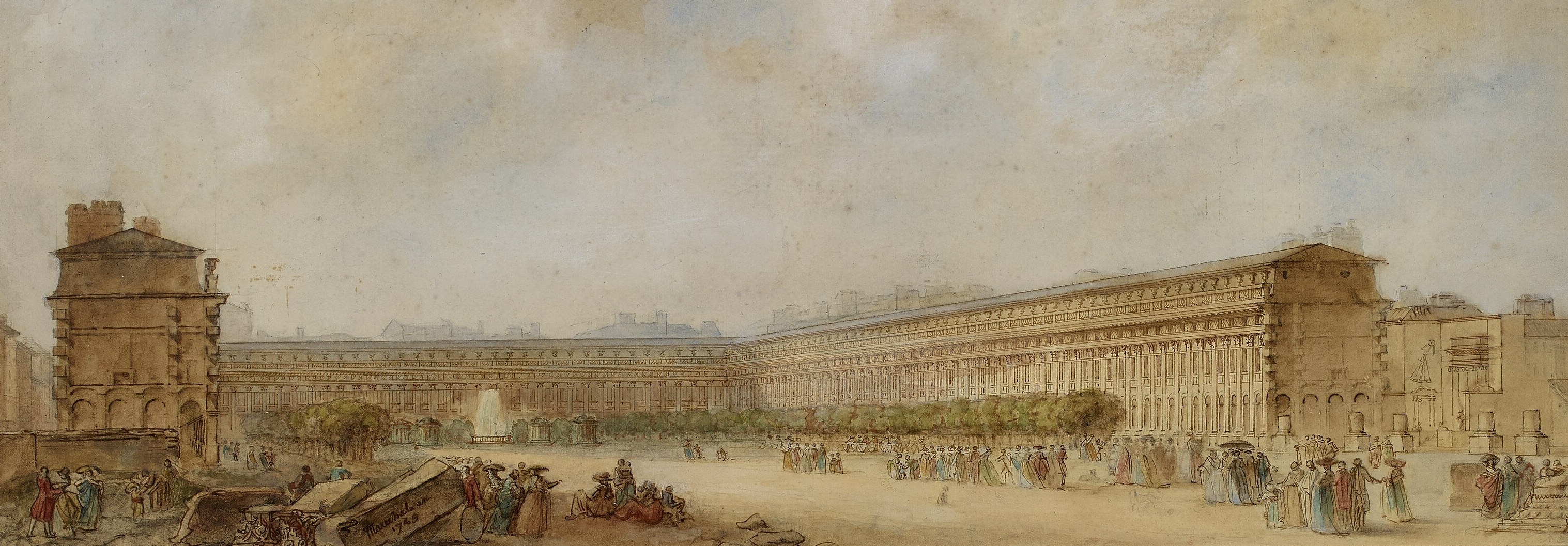
Above: Jean-Baptiste Maréchal, “The Palais-Royal in 1789,” 1789. Public domain via Wikimedia Commons.

SIÈCLE: Both practical, productive and symbolic — all three at once.
CLARK: Yes, yeah, definitely all three at once. The other thing that’s starting to happen here is also, as I mentioned before, you know, the duke, through his marriage, has inherited extraordinary wealth. They are the wealthiest family outside the royal — the monarchs themselves. He’s really starting to use that wealth for kind of political positioning. So what he’s doing is kind of building what we would kind of think of as, like, a modern political machine, that he is funding propaganda to shape public opinion, to influence policy, to craft his own personal image. And he’s doing this in a variety of ways. Yes, he’s sponsoring printing — and of course, anything could be printed in the Palais-Royal; the police cannot shut down the presses that are in there. But he’s also sponsoring charitable societies. He’s funding bread rations during particularly harsh winters. He’s funding scientific experiments. And so all of this is helping to kind of bolster the popularity of the House of Orléans, and he’s using his wealth and his power, I suppose, you know, kind of positioning himself as a contrast to the monarchy itself.
 But in addition to this, I said there was kind of two themes. One was the growing clout as a center of opposition, and the other was the detachment from the royal family. So once Louis XV dies, there’s, I suppose, a bit of an opportunity for the Duc d’Orléans to kind of become closer with the grandsons of Louis XV — so that would be Louis XVI and then the future Louis XVIII and Charles X, but the Comte de Provence and the Comte d’Artois in our kind of timeline. There’s this opportunity that they could maybe kind of become — the cadet branch could, I suppose, move closer to the ruling dynasty. But that’s not what happens. In the 1770s, the Duc d’Orléans undergoes kind of a series of public humiliations. One of them in particular is linked to a naval battle just off the French coast with the British. What happens in this battle is he’s essentially a commander of a squadron. He goes back to Versailles after the battle and claims this great victory, but in reality it’s just a bit of a stalemate. Like, neither the British nor the French are happy, and this is used by the duke’s detractors to really kind of bring his name through the mud. And so this results in a range of slights and what he sees to be orchestrations from the king and from Marie-Antoinette.
Above: Unknown artist, “Equestrian portrait of the Duc d’Orléans in uniform of a Colonel-Général of Hussars,” 18th Century. Public domain via Wikimedia Commons.”
And so in the lead-up to the French Revolution, not only is the Duc d’Orléans becoming more powerful and kind of building this well-oiled political machine, but he is becoming further — estranged is too strong a word, but he is becoming, you know, moving further apart with the royal family, which obviously has significant implications for what’s to come.
The scheming duke?
SIÈCLE: We’ve got this duke who’s really wealthy, really powerful, influential and popular, and is also very politically and personally on the outs with the royal family. Did people start to talk about maybe he was going to take this further than just mere political opposition?
CLARK: Absolutely. I mean, you know, by the time — on the eve of the revolutionary crisis, if you like — you have this incredibly wealthy and influential Prince of the Blood who has created within the Palais-Royal, within the heart of Paris, this sanctuary not only of vice but also for dissent and freedom of speech and freedom of expression, etc. He is portraying himself as a patron of the Enlightenment, both of its ideals but also things of scientific innovations. It’s no secret that he’s an Anglophile as well. He’s regularly going back to London and kind of espousing the virtues of the British system.

Unknown artist, “The Frolick or a New-Market Race,” 1788. The Duc d’Orleans (left) chases the Prince of Wales with a whip. Both wear riding-dress with top-boots. Behind them is a pond from which emerge the legs of a man who is submerged from the waist. They are on a path leading to a pavilion (right), the door of which is inscribed ‘The Coffee Room’. Men stand at the door watching the scene, others look from a balcony. Behind Orleans, on the extreme left, are the profile and arms of a Frenchman, who says, “ah ha de French Man make de English run”. Public domain via Wikimedia Commons.
The other thing I haven’t mentioned, but he is heavily involved in Freemasonry at this period of time as well. And of course, there are all sorts of conspiracies linking the Freemasons to the French Revolution.
And so what this means is that by the time you get to kind of the Assembly of Notables in 1787 — which is kind of like the first attempt to summon some sort of body to deal with the looming bankruptcy crisis — we already have a very powerful figure. He doesn’t play that interesting role in the Assembly of Notables, but where he really comes into his own is later that year, where the reinstated parlements are proving to be very pesky for Louis XVI. They’re not, you know, particularly grateful for what they did for them, you know, 15 years before. And famously, in a royal session in November 1787, Louis XVI kind of stands up and abruptly orders the parlements to register his controversial edicts without taking a formal vote. And the Duc d’Orléans rises in opposition, and he directly challenges the king and, you know, essentially says that this is illegal — which depends how you want to view it, but most people would agree that it is illegal for the norms of the nation. Obviously, we don’t have a written constitution at this time. And Louis XVI famously replies — infamously replies — “It is legal because I wish it.”
And there’s huge consequences to this. Anyone who’s ever studied the French Revolution spends a lot of time on this event in November 1787. It’s not only important for the king, it’s important for the duke as well. He’s not literally a martyr — he just goes into exile — but he does become the personification of kind of opposition to the crown, of ministerial despotism, if you like. He then is able to portray himself as a champion of the Third Estate. Most of the other Princes of the Blood will go to write a public memoir kind of calling against significant reforms the following year, and the Duc d’Orléans refuses to sign on to that, and so this helps him with his public popularity. But yes, as you kind of alluded to, it doesn’t take too long for, I suppose, the popularity to fuel rumors of something else.
SIÈCLE: So, I mean, there are rumors that the Duc d’Orléans was sort of plotting for the throne, or the power behind the throne, or anything like that. Was there any truth to those rumors? Was the duke actually scheming here?
CLARK: Short answer — well, I mean, I suppose the real short answer is we don’t know. These rumors start to pop up immediately. And I suppose, you know, before we get into the specific conspiracy theories around the Duc d’Orléans, I would want to issue, like, a blanket statement just to remind everyone that conspiracy theories are central to the French Revolution. And if you try to itemize all of them, or even those that are of significance, you would be here for a very, very long time. The revolution starts this way, and then it becomes even more so. It is a revolution defined by suspicion, by fear, in many ways by paranoia. And where I am in the main narrative, we are in the heart of the Foreign Plot, and Jacobins kind of killing former friends and former allies on the grounds that they are all foreign agents and secret royalists, etc. So it is important to remember, before we open up this conspiracy can of worms, that conspiracy and the French Revolution go hand in hand.
As it relates to the Duc d’Orléans specifically, and trying to kind of use the political situation for his advantage: following his kind of exile after the royal session in November 1787, there are whispers in some court circles and amongst royalist pamphleteers that there are kind of members of the Orléans political machine that are making the case that he could substitute King Louis XVI, either as a regent or replace him outright. And again, even before the Estates-General meets in the middle of 1789 — the Duc d’Orléans will be elected to the Estates-General to represent the nobility — there is, just before that, there’s a series of violent riots in Paris in April 1789. And again, there are whispers that maybe the Duc d’Orléans is kind of orchestrating these riots to try to create the kind of chaos that might facilitate a change in the crown.
The two key moments, though, if we’re really looking for kind of an early, honest conspiracy — the two opportunities and the two moments occur later in 1789. The first is kind of, I suppose, during that period of time between the declaration of the National Assembly in mid-June through to the fall of the Bastille in mid-July, so that kind of three-to-four-week period there. And then the second period a few months later, during the so-called October Days, or the Days of the Market Women, or the March on Versailles — by many names.
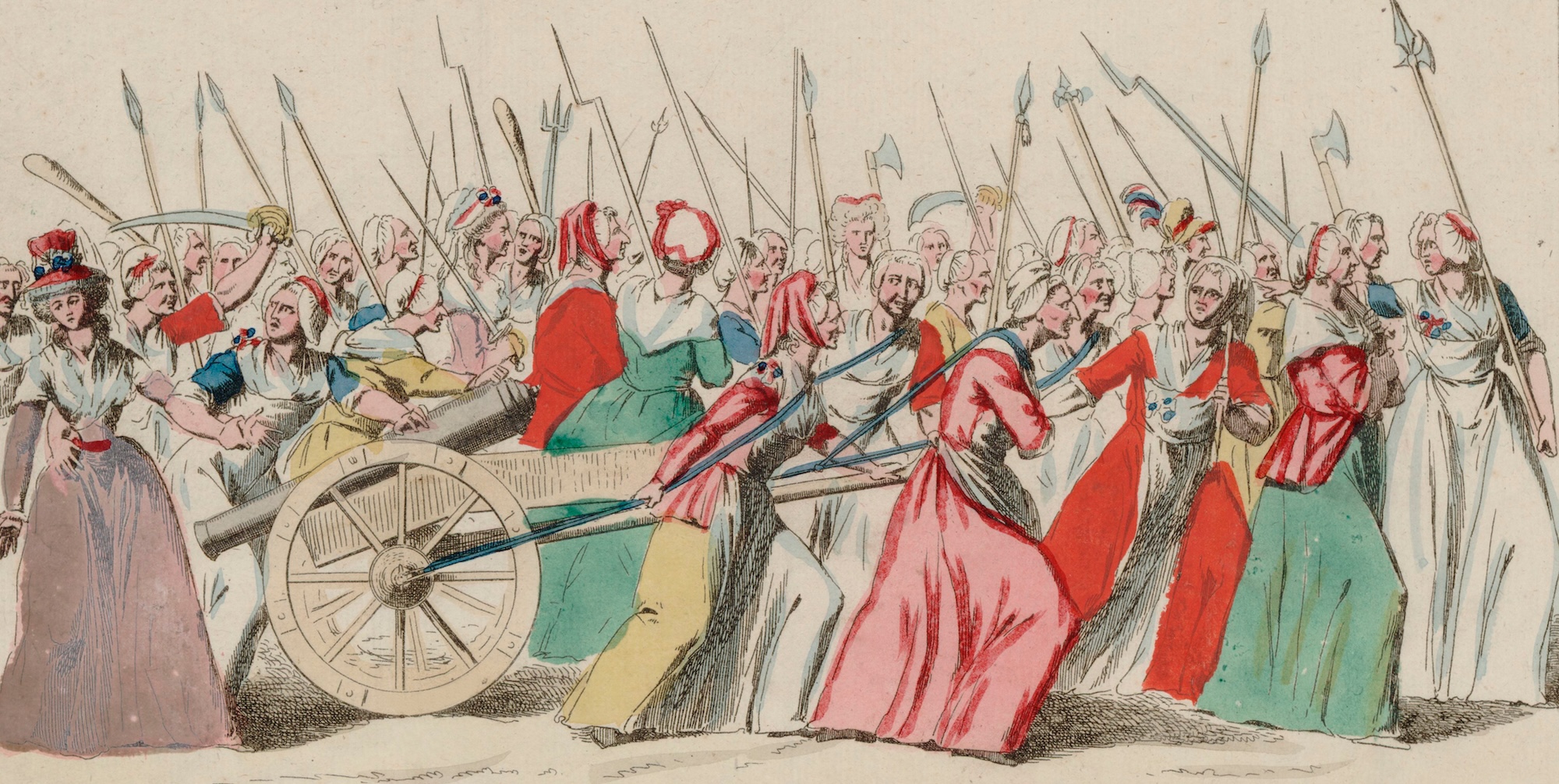
Above: Unknown artist, “To Versailles, to Versailles!” 1789. Depiction of the Oct. 5-6, 1789 women’s march on Versailles. Public domain via Wikimedia Commons.

If we start with the former — so the days kind of immediately after the declaration of the National Assembly, so just before the Tennis Court Oath — rumors reach Louis XVI that the Third Estate intends to ask nearby troops for an oath of loyalty to the Assembly, and that the Assembly intends to place them under the command of none other than the Duc d’Orléans. Now, these are rumors, but this is kind of intensifying suspicion around the duke. And do keep in mind that for the last 20 years there has been a kind of Black Legend around the duke, that he’s willing to do anything for power and wealth. He’s even willing to murder or poison one of his close friends, you know, as he kind of climbs the ladder, so to speak. So the court is concerned about these whispers that are around the duke.
I would point out that actually during this time, late June 1789, the duke is just sitting on his hands. He does the odd kind of symbolic gesture, but when he defects from the Second Estate to go join the National Assembly, if you like, he does that with several dozen other nobles at the same time. Records don’t generally see him as being a leading figure in that defection. And it is, by this point in time, almost a couple of weeks since the first priests started to defect from representing the First Estate to join the Third Estate and then the National Assembly. So it’s not like he’s the mover and shaker here by any means. And of course, if he really wanted to, you know, throw a spanner in the works, he could have actually just been an elected deputy for the Third Estate to begin with, which is what Mirabeau and several other, you know, high-profile nobles do. So he’s not really doing much during this period of time.
But where you kind of — his opportunity is, I suppose, a few weeks later, when we get the dismissal of the very popular finance minister, Necker, on the 11th of July. It’s the following day that Camille Desmoulins, the famous Jacobin journalist, he gives this rousing speech — and of all places, the Palais-Royal, the domain of the Orléans household, this kind of center of opposition in Paris — and he encourages Parisians to revolt and to defend their interests and their rights. And the crowd in the Palais-Royal proceeds to do that. But when they do that, they also break into a wax sculptor’s workshop, and they seize the busts of not only Necker but also the Duc d’Orléans. And this armed crowd proceeds to march around Paris, you know, with these busts of the duke. And so for royalists who are looking for proof that the opposition movement in Paris intends to replace the king with Orléans, this helps to draw those connections.
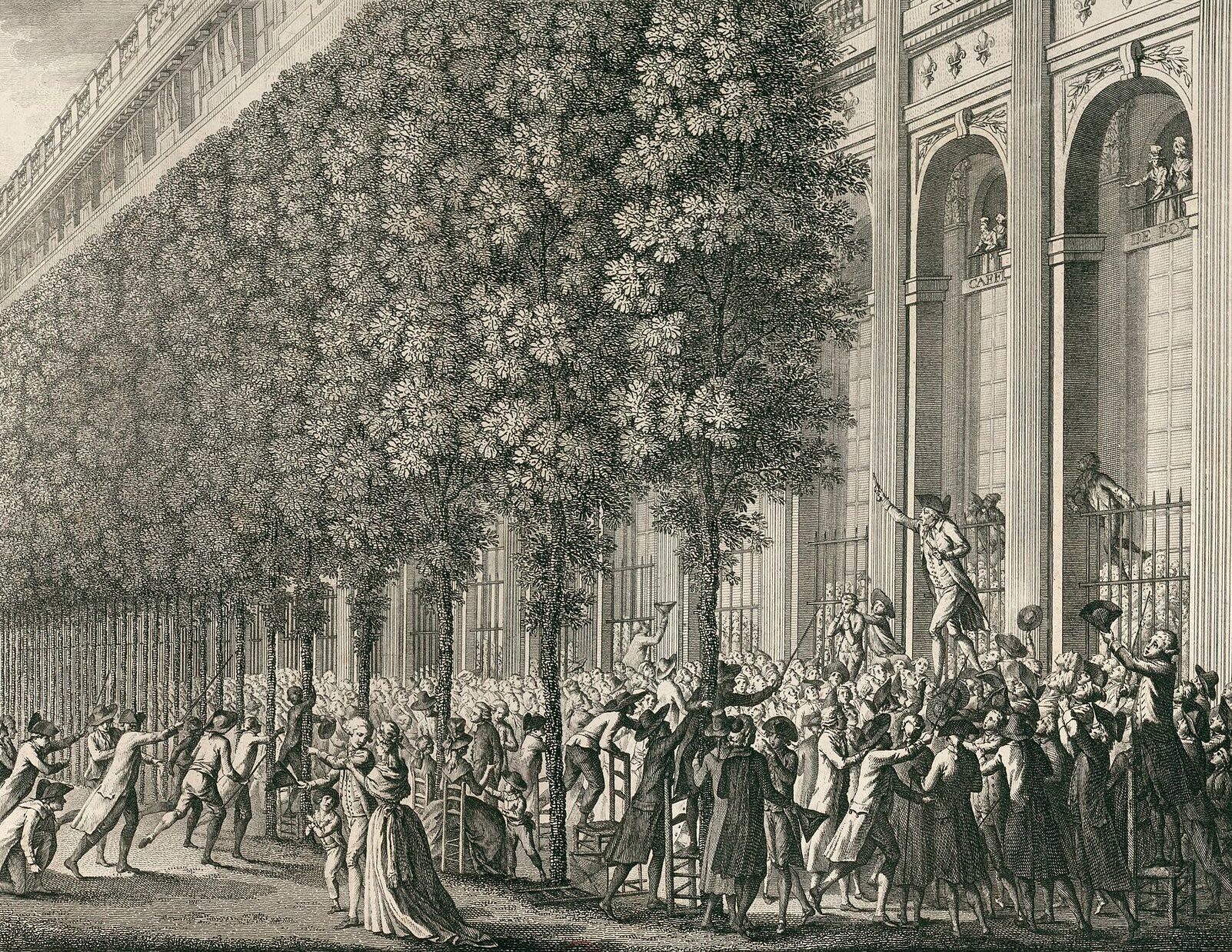
Unknown artist, “Camille Desmoulins harangues the crowd at the Palais-Royal, July 12, 1789, 1802. Public domain via Wikimedia Commons.”

You asked what evidence we have of something, and this is where it gets really murky. So there are definitely instances where the Duc d’Orléans is meeting with some very prominent, powerful and influential members of the Third Estate during these few days. He is having meetings with Lafayette. He’s having meetings with Bailly, who’s the first president of the National Assembly, will go on to become the first mayor of Paris — people like Abbé Sieyès and the like. But, you know, it kind of reminds me a little bit — I said earlier — of your recent episodes of the July Revolution, where there’s all this kind of — yeah, everything’s in flux. And there are these people that are trying to make their own agendas happen. And I know in your episode they’re trying to, you know, lure the then-Duc d’Orléans, the future King Louis-Philippe, into, you know, kind of participating, and they’re having to deal with Adélaïde as an intermediary, and it’s all just a little dysfunctional. You get those kind of vibes here in July. It would have been another July Revolution — July 1789.
But the Duc d’Orléans — you know, there are witnesses that say there are discussions about him becoming a regent or a lieutenant general of the kingdom. Not quite seizing the throne, but not far off it. But actually, it seems like the duke has no intention of doing this. There are a range of eyewitnesses that very much attest to the fact that he is surprised by what’s happening in Paris, that he doesn’t know what to do, that he’s quite timid. And if he is orchestrating a conspiracy for his own benefit, he’s certainly doing a great job of acting like he knows nothing about it, and he’s certainly doing a great job of not actually really acting in a way to try to shape the agenda. And his opportunity is then missed a few days later. By the time Louis XVI comes to Paris, accepts the keys of the city, has a big kumbaya moment with Lafayette and Bailly, that opportunity is gone.
The more interesting one, in terms of, you know, the other opportunity, is of course in October, a few months later — the October Days, the 5th and 6th of October — when tens of thousands of market women and Parisians march on [Versailles], and then eventually they break into the king’s apartments the next morning — or the queen’s apartments the next morning — and almost murder Queen Marie-Antoinette. According to those conspiracies, the duke and his political machine are orchestrating this march. There are many “witnesses” — and for those not watching the video, I’ve got, you know, my quotation marks here — that say that the duke is in the crowd and that he’s actively pointed out how to break into Marie-Antoinette’s bedchambers and the like. But of course, this all kind of dovetails into that idea before — that at this point in time, no one talks about, you know, high bread prices, or the political anger of the fallout of the behavior of the Flanders Regiment a few days before. It’s all about conspiracies. This is the other big moment. And again, the evidence is pretty limited.
SIÈCLE: You read lots of accounts then, and by royalists ever since then, who are just absolutely convinced that the French Revolution was not bottom-up — it was a top-down plot from the Duc d’Orléans. I wonder if the duke, even if he wanted to — if the duke had the attention span to pull off such a scheme.
CLARK: He doesn’t. The accusations that the duke is behind the October Days is credible enough that the National Assembly is conducting formal investigations into it. Like, there are investigations into what caused this and who was behind it. And there are many contemporaries that essentially state that there’s no way that this guy’s capable of pulling off a plot like this. Like, he just doesn’t have it. And then you get into the other layers where, you know, they do — as I said, they thoroughly investigate it, and they point out that they’ve got all these witness statements, and it’s like, the duke was in a gray coat, and then you speak to someone else who apparently saw the duke at the same time and he’s in a striped coat, and this person says he’s in a three-cornered hat, and this person says it’s a round hat. And of course, the beautiful thing about conspiracies is that you can always just add another layer — and maybe these were false witnesses produced by the Duc d’Orléans to cover his tracks. But as you say, I think the main thing here is that this is not a man that can distract himself long enough from the pleasures of the flesh to be involved in kind of high-stakes political coups. He doesn’t have the stomach, from what I can tell.
From duke to Equality
SIÈCLE: So we’ve talked about how the duke was maybe trying to supplant the king, didn’t end up doing that, but he is perhaps most famous for his role in the death of Louis XVI. Talk us through, in a very accelerated fashion, how we go from the alleged plotter in 1789 to the regicide.
CLARK: Yeah, so he essentially has to go into exile after the October Days because of all these rumors of what he’s been up to. He comes back not quite a year later — let’s call it nine months later — just before the Fête de la Fédération, just before the first anniversary of the storming of the Bastille, where listeners may remember there is this huge celebration in Paris where everyone holds hands and, you know, pretends that they’re all getting along. He plays a relatively low profile, though, for the next little while. He does encourage his son, the future King Louis-Philippe, to be involved in Jacobin Club politics, but for the most part, he’s not up to much.
The one — obviously, another opportunity where he could have seized the mantle, this, you know, ever-conspiratorial plotter, would have been after the flight to Varennes in 1791, when the royal family tried to flee the country. And we do get a movement from some Jacobins for dethronement. There are members of his political machine that do seem to be maneuvering to make sure that he could potentially come out the winner of any sort of dethronement or regency or the like. But the duke himself, again, in terms of his personal actions, it doesn’t seem like he’s really there to meet the moment.
Fast-forward the clock: you know, he’s a little — in a little bit of hot water in the following [year]. His sons will be in the [royal] armies still when the war breaks out with Austria in 1792, but he will get into a little bit of hot water when his daughter Adélaïde essentially joins the émigrés and migrates initially to London, but then further beyond.
You know, the key thing, obviously, in 1792 is the overthrow of the monarchy on the 10th of August. He will very shortly, in the weeks that follow, start to try to stylize himself as Philippe Égalité, or, you know, Philip Equality. Most importantly, then, in addition to this, he will also go get himself elected as a representative of Paris to the National Convention. And of course, one of the first things that that Convention has to do is deal with the fate of King Louis XVI.
Interestingly — and talk about a man that doesn’t have the political stomach for big things — he actually spends a bit of time trying to figure out if he can recuse himself from the trial and essentially abstain through the entire process. And in an unusual little quirk, there is a law that essentially allows you to recuse yourself if you have a certain degree of kinship with whoever is accused. And while the Duc d’Orléans would not be able to claim that through the kind of male ancestry line, he would have been able to do it through the female ancestry line. He was within X degrees of separation. But that would have required him, A, to just cop out and just be a giant cowardly act for his constituents. But B, it would have required him to really highlight all this German and Italian and foreign ancestry of the various monarchies that are now currently fighting France. So I think it was a good political move that he did not do that.
You know, we get the trial. He votes for guilty. He votes against the appeal to the people, the kind of national referendum on the king’s fate. He explicitly states that he thinks that those that have betrayed the sovereignty of the people should die. And so he votes for death, and he votes against any postponement of the execution.
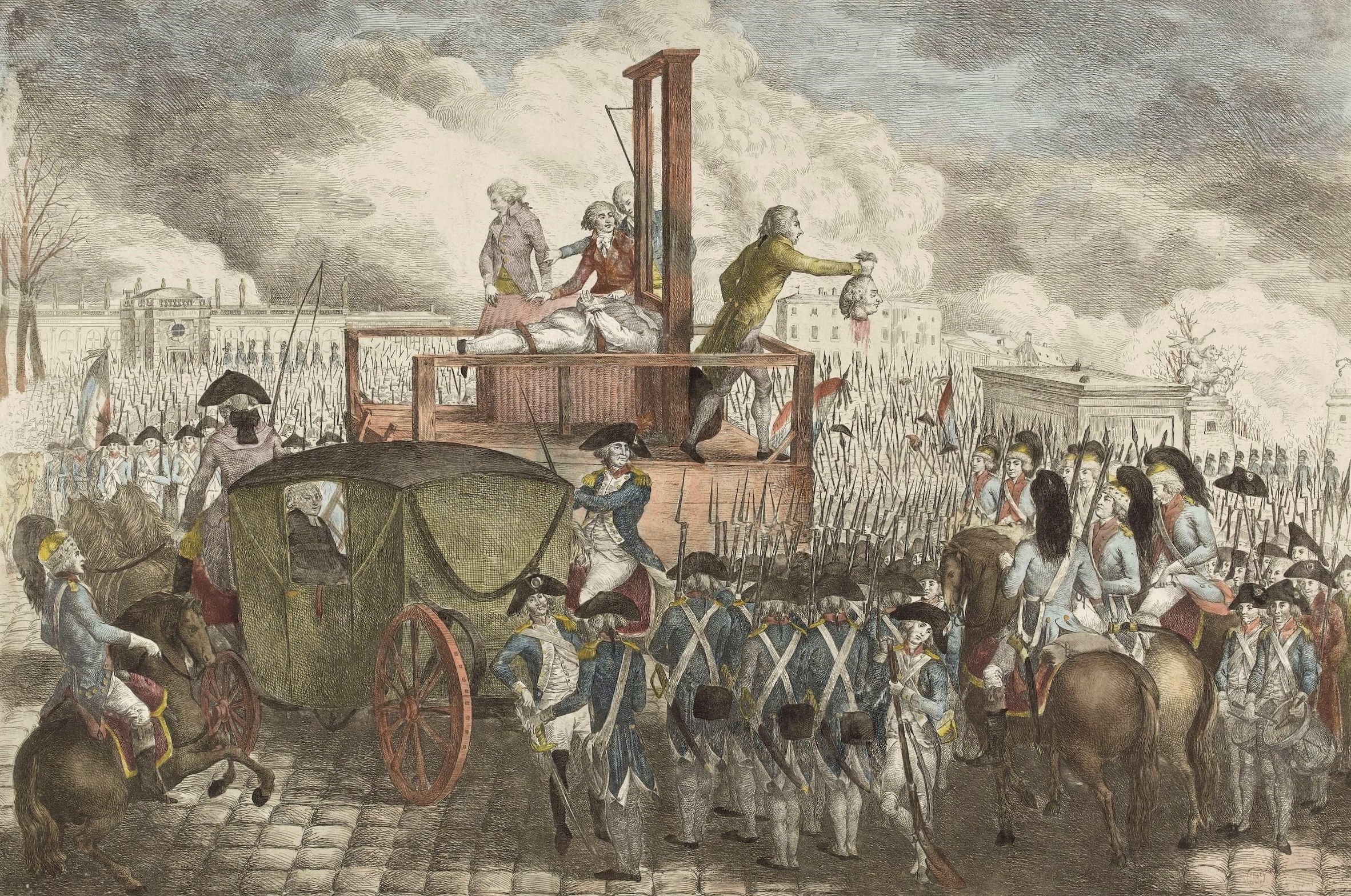
Unknown artist, “The execution of Louis Capet,” 1793. Public domain via Wikimedia Commons.

The problem for the Duc d’Orléans, though, at this point in time, by the start of 1793, is you’re now dealing with an incredibly isolated figure, because he has well and truly become just kind of a pawn in the political factionalism of the Convention. Because he is associating with the Mountain —
SIÈCLE: The left wing of the assembly.
CLARK: Yeah, the left wing of the assembly. The Girondins, by this point in time, have kind of broken away from the Jacobin Club. They will use his presence to essentially tarnish the Jacobins, the Montagnards, with royalty. And they will say, “Look, they have the new Philippe Égalité. Robespierre, Danton, Marat, they are going to try to install him either as a regent for Louis XVII or as the new king.” And so there’s kind of mud going back on both sides. But that puts the Montagnards in a bit of a weird position as well. There are some that would love to throw the former duke under a bus, and they will seize their chance in a few months’ time. But he’s kind of friendless and isolated in the National Convention once that vote occurs. And I mean, he was pretty friendless and isolated even before all that. But if we go back to that Black Legend of this man willing to do anything to get ahead, of willing to betray his closest friends — I mean, the execution of the king in this instance, it further fuels that kind of sinister legacy that already surrounded him.
SIÈCLE: And we’ll talk about that more in just a few minutes. I want to circle back to the Philippe Égalité name, because that’s maybe the thing, other than the execution, that the Duc d’Orléans is most known for, is that this duke, this Prince of the Blood, who changed his name to Philippe Égalité. But I think the popular understanding of that can be a little murky sometimes. I’ve seen it held up by people saying that this is evidence of the duke’s radicalism, that he was so devoted to the cause of the revolution that he changed his name to Philippe Égalité. I’ve seen it pitched as a desperate bid for survival, as aristocracy became tarnished and the guillotine started to fall, and he was trying to do anything he could to stay away from — ahead of that, to try to separate himself from his high blood at a time that was becoming a fatal liability. What do you know about this decision to change his name, to move away from his ancestral name and embrace this sort of democratic, republican nomenclature?
CLARK: So, as you’ve kind of alluded to there — and especially with a figure as divisive as the Duc d’Orléans — this is kind of a pick-your-own-adventure. You know, like, every historian or contemporary sees in this what they want to see. I tend to see something a little bit closer to the latter. The duke does seem to have a bit of a sense of where the wind is blowing, even if he’s not necessarily able to seize the agenda. And I think he is very conscious of the fact that at a period of time where the royal family is arrested, that he is in a vulnerable position, that he has very few friends in the National Convention.
I do wonder if running for electoral politics is potentially a way that he’s going to try to shield himself — kind of wrap himself in the cloak of republican patriotism, if you like. Obviously, when he is elected to the Convention, France is not yet a republic. It’s not necessarily clear that they will become a republic. You can argue it a variety of ways. But we do have a situation at that point in time where members of the National Convention will have essentially parliamentary immunity. And I wonder if he kind of figures that if he joins this body, votes yes on a few key symbolic things, tries to keep a low profile, if that is going to be enough to prove his credentials — in addition to things like the name change and a few charitable pursuits — to get through it.
And, you know, there’s reasons to believe that that might have worked. Back in the middle of 1793, when the Committee of Public Safety is headed by Danton, Danton is openly trying to explore — or secretly trying to explore — peace negotiations with the Prussians, amongst others. You know, he’s trying to find an off-ramp for the revolution. Danton does not want to execute Marie-Antoinette. You know, there are many Jacobins that, up until the kind of Federalist revolts go really haywire, they don’t want to execute leading members of the Girondins as well, which of course are other elected deputies. So I think if you’re viewing this, that maybe this is a bit of an attempt at an insurance policy, I don’t think it’s necessarily the wrong bet. It just doesn’t play out for him. But that’s not to say that it wasn’t the wrong decision. I don’t think that continuing to call himself the Duc d’Orléans, or even just going by Louis-Philippe or whatever, would have been any better, that’s for sure.
With sons like these…
SIÈCLE: So after having helped send his own cousin to the scaffold, Philippe Égalité is going to end up there himself, no thanks to his son. Can you talk a little bit more about the final downfall of the man who at one point may have been poised to usurp the throne of France?
CLARK: Yeah, so as I mentioned, after the vote to execute his cousin in January 1793, he is incredibly isolated. And he had already been this kind of tool, I suppose, for factional fights in the Convention since the moment the Convention started. You’ve got to remember, when the Convention first sits, it’s only a few weeks after the September Massacres, and the Girondins are going hard against what they view as the kind of triumvirate of Marat, Danton and Robespierre, and this kind of Jacobin tyranny, anarchy, royalism, etc. And being able to tie the king’s cousin, and this kind of candidate to the throne, to the Jacobins is a key tool.
At the end of January, start of February, we get the introduction of the Dutch and the British in the war. Dumouriez leads an ill-fated campaign into the Dutch Republic. There is a coordinated counterattack by the Prussians and the Austrians towards the end of that month, and essentially we get some real military reversals and setbacks for the French. And Dumouriez essentially enters secret negotiations with the Austrians, trying to buy himself some time, with the intention of marching on Paris and dealing with the kind of anarchy and rabble that have taken over the capital. And critically, the Duc d’Orléans’ son, the future King Louis-Philippe, is a military officer with Dumouriez in his army, and he will essentially participate in this coup. And when the coup does not work, he will defect to the other side, you know, in order to save his own life.
Now, the problem for this is that the Duc d’Orléans is, you know, already in this vulnerable position. But the situation that this creates in the Convention, for a variety of reasons, is just terrible. First of all, Dumouriez is the savior of the Republic. This is the man that is seen as the champion of the Republic’s interests. And so for him to betray the revolution, it means that literally no one can be trusted. Everyone is a suspect. But you also have, I suppose — again, we come back to this kind of factional politics dynamic. Dumouriez had been closely associated with the Girondins. He had been associated with the so-called Brissotin ministry of the year prior. He’s heavily linked to this more moderate — you know, again, use air quotes here — “more moderate” wing of the revolutionaries in the Convention. And so they are deeply exposed. They are vulnerable. And so what the Girondins have to do is they have to go on the attack, even though Dumouriez is really their man.
And the way they do that is they go after two people in particular. The first is they go after Danton. This is one of those moments in time that later kind of haunts Danton — of what’s he up to, and what’s his own kind of conspiracies and corruption and the like — because he was meant to be supervising Dumouriez, and then Dumouriez goes rogue. That’s a story for another time. But the other person that they go after is the Duc d’Orléans, because his son and heir is an officer quite close to Dumouriez.
Now, interestingly, I will give credit where credit’s due — and there’s very few times that I am going to give credit to Jean-Paul Marat — but this is one of the instances that I will, because he’s one of the few Jacobins that kind of gets up and he’s like, “It’s ridiculous that we’re going to arrest the Duc d’Orléans. Like, he’s not responsible for his son’s actions.” But most of the Jacobins are willing to just offer him up. And the Convention will pass a motion that all members of the former dynasty need to be arrested. And he is indeed arrested. And he’s not the only Montagnard former noble, actually, deputy that is arrested; there is another at the same time. And so this is a big temporary win for the Girondins. But the Duc d’Orléans will go and essentially rot — well, not rot, but he’ll go sit in a dungeon for several months.
And as the year progresses, as the factionalism of 1793 intensifies, as you get the purging of the Girondins in June 1793, leading into the Federalist revolts, you have growing calls from the popular movement in Paris to deal with the people’s enemies — most importantly, that is Queen Marie-Antoinette and the so-called Girondin leadership. They are both executed in October. That is kind of promised to the crowd as a result of the Convention being surrounded in early September, where the words “Let terror be the order of the day” is famously uttered, even if it’s not officially decreed as the Convention’s policy. But the next cab off the rank after the queen and after the Girondin leadership is naturally the king’s cousin and this aspirer and rumored claimant to the throne — well, he is a claimant to the throne in some ways, but, you know, these conspiracies and these rumors that that’s what he’s desiring. And so he has a very brief trial. He’s associated with the treason of Dumouriez and with the treason of the Girondins, and he is promptly executed. And that’s that.
I mean, yeah, the Jacobins, as soon as he’s arrested, pretty much you have Jacobins that can’t run away from him fast enough. And Camille Desmoulins — to go full circle, the same individual that helps rally Paris into revolt on the 12th of July 1789 — he’s one of the first high-profile Jacobins to really kind of put the dagger in the back, if you like, in the weeks following the duke’s arrest, using his publications. So, yeah, he certainly dies friendless. That’s one way to put it.
Sins of the father
SIÈCLE: You talk about Louis-Philippe, whose own sort of treason involving the Dumouriez plot sort of sparked Philippe Égalité’s downfall. And I guess we’re sort of going to keep following Louis-Philippe as his father’s head rolls, because we’re getting [to] sort of my area of expertise, covering the Bourbon Restoration and July Monarchy.
One thing about Louis-Philippe is that he was always, his whole life, haunted by his role in the death of his father. He felt deeply guilty by it. It’s hard not to see that having some effect in shaping his later political personality, as someone who could be both melancholy and also deeply cautious and afraid of making the wrong move — a fence-sitter who wanted to keep all his options open as long as possible. This was someone who, on one of the occasions when he tried to get involved in a bold, direct action, saw his father killed for it. I’m not saying that we have absolute proof that that was the association he made, but it certainly seems like a strong one.
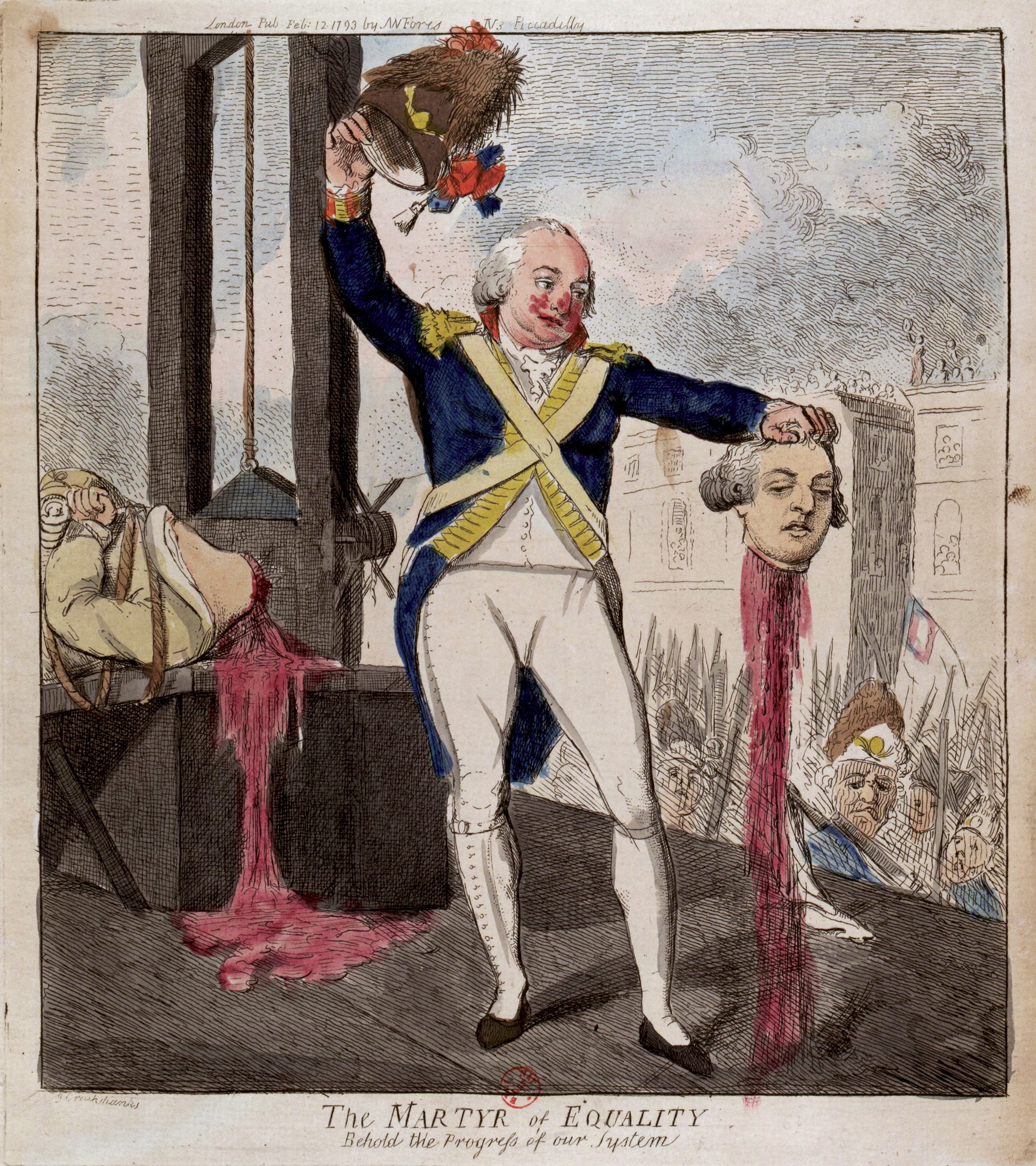 More directly, Philippe Égalité was seen within the aristocratic and royal circles of Europe as a traitor — to his family, to his country, to the cause of aristocracy in general. His son and the rest of their family bore the brunt of that, since Philippe Égalité wasn’t there to kick around anymore. There’s a story — I don’t know, possibly apocryphal — that Philippe Égalité, the Duc d’Orléans, Philippe’s name was struck from the rolls of a tony London club he’d been a part of, but that so great was the betrayal that they didn’t strike it off themselves. They sent a servant, a waiter, to strike his name off the rolls, for the final insult.
Left: George Cruikshank, “The Martyr of Equality,” 1793. Philippe Égalité holds up the severed head of Louis XVI at a Parisian guillotine. Public domain via Wikimedia Commons.

But that’s symbolic. More direct was Louis-Philippe and Adélaïde and others in exile in Switzerland being chased from town to town by émigré mobs trying to tear them limb from limb as punishment for their family’s role in all the — as these people saw it — the traumas and terrors and disasters of the revolution. And this blacklisting continued for years. Louis-Philippe and his brothers went to America. They eventually went back to England. He had to sort of crawl on bended knee back to his Bourbon cousins to try to get officially forgiven. And he did get this, although Louis XVIII nursed a lifelong dislike of Louis-Philippe and never forgave him, took every opportunity to slight him and insult him, marginalize him. Charles was much friendlier, seemed to bear fewer grudges. It was, of course, Charles who would ultimately see himself supplanted by Louis-Philippe.
And the final thing I want to mention is the way the role of Philippe Égalité and his downfall, his death, helped shape both Louis-Philippe and Adélaïde, who were sort of the two surviving Orléans children, the ones who lived long lives. The other two brothers died of tuberculosis as young adults.
Louis-Philippe [was] a member of that sad fraternity of men whose fathers had been guillotined during the French Revolution. Other prominent politicians like François Guizot, the Duc de Broglie, other people like that, had also had their own fathers killed. And for a lot of these people, this was a traumatic experience that seemed to stir a conservatism, a desire to avoid seeing anything like the revolution, or at least the Terror, happen again. And we know that Louis[-Philippe] was haunted by the revolution, was trying to avoid recreating anything like this. Though he was definitely liberal — liberal-minded, opposed to the ultra-royalist faction, wanted to see France steer in a more liberal direction — but he was doing everything he could to avoid seeing a revolution occur again, because for him this was a deeply personal loss.
But Adélaïde, who was a few years younger than Louis-Philippe, had been more physically removed from when things started to spiral in Paris, maintained for her life a much more romantic view of the French Revolution and of their father. She did not have the dark guilt that Louis-Philippe had. Certainly she hadn’t played his direct role in his downfall and hadn’t been as closely connected to everything that happened. And so Adélaïde, who was a little bit more progressive than Louis-Philippe — and a lot of that came back to their different relationships with, and different memories of, their father, the Duc d’Orléans, Philippe Égalité.
CLARK: I think that makes sense. I mean, the thing for Adélaïde is that she doesn’t have — you know, why would she hold a personal guilt for what happens to her father? Well, you can see where the Duc d’Orléans [Louis-Philippe] is probably second-guessing things for the rest of his life, where he’s thinking to himself, “Oh, if only I either hadn’t done something, or if only Dumouriez and I had done this instead of that.” It would be easy to see why their kind of relationship with their father’s memory would be very different, given their experiences of the revolution. And it’s fair to say that King Louis-Philippe did in some way shape the revolution in a way that Adélaïde did not.
SIÈCLE: Will, clearly this is a figure who was important not only in his own time, but in the generations that followed. So thank you very much for coming on The Siècle to help explain a little bit more about Louis-Philippe’s very important father.
CLARK: Anytime. These enigmas of the French Revolution — it’s always a pleasure. Thank you for having me.
Thank you again to Will for your French Revolution expertise. Check out Grey History wherever you get podcasts. In the meantime, you can also join Will and I for a live aftershow discussing this episode at 7 p.m. U.S. Central Time on Thursday, November 12, 2026. That’s 8 p.m. Eastern Time, 1 a.m. UTC, and noon on Friday November 13 in Will’s home of Melbourne, Australia. I’ll post a link to the aftershow on the show’s Patreon — available to patrons and non-patrons alike — where you can watch the stream or leave questions for us. That’s patreon.com/thesiecle, or linked at thesiecle.com/support. While you’re there, I hope you’ll consider supporting the show. After the aftershow, The Siècle will be leaving both Paris and the upper classes behind as we visit the unhappy workers of Lyon. I hope you’ll join me for a look at labor struggles in Episode 53: The Silk Revolt.